Feminism perspectives of the family AQA Sociology A-levelQuick View
Smithh4

Feminism perspectives of the family AQA Sociology A-level

(1)
AQA A-Level Sociology: Feminism and the Family – Complete Lesson & Resources This is a fully resourced and challenging A-Level Sociology lesson on Feminist Perspectives of the Family, designed specifically for the AQA Paper 2 Families & Households unit. Perfect for both first-teach and revision, this bundle is structured to stretch the most able while supporting students who need more scaffolding. It is ideal for 50–90 minutes of teaching. What’s Included? -Fully editable PowerPoint (Feminism and the Family) Clear explanations, debate prompts, AO1/AO2/AO3 integration, and scenario-based application tasks. -High-level hinge questions (MCQ style) Designed to check for understanding after teacher-led explanation, with plausible distractors for desirable difficulty. -Concept sorting task (worksheet and task slides) Engaging, challenging retrieval activity where students categorise quotes, policies, and theorists by feminist type — includes false clues to stretch thinking. -Structured consolidation worksheet Allows students to apply knowledge, justify answers, and revisit key theorists and ideas across all four feminist strands. -Embedded case studies & debates Realistic family scenarios to apply feminist perspectives and encourage critical thought. Each theory includes a debate question for stretch and evaluation. Feminist perspectives covered in depth: Liberal Feminism (Oakley, Young & Wilmott) Marxist Feminism (Fran Ansley) Radical Feminism (Greer, Delphy & Leonard) Difference/Black Feminism (hooks, Mirza, intersectionality) It has: Balanced blend of AO1 knowledge, AO2 application, and AO3 evaluation Easily adapted for 1 hour or double lessons Promotes discussion, critical thinking, and high challenge Visually clear and student-friendly without oversimplifying the theory If you like it, please consider leaving a review!
AQA Sociology Role of the family A-Level essay planning lessonQuick View
Smithh4

AQA Sociology Role of the family A-Level essay planning lesson

(1)
AQA A-Level Sociology: 20 Mark Essay Planning – Evaluate Marxist Explanations of the Family This fully resourced and structured lesson prepares students to plan and write a high-level 20-mark AQA essay on Marxist explanations of the role of the family. Designed for Paper 2 (Families and Households), this resource helps students build strong arguments, structure their ideas clearly, and integrate multiple perspectives for top-band evaluation. What students will learn to do: Recall and explain the key AO1 content for Marxism (Engels, Zaretsky, Poulantzas) Apply sociological material from the stimulus and their own knowledge (AO2) Evaluate Marxism using Functionalism, Feminism, New Right and Personal Life Perspective (AO3) Structure 20-mark essays with confidence using the PEECL model (Point, Evidence, Explain, Counter, Mini-Conclusion) What’s included in this download: Editable PowerPoint (Essay Skill – Marxism and Families) Clear modelling of an introduction, AO1 paragraph, and 4 fully scaffolded evaluation points (Functionalist, Feminist, New Right, PLP), plus a model conclusion. Knowledge Check Hinge Questions (MCQ) Desirably difficult multiple-choice questions test understanding of key Marxist ideas and their critiques. PEECL Planning Grid Template (on slides) Structured table to help students build four strong evaluation paragraphs in preparation for writing under timed conditions. Suggested Timings and Teaching Plan Retrieval starter, teacher explanation, hinge checks, planning time, and options for in-class writing or homework follow-up.
Personal Life Perspective view of the family AQA Sociology A-levelQuick View
Smithh4

Personal Life Perspective view of the family AQA Sociology A-level

(1)
AQA A-Level Sociology: The Personal Life Perspective and the Family (Paper 2) This complete, high-challenge Sociology lesson unpacks the Personal Life Perspective (PLP) in an engaging, accessible, and evaluative way. Designed for AQA A-Level Paper 2 (Families and Households), the resources are ideal for either a first-teach double lesson or revision masterclass — fully differentiated and ready to go. What students will do: Explore the PLP view of the family and how it differs from structural theories (AO1) Apply PLP ideas to real-life case studies of donor-conceived children and chosen families (AO2) Evaluate the strengths and criticisms of the perspective, using quotes, dilemmas, and sociologists like Tipper, Smart, and Nordqvist (AO3) What’s included in this download: Editable, structured PowerPoint (Personal Life Perspective and Families) Clear, concise explanations with application tasks, challenge questions, and interactionist contrasts. Scaffolded worksheet (“Consolidation Challenge”) Students explore emotional, social and legal dilemmas of donor families and write an AO2/3 mini-essay with guidance and quote unpacking. Hinge Questions (MCQ) Desirably difficult questions with plausible distractors — great for mini-whiteboards, AfL, or revision quizzes. Thinking tasks and scenario sorting Includes a challenging activity where students decide which people (e.g. fictive kin, pets, donors) count as family from a PLP vs structuralist view — brilliant for debate and deeper reflection. AO1/AO2/AO3 Exam Link Includes practice planning for a 10-marker: “Outline and explain two ways the Personal Life Perspective views the family differently from other sociological theories.” This lesson is: Perfect for high-ability stretch with clear scaffolds for lower-ability support Encourages independent thinking and debate Builds clear conceptual understanding of PLP vs structural theories Integrates videos, quotes, and contemporary case studies Whether you’re teaching this for the first time or need a fresh take for revision season, this lesson delivers high engagement, deep thinking, and brilliant outcomes. Easy to adapt. Fully editable. No textbook needed.
Bundle Functionalism & Crime -  AQA A-level SociologyQuick View
Smithh4

Bundle Functionalism & Crime - AQA A-level Sociology

(1)
Functionalist & Subcultural Theories of Crime – AQA A-Level Sociology (Paper 3) Resource Bundle Includes: Lesson 1: Durkheim & the Functionalist View of Crime Lesson 2: Merton’s Strain Theory Lesson 3: Subcultural Theories – Cohen, Cloward & Ohlin Worksheets, application tasks, evaluation activities, and model case studies Critic Stations and real-world media application Fully editable PowerPoints + printable student handouts What’s Included: Lesson 1 – Durkheim (Functionalism and Crime): Clear explanation of Durkheim’s 3 key ideas: inevitability, boundary maintenance, and adaptation & change Visual aids, sentence scaffolds, and case study application tasks ‘Critic’s Corner’ activity with 5 station cards evaluating Durkheim’s theory Retrieval tasks and consolidation paragraph practice Lesson 2 – Merton’s Strain Theory: Student-friendly PowerPoint and worksheet Explains all 5 adaptations (conformity, innovation, ritualism, retreatism, rebellion) with memorable case studies Realistic scenario-based application (e.g. “Dave the drug dealer”) Hinge questions, 10-mark practice, and evaluation prompts Lesson 3 – Subcultural Strain Theories (Cohen, Cloward & Ohlin): Guided breakdown of status frustration and 3 subcultures Application tasks including character design, behaviour categorisation, and news annotation Differentiated activities to stretch and scaffold learners Real-life case: teenage cyber gangs (The Guardian) used to apply both theories
Neo-Marxism and Crime | A-Level Sociology (AQA) | Crime & DevianceQuick View
Smithh4

Neo-Marxism and Crime | A-Level Sociology (AQA) | Crime & Deviance

(0)
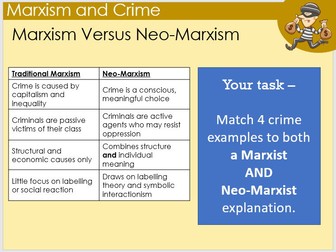
Engaging, challenging, and fully resourced lesson on Neo-Marxist explanations of crime – perfect for AQA A-Level Sociology Paper 3 (Crime & Deviance). Ideal for Year 13 students who already have a foundation in traditional Marxism. What’s included: Fully editable PowerPoint with structured tasks and clear explanations Case study handouts on Hall et al. and Paul Gilroy Comparison activity sheet contrasting traditional Marxist and Neo-Marxist views AfL opportunities: MCQs, discussion tasks, and plenary reflection Lesson focus: Introduces the key ideas from The New Criminology (Taylor, Walton & Young) Explores the concepts of crime as resistance, symbolism, and political expression Includes high-quality application of theory to real-world examples Develops students’ evaluative skills through comparative and discussion-based activities Learning Outcomes: Students will be able to: Explain the Neo-Marxist perspective on crime Analyse key case studies with a sociological lens Compare and contrast with traditional Marxist and labelling theories Apply theory to contemporary examples and exam-style questions Why choose this resource? Ready to use but fully adaptable Encourages higher-order thinking and critical evaluation Supports AO1, AO2 and AO3 skills Designed by an experienced A-Level Sociology teacher
Left and Right Realism | A-Level Sociology (AQA) | Crime & Deviance BundleQuick View
Smithh4

Left and Right Realism | A-Level Sociology (AQA) | Crime & Deviance Bundle

(0)
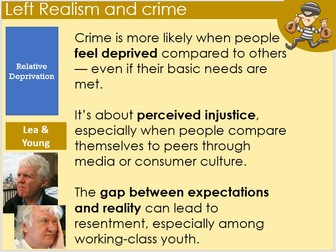
Two-lesson bundle on Realist theories of crime – fully resourced, exam-focused, and packed with real-world examples. Perfect for AQA A-Level Sociology Paper 3 (Crime & Deviance), this set contrasts Left and Right Realist explanations in a way that’s clear, challenging, and memorable. What’s included: 2 x fully editable PowerPoints (Right Realism + Left Realism) 2 x student handouts with contemporary crime scenarios Theory summaries and evaluation activities Exam-style questions and structured planning prompts Venn diagram comparison task to consolidate learning What students will learn: The key causes of crime according to Right Realism: Biological predisposition (Herrnstein & Murray) Underclass culture and lone parenting (Murray) Rational Choice (Clarke) and Routine Activity (Felson) Crime prevention: Broken Windows, Zero Tolerance, Target Hardening The key causes of crime according to Left Realism: Relative deprivation (Lea & Young) Subcultures and marginalisation Late modernity and media-fuelled exclusion (Young) Solutions: community policing and social reform Key Skills Developed: Application of theory to real-world examples (e.g. stop-and-search, riots, shoplifting) AO2/AO3 exam technique for 10- and 30-markers Critical comparison of political ideologies and sociological perspectives Evaluation of strengths, weaknesses, and real-life impact Why choose this bundle? Complete scheme of work for teaching Realism in Crime & Deviance Engaging tasks, relatable examples, and theory clearly explained Promotes comparison, critical thinking, and confident application Designed by an experienced A-Level Sociology teacher with a focus on stretch and challenge
Labelling Theory – AQA A-Level Sociology (Crime & Deviance)Quick View
Smithh4

Labelling Theory – AQA A-Level Sociology (Crime & Deviance)

(0)
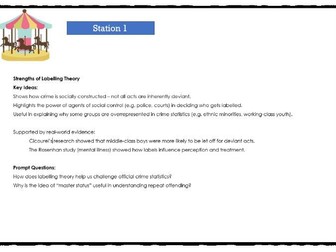
Labelling Theory of Crime – Full Lesson with Evaluation Carousel (AQA A-Level Sociology) Description: A complete, engaging AQA Sociology lesson on Labelling Theory (Crime & Deviance) suitable for Year 13. This resource blends teacher-led explanation, student interaction, structured application, and critical evaluation. It assumes students have previously studied Functionalist perspectives but are new to Labelling Theory. The lesson includes: A clear and accessible PowerPoint Real-world discussion scenarios (e.g. “The Naked Man” and “Brenda at Bingo”) Core theorists: Becker, Lemert, Cicourel, and Braithwaite A visual timeline of deviance from primary acts to self-fulfilling prophecy 5 Hinge Questions (multiple choice) for checking understanding Application task based on a realistic case study (Ahmed) Evaluation Carousel with printable station sheets: Strengths of labelling theory Weaknesses and determinism Marxist critique Braithwaite’s reintegrative shaming as a solution Final whole-class discussion question: Does labelling theory overstate the power of labels? Perfect for: Developing AO1, AO2, and AO3 skills Stretch and challenge Encouraging critical engagement with sociological theory Creating a dynamic and student-led evaluation task Format: PowerPoint (.pptx), Word Document (.docx), and optional printable worksheet (.pdf) Exam Board: AQA A-Level Sociology (Paper 3 – Crime & Deviance)
AQA Perspectives of crime Sociology AlevelQuick View
Smithh4

AQA Perspectives of crime Sociology Alevel

6 Resources
Here is a full bundle of the following perspectives of crime Functionalism Marxism Labelling Neo-Marxism Right Realism Left Realism It contains lessons for 1 hour 30 minutes and consists of Powerpoints Worksheets Challenge tasks Checking for Understanding A01/A02/A03
Sociology Functionalist perspective of the family AQA A-levelQuick View
Smithh4

Sociology Functionalist perspective of the family AQA A-level

(0)
AQA A-Level Sociology: Functionalism and the Family (Families & Households) Perfect for early Year 12 | Fully resourced | Application-rich and evaluative This lesson introduces students to the Functionalist perspective on the family within the Families and Households unit of AQA A-Level Sociology (Paper 2). It provides a clear foundation in Murdock’s and Parsons’ theories, while encouraging students to question whether these views still apply in contemporary society. Included in this comprehensive pack: Detailed PowerPoint with retrieval starters, visual tasks, interactive questioning, knowledge checks, and theory evaluation Murdock summary sheet to consolidate the four functions of the family with definitions and clear examples Parsons sheet to support understanding of Functional Fit Theory and key concepts like primary socialisation and stabilisation of adult personalities Application worksheet featuring a real-life family case study (The Ali Family) with structured AO2 and AO3 prompts Discussion task prompts for evaluating the relevance of Functionalist theory, supported by feminist, Marxist, and postmodernist alternatives Key content covered: Murdock’s four functions of the family Parsons’ Functional Fit theory and two key functions Shifts from extended to nuclear family Social and geographical mobility Evaluation using contrasting sociological perspectives Learning aims: Understand the key Functionalist explanations of the family’s role in society Apply theories to real-life examples through structured case study tasks Evaluate whether Functionalism is outdated or still relevant today Build confidence in AO1, AO2, and AO3 responses This resource is ideal for setting a strong theoretical foundation and encouraging analytical, evaluative thinking right from the start of the Families & Households topic.
New Right view of the family (Neo-Liberalism) AQA Sociology A-levelQuick View
Smithh4

New Right view of the family (Neo-Liberalism) AQA Sociology A-level

(0)
The New Right and the Family – A-Level Sociology (Paper 2) This fully resourced 1 hour 40 minute lesson explores the New Right/Neoliberal view of the family in depth, with a focus on applying key concepts, evaluating criticisms, and making links to Functionalism and Marxism. Perfect for AQA A-Level Sociology (Families and Households), this lesson balances teacher explanation, application tasks, desirable difficulty, and exam prep, while offering stretch and scaffolding for all learners. What’s Included: Editable PowerPoint with retrieval tasks, hinge questions, and theory explanations 4 real-life family scenarios for carousel application activity Structured written evaluation worksheet comparing New Right with Functionalism and Marxism MCQ hinge questions designed to build from basic recall to deep thinking Exam-style 10-mark question with planning scaffold (I.D.E.A. model) Homework extension task to explore media representations of New Right values Topics Covered: Core beliefs of the New Right (e.g. minimal state, nuclear family, traditional roles) Key thinkers: Charles Murray Concepts: underclass, dependency culture, moral decline Policy context: links to Thatcherism and Conservative ideology Key criticisms: blaming the victim, sexist assumptions, golden age myth, lone-parent success Skills Developed: Critical evaluation and comparison of sociological perspectives Real-life application using sociological language Independent and group written analysis Confidence in answering 10-mark “outline and explain” questions Designed for KS5 Sociology teachers who want a lesson that’s: Thought-provoking Exam-focused Fully differentiated Ready to deliver
Marxist view of the family Sociology AQA A-levelQuick View
Smithh4

Marxist view of the family Sociology AQA A-level

(0)
TES Resource Summary: Marxist View of the Family – Complete A-Level Sociology Lesson & Evaluation This fully resourced A-Level Sociology lesson provides a comprehensive and engaging introduction to the Marxist perspective of the family, ideal for Paper 2 (Families and Households – AQA specification). Designed for approximately 1 hour 40 minutes, this lesson includes a balance of teacher-led explanation, real-life application, retrieval, discussion, and evaluation, with carefully scaffolded tasks that build challenge and desirable difficulty throughout. No prior knowledge of Marxism is needed. What’s Included: PowerPoint presentation covering all key Marxist thinkers: Engels – inheritance of property Zaretsky – unit of consumption & illusory haven Poulantzas – ideological functions of the family Thought-provoking discussion prompts and scenario-based application tasks Multiple-choice retrieval questions to check understanding Differentiated evaluation worksheet comparing Marxism and Functionalism Key terms bank and sentence starters to support students’ written analysis Stretch questions for high-attaining students Exam-style question scaffolding for 10-mark practice Learning Objectives: Understand and explain the Marxist view of the family Apply theory to real-life and historical contexts Evaluate the strengths and limitations of Marxist explanations Compare Marxism with Functionalism using key sociological language Perfect for KS5 Sociology teachers who want a lesson that’s ready to go, clearly structured, and designed to support all learners through application, challenge, and critical thinking.
Sociology introduction to New Right (neo-liberalism)  AQA A-levelQuick View
Smithh4

Sociology introduction to New Right (neo-liberalism) AQA A-level

(0)
AQA A-Level Sociology: Introduction to the New Right / Neo-Liberalism (Theory & Methods) High engagement | Debate-based learning | Real-life application This resource introduces students to Neo-Liberalism / New Right theory within the Theory and Methods section of AQA A-Level Sociology. Perfect for Year 12 students, this lesson challenges learners to explore a contrasting right-wing perspective and critically evaluate its influence on social policy and inequality. What’s included: Engaging PowerPoint introducing key thinkers (e.g. Charles Murray), concepts (e.g. dependency culture, meritocracy, marketisation), and structured tasks with opportunities for discussion, debate, and application A3 summary sheet to consolidate key beliefs, terms, examples, and comparisons with other perspectives ‘Defend Your Theory’ discussion activity – 10 provocative statements for students to justify from a New Right viewpoint and defend in role against Marxist, Functionalist, or Feminist critiques Core content covered: Free market economics, privatisation, marketisation Traditional family values and moral decline Minimal state intervention and individual responsibility Charles Murray, the underclass, and welfare criticism Criticisms from Marxism and Feminism Learning aims: Understand and explain New Right beliefs and values Analyse real-life applications (e.g. welfare reform, education policy) Compare and evaluate New Right theory with other sociological perspectives Practise AO3 skills through structured debate and PEEL scaffolding This resource is ideal for creating challenging, thought-provoking lessons with a strong emphasis on critical engagement, real-world relevance, and student-led evaluation.
Sociology Marxism Introduction AQA A-levelQuick View
Smithh4

Sociology Marxism Introduction AQA A-level

(0)
Perfect for early Year 12 students This complete lesson package introduces students to Marxism as a sociological theory, tailored for the Theory and Methods section of the AQA A-Level Sociology specification. Ideal for the start of Year 12, it provides a rigorous and engaging foundation in Marxist ideas, preparing students to apply theory across topics such as education, crime, and the family later in the course. Included in this resource pack: PowerPoint presentation with teacher-led explanation, talk tasks, and retrieval questions, hinge questions and desirable difficulty A3 support sheet summarising core concepts with tier 3 terminology, quick prompts, and memorable examples (e.g. Amazon warehouses, CEO pay gaps) Comparison Venn diagram to challenge students to evaluate similarities and differences between Marxism and Functionalism, building their AO3 skills Key content covered: Historical materialism Base and superstructure Class conflict Ideology and false consciousness Alienation Revolution and criticism of Marxism Designed to prompt critical thinking, classroom debate, and deeper understanding, this lesson offers clear knowledge-building while pushing students to engage with contemporary examples and evaluative thinking.
Sociology Neo-Marxism introduction AQA A-levelQuick View
Smithh4

Sociology Neo-Marxism introduction AQA A-level

(0)
AQA A-Level Sociology: Neo-Marxism – Theory & Methods Engaging, thought-provoking, and exam-focused | For Year 12 This lesson pack introduces Neo-Marxism as a theoretical development of classical Marxism, with a focus on Gramsci and Althusser. It is designed for the Theory and Methods section of the AQA A-Level Sociology course and is ideal for teaching after the introduction to classical Marxism. What’s included: Interactive PowerPoint covering Gramsci (hegemony, organic intellectuals) and Althusser (ISAs, RSAs, ideological control), complete with tasks, talk prompts, and knowledge check questions A3 comparison sheet for students to contrast classical Marxism and Neo-Marxism across key categories (e.g. cause of inequality, role of the individual, possibility of revolution), supported with a visual key term bank PEECL paragraph builder sheet to scaffold students’ AO3 evaluation and comparative writing with clear structure (Point, Evidence, Explain, Counter, Link) Learning objectives: Understand how Neo-Marxism develops and critiques classical Marxist theory Explore the concepts of hegemony, ideological state apparatuses, and structural determinism Analyse why a working-class revolution hasn’t happened in Britain Evaluate which version of Marxism better explains modern inequality This resource will help students deepen their theoretical understanding, build critical thinking, and practise exam-style paragraph writing, all while making complex thinkers accessible and relevant to real-world examples.
AQA A-Level Sociology: Families & Households – Full Perspectives Bundle (Functionalism, Marxism, Feminism, New Right, PLP)Quick View
Smithh4

AQA A-Level Sociology: Families & Households – Full Perspectives Bundle (Functionalism, Marxism, Feminism, New Right, PLP)

6 Resources
This complete, high-quality bundle includes everything you need to teach the main sociological perspectives on the family for AQA A-Level Sociology Paper 2: Families and Households. Each lesson is carefully structured to develop AO1 knowledge, AO2 application, and AO3 evaluation, with stretch and scaffolding throughout. Included Perspectives: -Functionalism – the family as a stabilising institution -Marxism – the family as a tool of capitalism -Feminism – gender inequality and power dynamics in the family -New Right – the decline of the nuclear family and social stability -Personal Life Perspective (PLP) – individual meaning and family diversity Each lesson includes: -Editable and visually engaging PowerPoints with clear explanations -Hinge questions and desirable difficulty for retrieval and checking understanding -Structured application and evaluation tasks (e.g. case studies, debates, quote analysis) -Scaffolded PEECL or exam-style writing frames -Worksheets and consolidation resources tailored to each perspective -A strong emphasis on essay skills and comparative thinking across perspectives Bonus Resource: Also includes a 20-mark essay planning lesson on the question: Evaluate Marxist explanations of the role of the family in society today. This builds students’ confidence with structure, counterpoints and theory comparison. It is: Fully editable and easy to adapt Equally effective for first-teach or revision High challenge with built-in support Encourages real debate and deep conceptual understanding Everything is ready to use — no textbook required. 📝 Please consider leaving a review if this bundle saves you time!
Marxism and Crime – Full A-Level Sociology Lesson (AQA Paper 3)Quick View
Smithh4

Marxism and Crime – Full A-Level Sociology Lesson (AQA Paper 3)

(0)
This complete 1hr 40min lesson introduces students to the Marxist view of crime and includes a variety of challenging, high-quality activities and differentiated materials. Designed for A-Level Sociology (AQA Paper 3 – Crime and Deviance), the lesson encourages deep thinking and critical evaluation using contemporary case studies and classic theory. What’s Included: PowerPoint: Clear, engaging slides covering 4 core Marxist concepts: Criminogenic Capitalism Law Making and Power (Chambliss) Selective Enforcement (Snider) Ideological Functions of Law (Pearce) Retrieval & Hinge Quiz: 5 multiple choice hinge questions to check understanding and build desirable difficulty. Application Scenarios: Crime examples students must categorise using Marxist theory — with stretch to apply alternative theories like strain or labelling. Critic’s Corner Activity: Fully resourced station-based critique of Marxism with thought-provoking statements to evaluate. Real-World Case Study Carousel: 4 accessible A4 case summaries (Enron, Amazon, Chiquita, Nestlé) exploring white-collar and corporate crime through a Marxist lens. Case Study Questions: Structured response sheets asking students to identify victims, media portrayal, and theoretical links. Plenary Evaluation Task: Students assess the usefulness of Marxism for understanding crime today, using theory and examples. Designed For: AQA A-Level Sociology (Paper 3: Crime and Deviance with Theory and Methods) Year 13 or high-attaining Year 12 Suitable for both teacher-led and independent learning Pedagogical Features: Retrieval practice AO1, AO2, and AO3 integration Stretch & challenge throughout Scaffolding for less confident learners Engaging, relevant, and topical examples
FREE Functionalism & Crime Lesson – AQA A-Level SociologyQuick View
Smithh4

FREE Functionalism & Crime Lesson – AQA A-Level Sociology

(0)
Ideal for Paper 3: Crime and Deviance (AQA A-Level Sociology) This FREE complete lesson introduces students to Durkheim’s functionalist view of crime. Designed to be engaging, accessible and exam-focused — perfect for new teachers, busy departments, or revision sessions. What’s Included: Fully editable PowerPoint lesson with key content and visuals Printable “Critic’s Corner” activity sheet with 5 evaluative stations Knowledge retrieval and recap activities AO1 theory: Durkheim’s core ideas (Boundary Maintenance, Social Change, Inevitability of Crime) Real-life application (e.g. TikTok school theft trend) Stretch & challenge: exam-style questions, evaluation scaffolds, peer discussion Consolidation writing task and 10-mark practice Lesson Aims: Students will: Understand key functionalist concepts about crime Apply theory to contemporary examples Critically evaluate Durkheim’s theory Begin developing AO3 skills for assessment success Suitable for: Year 13 A-Level Sociology (AQA) Whole class teaching, flipped learning or revision Teachers looking to boost their resource ratings with a free, high-quality download! If you find this useful, please leave a short review — I’m sharing this for free to build positive feedback and help other sociology teachers!