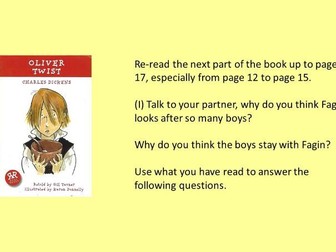
Oliver Twist Guided / Shared ReadingQuick View
gpmtiggs

Oliver Twist Guided / Shared Reading

(1)
This bundle of guided / shared reading material, and the page numbers referenced therein, relates to “Oliver Twist” by Charles Dickens; specifically, the edition retold by Gill Tavner and published by Real Reads Ltd in 2018. Used initially with a lower ability Year 4 set. Split over 6 weeks, each week works on a format where; Day 1 is a first read using a word detective exercise which allows pupils to explore some of the more unusual vocabulary they encounter. A simple version of this is also included as differentiation. Days 2 & 3 allow for further reads of the same section of the text, employing diverse sets of questions presented in a SATs style format with an indication in brackets of the VIPERS focus involved (ie. Vocabulary, Inference, Predict, Explain, Retrieve, Summarise). Day 4 requires a further read of the same section of the text, encouraging pupils to generate their own questions with a VIPERS focus. Day 5 allows for a contrasting non-fiction text to be considered (PLEASE NOTE THIS IS NOT PROVIDED) In addition, the standard questions for days 1 – 4 are all combined in a PowerPoint presentation.
Writing a Riverside Setting DescriptionQuick View
gpmtiggs

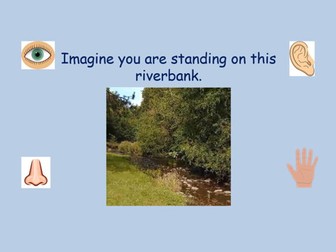
Writing a Riverside Setting Description

(0)
The intention with these lessons was to describe a riverbank setting using illustrations and film clips as stimuli before editing and re-writing their work. I used these materials as a series of 3 – 4 lessons with mixed ability LKS2 classes, usually Year 4. The materials include; Riverbank notes – a sheet which encourages pupils to think in terms of their senses when organising their notes and ideas. Riverbank notes top – a sheet as above but also encouraging consideration of the weather encountered and useful conjunctions, adjectives and adverbs that might be used. Riverbank notes top pic – a picture stimulus for use with the above. Inspiration sheet – this is a selection of additional items to help develop notes. Writing prompt bottom – a sequence of questions to inspire descriptive answers. Writing prompt mid – a sheet with a picture and advisory marking ladder for reference during the writing process. Writing prompt top – a sheet similar to the above but with a more extensive advisory marking ladder for reference during the writing process. Riverbank Setting PowerPoint - this is intended to take pupils through a process of note taking, drafting and editing, with reference to the other materials. River Clip 1 – A riverside film clip (32 sec) for use as part of the PowerPoint presentation to encourage pupils to listen as well as look. River Clip 2 – A longer film clip (59 sec) from a different perspective and with more to see and hear. I would recommend checking the PowerPoint beforehand as it may be necessary to re-link the film clips on the appropriate slides.
Introducing the United KingdomQuick View
gpmtiggs

Introducing the United Kingdom

(0)
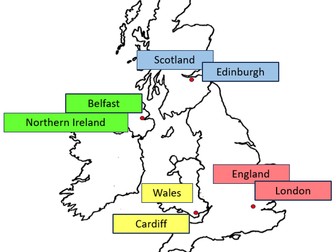
This PowerPoint and bundle of worksheet materials was used with KS1 classes, both Yr1 and Yr2, but could also be beneficial with EAL pupils and as a refresher for LKS2. The materials provide an introduction into the countries that make up the UK and were useful when regular opportunities for partner testing and recall was included. The Power Point incorporates simple animation and colour to focus attention on each country when being introduced. The associated sheets include; UK Country Information – This provides a pupil reference sheet for the information contained in the Power Point. UK Country Close Procedure – This could be used with the above reference sheet as required, to encourage pupils to record information. UK map with dots – This sheet has an outline map of the UK along with dots to identify the location of the capital cities. UK map with labels – This sheet allows a further level of differentiation and has an outline map of the UK with dots as above along with label boxes and the starting letter of each capital city. UK Towns and Cities – This sheet was used as an extension task where pupils were able to use an atlas to locate other prominent towns and cities and add these to their maps of the UK. Country Flags – This sheet gives basic grey outlines of the different country flags and guidance on how to colour them.
Nothing To See Here Hotel Guided / Shared ReadingQuick View
gpmtiggs

Nothing To See Here Hotel Guided / Shared Reading

(0)
This bundle of guided / shared reading material, and the page numbers referenced therein, relates to “The Nothing To See Here Hotel” by Steven Butler, published by Simon & Schuster UK Ltd in 2018. I used this text and material with a mixed ability Year 4 class. Each of the 26 chapters has a diverse set of questions presented in a SATs style format with an indication in brackets of the VIPERS focus involved (ie. Vocabulary, Inference, Predict, Explain, Retrieve, Summarise). A few of the lengthier chapters also have word detective exercises which allow pupils to explore some of the more unusual vocabulary they encounter. In addition, the questions are all combined in both ActivInspire and PowerPoint presentations.
The Lion And The Unicorn Guided / Shared ReadingQuick View
gpmtiggs

The Lion And The Unicorn Guided / Shared Reading

(0)
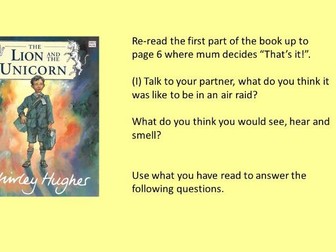
This bundle of guided / shared reading material, and the page numbers referenced therein, relates to “The Lion And The Unicorn” by Shirley Hughes; specifically, the edition published by Red Fox in 2000. Used initially with a Year 3/4 class, it also worked well with a Year 6 EAL group who needed an alternative WW2 themed text. Split over 5 weeks, each week works on a format where; Day 1 is a first read using a word detective exercise which allows pupils to explore some of the more unusual vocabulary they encounter Days 2 & 3 allow for further reads of the same section of the text, employing diverse sets of questions presented in a SATs style format with an indication in brackets of the VIPERS focus involved (ie. Vocabulary, Inference, Predict, Explain, Retrieve, Summarise). Day 4 requires a further read of the same section of the text, encouraging pupils to generate their own questions with a VIPERS focus. Day 5 allows for a contrasting non-fiction text to be considered (PLEASE NOTE THIS IS NOT PROVIDED) In addition, the standard questions for days 1 – 4 are all combined in a PowerPoint presentation.
Cliffhanger Guided / Shared ReadingQuick View
gpmtiggs

Cliffhanger Guided / Shared Reading

(0)
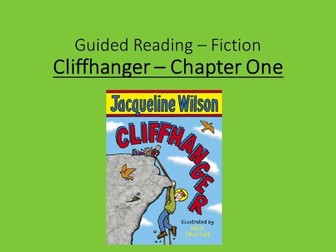
This bundle of guided / shared reading material, and the page numbers referenced therein, relates to “Cliffhanger” by Jacqueline Wilson; specifically, the Corgi Yearling edition published in 2009. I used this text and material with a mixed ability Year 3 class, a Year 4 class and with an EAL group. Each chapter has a diverse set of questions presented in a SATs style format with an indication in brackets of the VIPERS focus involved (ie. Vocabulary, Inference, Predict, Explain, Retrieve, Summarise). Chapters 1 - 5 have these sub-divided into two sets and, have two word detective exercises which allow pupils to explore some of the more unusual vocabulary they encounter. In addition, the questions are all combined in both ActivInspire and PowerPoint presentations.
One Boy’s War Guided / Shared ReadingQuick View
gpmtiggs

One Boy’s War Guided / Shared Reading

(0)
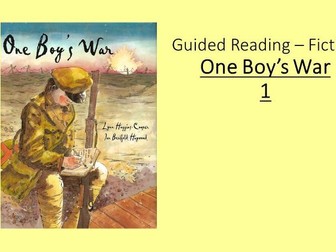
This bundle of guided / shared reading material, and the page numbers referenced therein, relates to “One Boy’s War” by Lynn Huggins-Cooper, published by Frances Lincoln Publishers Ltd. Used initially with a Year 3/4 class, linked to a deeper themed understanding of WW1. Split over 3 weeks, each week works on a format where; Day 1 is a first read using a word detective exercise which allows pupils to explore some of the more unusual vocabulary they encounter Days 2 & 3 allow for further reads of the same section of the text, employing diverse sets of questions presented in a SATs style format with an indication in brackets of the VIPERS focus involved (ie. Vocabulary, Inference, Predict, Explain, Retrieve, Summarise). Day 4 requires a further read of the same section of the text, encouraging pupils to generate their own questions with a VIPERS focus. Day 5 allows for a contrasting non-fiction text to be considered (PLEASE NOTE THIS IS NOT PROVIDED) In addition, the standard questions for days 1 – 4 are all combined in a PowerPoint presentation.
Finding Symmetry in Shapes and PatternsQuick View
gpmtiggs

Finding Symmetry in Shapes and Patterns

(0)
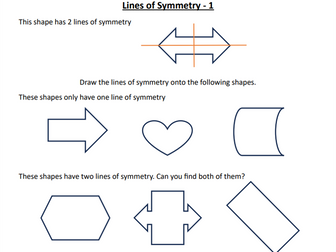
This is a set of 9 worksheets and materials. I used some or all of these with Year 2 and LKS2 classes, to help pupils gain an understanding of symmetry in shapes and extending to coloured patterns in different arrangements. Depending on the pupil’s understanding, I encouraged them to work individually, with a partner or in a guided group to complete these. I also provided mirrors for these activities but tried to encourage pupils to use these as a form of checking answers as these could sometimes cause confusion rather than aid answering. The 9 sets of sheets are; Lines of Symmetry shapes – these two sheets encourage pupils to identify all the lines of symmetry in given shapes. Lines of Symmetry shapes ANSWERS – these two sheets are the answers to the above to aid with marking. Symmetry letters low – this sheet allows pupils to organise given letters and symbols depending on whether or not they have lines of symmetry. Symmetry letters top – this sheet is as above but for more able pupils requiring them to identify if the letters and symbols have one, more than one or no line of symmetry. Symmetry letters cards – this is a master set of the cards required for sheets 3 and 4 above. Symmetrical Patterns bl & wh – this sheet has an arrangement of 8 patterns represented on grids which are to be completed with regard to the vertical mirror line shown. Symmetrical Patterns colour – this sheet is set out as the black and white version above but pupils are required to consider the placement of different colours. This could be used either as an extension activity or as a form of differentiation given only to more able pupils. Symmetrical Patterns blank – this sheet is set out as the black and white and coloured versions above but are blank grids. This allows pupils to create their own patterns for symmetrical completion either by themselves or for swapping with a partner. Symmetrical colour patterns – these three sheets follow a similar principle to that used in sheets 6, 7 and 8 however it extends to thinking about horizontal mirror lines and culminating in a grid that can be used to create symmetrical patterns across 4 quadrants.
Aladdin - Guided / Shared ReadingQuick View
gpmtiggs

Aladdin - Guided / Shared Reading

(0)
This bundle of guided / shared reading material, and the page numbers referenced therein, relates to “Aladdin And The Enchanted Lamp” by Philip Pullman. This was used initially with Year 4 but also with a lower ability Year 5 set. Split over 8 blocks, where each could constitute a week’s work if following a format where; Day 1 is a first read using a word detective exercise which allows pupils to explore some of the more unusual vocabulary they encounter. A simple version of this is also included as differentiation. Days 2 & 3 allow for further reads of the same section of the text, employing diverse sets of questions presented in a SATs style format with an indication in brackets of the VIPERS focus involved (ie. Vocabulary, Inference, Predict, Explain, Retrieve, Summarise). PLEASE NOTE, for the most part, these questions have NOT been split into two parts. Day 4 requires a further read of the same section of the text, encouraging pupils to generate their own questions with a VIPERS focus. Day 5 allows for a contrasting non-fiction text to be considered (PLEASE NOTE THIS IS NOT PROVIDED) In addition, the standard questions for days 1 – 4 are all combined in a PowerPoint presentation.
Hurricane Guided / Shared Reading ActivitiesQuick View
gpmtiggs

Hurricane Guided / Shared Reading Activities

(0)
This bundle of guided / shared reading material, and the page numbers referenced therein, relates to “Hurricane” by David Wiesner, published by Houghton Mifflin Harcourt Publishing Company. I used this initially with a Year 3 class, linked to themed work about Our Extreme Earth. It has also been useful for Year 2 children and an EAL group of older KS2 students. Split over 2 weeks, each week works on a format where; Day 1 is a first read using a word detective exercise which allows pupils to explore some of the more unusual vocabulary they encounter Days 2 & 3 allow for further reads of the same section of the text, employing diverse sets of questions presented in a SATs style format with an indication in brackets of the VIPERS focus involved (ie. Vocabulary, Inference, Predict, Explain, Retrieve, Summarise). Day 4 requires a further read of the same section of the text, encouraging pupils to generate their own questions with a VIPERS focus. Day 5 allows for a contrasting non-fiction text to be considered (PLEASE NOTE THIS IS NOT PROVIDED) In addition, the standard questions for days 1 – 4 are all combined in PowerPoint presentations.
Stig of the Dump Guided / Shared ReadingQuick View
gpmtiggs

Stig of the Dump Guided / Shared Reading

(0)
This bundle of guided / shared reading material, and the page numbers referenced therein, relates to “Stig of the Dump” by Clive King; specifically, the Puffin Book edition reissued in 2014. I used this text and material with a mixed ability Year 3 class, a Year 4 class and with EAL pupils. Each chapter has a diverse set of questions presented in a SATs style format with an indication in brackets of the VIPERS focus involved (ie. Vocabulary, Inference, Predict, Explain, Retrieve, Summarise). Most chapters have these sub-divided into at least two sets and, often, have word detective exercises which allow pupils to explore some of the more unusual vocabulary they encounter. In addition, the questions for each chapter are all combined and sequenced in both ActivInspire and PowerPoint presentations.
Adding Money – 1p and 2p / 5p and 10pQuick View
gpmtiggs

Adding Money – 1p and 2p / 5p and 10p

(0)
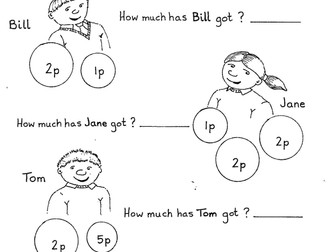
I used these worksheets with a Year 1 class, when pupils were first introduced to representing money calculations in written forms. They worked with plastic coins to represent these and gradually moved towards calculations without these as appropriate. The sheets are; Adding 1p and 2p – three sheets that largely require the identification of amounts from given arrangements of 1p and 2p coin representations. Add 1p and 2p problem – this sheet shows 3 children with different representations of coins and asks which of them could buy a ball costing 5p. Adding 5p and 10p – this sheet requires the identification of amounts from given arrangements of 5p and 10p coin representations.
Times Table Patterns ComparisonQuick View
gpmtiggs

Times Table Patterns Comparison

(0)
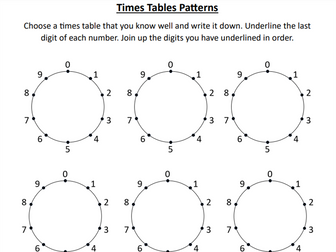
I used this worksheet with various KS2 classes, to help pupils identify and compare patterns in times tables as well as identifying commonalities between certain times tables. They also proved useful to reinforce learning times tables. The first sheet provides detailed instructions for how to carry out the activity on the second sheet.
The Butterfly Lion Guided / Shared ReadingQuick View
gpmtiggs

The Butterfly Lion Guided / Shared Reading

(0)
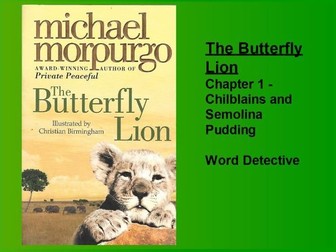
This bundle of guided / shared reading material, and the page numbers referenced therein, relates to “The Butterfly Lion” by Michael Morpurgo; specifically, the edition published by Harper Collins in 1996. I used this text and material with a mixed ability Year 4 class. Each chapter has a diverse set of questions presented in a SATs style format with an indication in brackets of the VIPERS focus involved (ie. Vocabulary, Inference, Predict, Explain, Retrieve, Summarise). Some of the lengthier chapters have these sub-divided into two sets and also may have word detective exercises which allow pupils to explore some of the more unusual vocabulary they encounter. There are also differentiated sets of questions, some of which use the format of colourful semantics. In addition, the standard questions are all combined in both ActivInspire and PowerPoint presentations.
Geography Fieldwork – Street SurveyQuick View
gpmtiggs

Geography Fieldwork – Street Survey

(0)
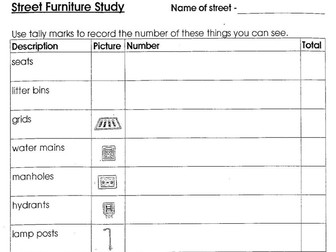
This bundle of worksheet materials was used with a mixed ability UKS2 class during a visit to Bridlington with a strong Geography focus. The Street Survey sheets encourage pupils to consider in greater detail the characteristics and make-up of a street and could be combined easily as a booklet. I gave these to pairs of pupils and employed simpler sheets, such as the alphabetic search, with less able pupils. Although my use was with primary pupils, I could see these being equally useful with KS3 students. The compass rose sheet encouraged pupils to stand at various given points and identify what could be seen in the different directions.
Introduction to Division by 2 and 3Quick View
gpmtiggs

Introduction to Division by 2 and 3

(0)
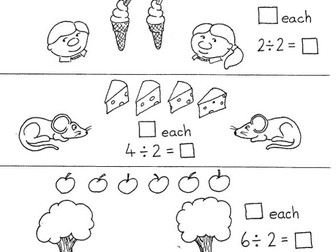
I used this worksheet with mixed ability KS1 classes, when first introducing the idea of division. Of course, a first step was getting children to use practical materials, such as cubes or sweets etc, to understand the concept of division. These sheets are a next step and use drawn representations to allow pupils to calculate simple divisions by colouring in or labelling before completing the same as mathematical sentences.
3 Little Pigs House DesignQuick View
gpmtiggs

3 Little Pigs House Design

(0)
I used this worksheet with mixed ability KS1 classes, usually Year 1, when developing the ability to analyse positive and negative features of a design. Initially this can be used to think about the straw, stick and brick houses but could equally be used to analyse more imaginative pupil designs for pig house “upgrades”.
Simple problems using add and subtractQuick View
gpmtiggs

Simple problems using add and subtract

(0)
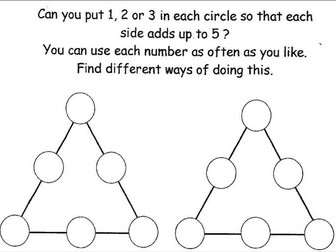
I used these worksheets with KS1 classes, especially Year 2, when encouraging the application of addition and subtraction skills within simple problems. Depending on the pupil’s understanding, I encouraged them to work individually, with a partner or in a guided group. It also proved useful, in certain cases, to encourage the use of cubes to visualise calculations. The three sheets are; Using the numbers 1 – 20 to generate suitable addition or subtraction statements. Using 1, 2 or 3 in the sides of a triangle to reach a total of 5. (I adapted this to allow 0 to be used as appropriate.) John has 3 more felt pens than Tom. How many could each boy have?
Data Collection and GraphsQuick View
gpmtiggs

Data Collection and Graphs

(0)
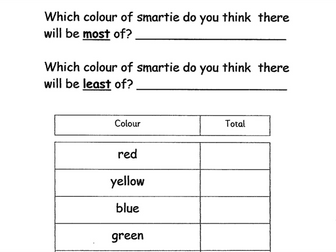
I used these worksheets with Year 2 and Year 3 classes. Pupils gained experience of using tally marks to collect information and then represent this data in the form of a graph. Depending on pupil abilities, I encouraged them to work individually, with a partner or in a guided group to complete these activities. There are also differentiated versions of some of these activities. The worksheets included are; Bag of cubes – used as an easy introduction to data collection and graphing, it requires pupils to be provided with a bag of mixed cubes to systematically tally according to colour and then complete the prepared graph. Smarties easy – Always popular and creating great enthusiasm as sweets are involved! Two sheets, largely pre-prepared where pupils in pairs or small groups are given boxes (or 2 tubes) of Smarties, to predict what the most and least colour represented will be before collecting data and completing a graph of results. Smarties mid – as above but the data collection grid and graph are in a minimal form requiring pupils to fill in the required details. Smarties top – as above but data collection requires the use and interpretation of tally marks and the graphing sheet is purely a squared grid allowing more able to compile their graph from scratch. Birthdays – Pupils use tally marks to record the birthdays of their peers (this needs to be done systematically and requires organising to avoid missing anyone or counting people twice!). Once collected they use either 5a. Birthdays Graph filled – a prelabelled graph format sheet or 5b. Birthdays Graph to fill – a basic, unlabelled graph format sheet to compile their graphs.
Whatever Next story retelling draftQuick View
gpmtiggs

Whatever Next story retelling draft

(0)
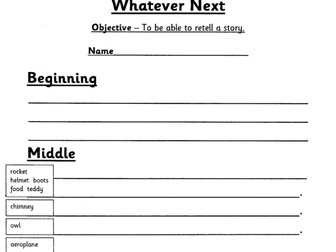
I used these worksheets with mixed ability KS1 classes, usually Year 2, when developing an understanding of story content and structure. There are two worksheets providing differentiated opportunities for pupils to record ideas when retelling the story “Whatever Next” by Jill Murphy. They then used these ideas within more extended pieces of writing in later lessons.
Comparing dates and timesQuick View
gpmtiggs

Comparing dates and times

(0)
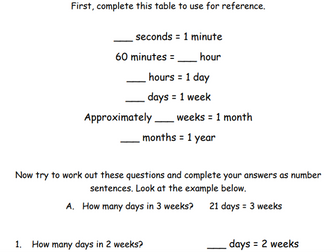
I used these worksheets with Year 2 and Year 3 classes, to help pupils learn and compare the relationships between different dates and times. Depending on pupil abilities, I encouraged them to either write out the facts and answers in their books or provided them with the cloze procedure style worksheet version.