


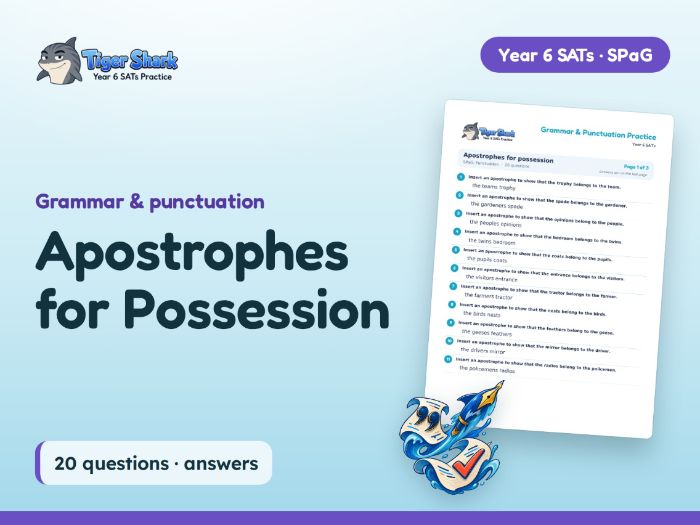
Year 6 SPaG worksheet on apostrophes for possession: 20 SATs-style questions with answers. Free printable PDF.
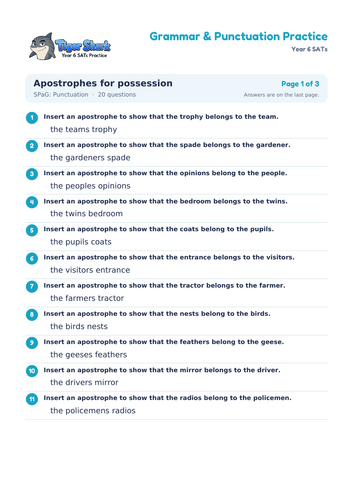
3-page A4 PDF from the Tiger Shark Education question bank (Punctuation): two pages of questions (insert the punctuation) and an answer page. Example questions: Insert an apostrophe to show that the trophy belongs to the team. the teams trophy / Insert an apostrophe to show that the spade belongs to the gardener. the gardeners spade
What are apostrophes for possession? An apostrophe shows that something belongs to someone: the dog’s lead. For a singular noun, add ‘s (the girl’s bag). For a plural noun ending in s, add only an apostrophe (the girls’ bags). For plural nouns not ending in s, add 's (the children’s toys, the men’s coats).
Common mistakes and tips: The most common errors are adding apostrophes to plurals that don’t own anything (apple’s for sale) and placing the apostrophe in the wrong position for plurals. Ask pupils first whether the noun is singular or plural, then write the owner word in full before adding the apostrophe. Irregular plurals such as children and people need explicit practice.
Quick example to try: give pupils phrases such as ‘the toys belonging to the children’ and ‘the bikes belonging to the boys’. They write the owner word first, decide whether it is singular or plural, then add the apostrophe.
This topic is part of the Year 6 English grammar, punctuation and spelling curriculum and appears in the SATs. Because the test uses precise terminology, practising with the correct terms here helps children recognise what a question is asking.
How teachers use it: as a ten-minute daily grammar slot, as a homework task, or as part of a mixed revision pack in the run-up to the SATs. Pairs can work through it and compare answers before checking the answer page. Revisiting the same topic a few weeks later is an effective way to check retention.
Building understanding, not just recognition: the SATs ask children to identify features, but the real aim is for them to use grammar confidently in their own writing. After completing the sheet, ask pupils to find examples of the topic in a class text and discuss why the author used them. Then set a short writing task where the feature must be used deliberately, such as a paragraph of a story or a piece of non-fiction. Shared editing, where the class improves a weak sentence together, is a powerful way to show the effect of a grammatical choice. Linking grammar to purpose and effect helps children remember the terminology, because it becomes a tool rather than a label.
Something went wrong, please try again later.
This resource hasn't been reviewed yet
To ensure quality for our reviews, only customers who have downloaded this resource can review it
Report this resourceto let us know if it violates our terms and conditions.
Our customer service team will review your report and will be in touch.
£0.00