



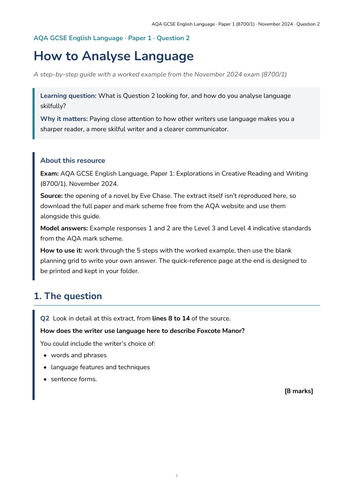
Step-by-step guide to AQA GCSE English Language Paper 1 Question 2 (8 marks): how to analyse language with model answers, worked example and planning grid.
This 10-page Word guide takes students through Question 2 of the AQA GCSE English Language Paper 1 (8700/1), using the November 2024 exam: “How does the writer use language here to describe Foxcote Manor?” It breaks language analysis into five clear steps that students can take into any Question 2:
- Read the extract
- Select your evidence
- Annotate your evidence
- Brainstorm ideas and make three claims
- Plan and write your answer
What’s included:
- What Question 2 is looking for: the what / how / why of language analysis, plus a “do this, not that” table of common mistakes (such as feature-spotting and generic effects).
- Model answers: the Level 3 and Level 4 indicative standards from the AQA mark scheme, colour-coded for meaning, method and explanation of method, with notes on what lifts the Level 4 response.
- A worked example for every step: annotating a quotation, grouping evidence into three claims (“intimidating”, “dilapidated” and “a haven for nature”), and a completed paragraph plan.
- The planning grid: Claim → Evidence → Analysis → Zoom → Analysis of zoom, which helps students move from spotting a technique to in-depth, word-level analysis.
- From Level 3 to Level 4: a first draft and a redrafted paragraph side by side, with notes explaining exactly what changed and why. It’s ideal for modelling redrafting and self-assessment.
- A blank planning grid for students’ own three paragraphs.
- A one-page quick-reference sheet for students to keep in their folders.
How to use it: the guide works for whole-class teaching, intervention groups, one-to-one tuition, homework or revision. Use it alongside the AQA November 2024 Paper 1 question paper and mark scheme, which are free to download from the AQA website. The extract itself isn’t reproduced in this resource.
Suitable for GCSE English Language students in Years 10 and 11, including those aiming to move from a Level 3 (5–6 marks) to a Level 4 (7–8 marks) answer.
Something went wrong, please try again later.
This resource hasn't been reviewed yet
To ensure quality for our reviews, only customers who have downloaded this resource can review it
Report this resourceto let us know if it violates our terms and conditions.
Our customer service team will review your report and will be in touch.
£0.00