


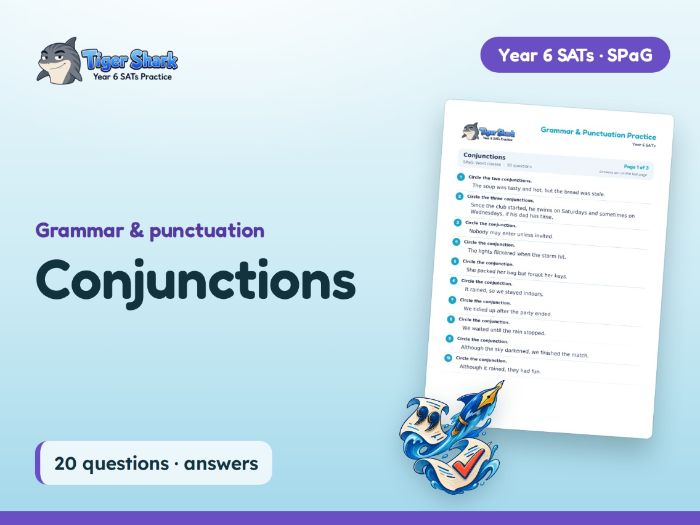
Year 6 SATs SPaG worksheet on conjunctions: 20 questions in the style of the SATs, with answers. Free PDF.
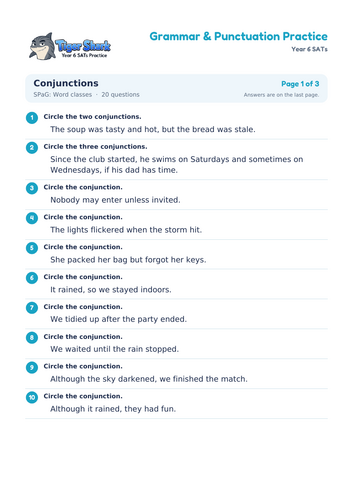
3-page A4 PDF from the Tiger Shark Education question bank (Word classes): two pages of questions (circle or underline) and an answer page. Example questions: Circle the two conjunctions. The soup was tasty and hot, but the bread was stale. / Circle the three conjunctions. Since the club started, he swims on Saturdays and sometimes on Wednesdays, if his dad has time.
What is a conjunction? A conjunction links words, phrases or clauses. Co-ordinating conjunctions join items of equal importance (and, but, or, so), while subordinating conjunctions introduce a subordinate clause (because, although, when, if, while, since). Using a range of conjunctions helps children write longer, more varied sentences. In the SATs, children identify conjunctions and choose suitable ones.
Common mistakes and tips: Children often confuse conjunctions with adverbs such as however and therefore, which link ideas but are not conjunctions. Others use ‘and’ and ‘but’ repetitively. Words such as before, after and since can be prepositions or conjunctions depending on what follows, so children need to check whether a clause with a verb comes next.
Quick example to try: write ‘I wanted to play outside ___ it was raining’ and ask pupils to try but, although and because in the gap. Discuss how each conjunction changes the meaning, and which ones make sense. This shows that choosing a conjunction is about the relationship between ideas.
In the KS2 SATs, grammar and punctuation are tested in a separate paper of around 50 short questions, and this topic regularly appears. The questions on this sheet use the same styles as the test (circle, tick, underline, insert), so children practise the format as well as the knowledge.
Teaching ideas: model the first two questions together and talk through the reasoning, then let children complete the rest independently. Use the answers to group pupils for a follow-up session. For extra challenge, ask children to explain their answers in a full sentence using the correct grammatical terms.
Supporting all learners: for children who find grammar difficult, read the questions aloud and work through the first few together before they continue alone. Colour-coding word classes or clauses on mini whiteboards makes abstract ideas more concrete, and sorting word cards or building sentences from strips helps too. More confident pupils can write their own test-style questions for a partner, with the answers and a short explanation. Once each topic is secure, mix it with others, because the real test does not group questions by topic and pupils need to recognise what each question is asking them to do.
Something went wrong, please try again later.
This resource hasn't been reviewed yet
To ensure quality for our reviews, only customers who have downloaded this resource can review it
Report this resourceto let us know if it violates our terms and conditions.
Our customer service team will review your report and will be in touch.
£0.00