


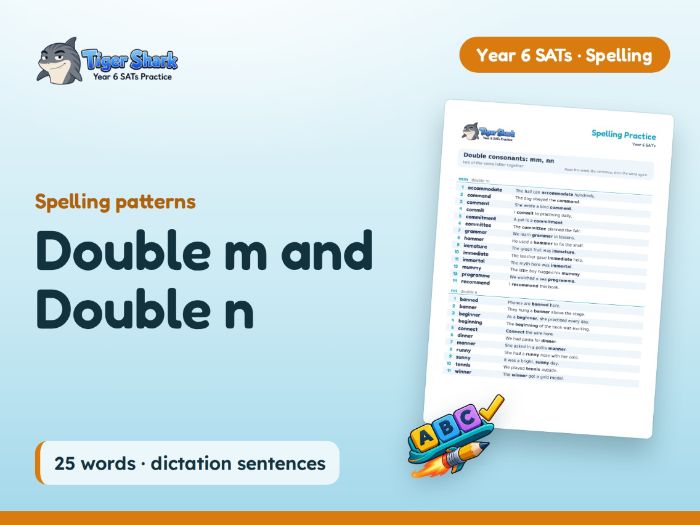
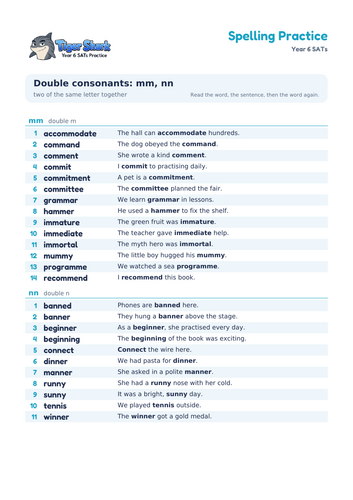
Year 6 KS2 SATs spelling list: 25 words with double m (mm) and double n (nn), each with a dictation sentence. Printable PDF for tests and homework.
One-page A4 PDF from the Tiger Shark Education spelling bank. Each numbered word is followed by a sentence using it in context, with the word in bold. Words such as accommodate, committee, immediate, beginning and connect. Numbering restarts under each heading.
What are double m and double n words? mm and nn appear in words such as accommodate, committee, immediate, beginning and connect. Many come from Latin prefixes such as im- and con- (immediate, connect). Suffixes also cause doubling: begin, beginning.
Common mistakes and tips: Accommodate (cc and mm) and beginning (nn) are among the most misspelt words in Year 6 writing. Breaking them into parts (ac-com-mo-date, be-gin-ning) helps. Explain that im- and con- combine with roots that start with m or n to create the double letter.
These words matter beyond the SATs spelling paper. Accurate spelling is part of the ‘working at the expected standard’ writing judgement at the end of Key Stage 2, so a pattern learned here pays off in every subject where children write at length.
Ways to use this sheet: choose 10 to 20 words for a weekly test, use a few words a day as a starter, or set the sentences as dictation. It works well for intervention groups because the words are grouped by pattern, and for homework, since parents can read the sentences aloud. Ask children to highlight the spelling pattern in each word before they learn it, then test them in a different order.
Why practise spelling by pattern? Children tend to remember spellings better when they understand why a word is spelt the way it is, rather than learning each one as a random string of letters. Grouping words by pattern lets pupils spot the rule, test it on new words and notice the exceptions. Once a pattern is secure it helps with many words beyond the list, including unfamiliar ones children meet in their reading. It also shows you what has really been learned: a pupil who can apply the pattern to a new word has understood it, not just memorised a list.
Read the word, the sentence, then the word again, as in the KS2 SATs spelling paper. Use it as a word bank: pick 10 to 20 words for a weekly test, dictation, an intervention group or homework. Also suits Year 5.
Part of a set of 40 grapheme-organised sheets covering all 1,164 words in the spelling bank.
Something went wrong, please try again later.
This resource hasn't been reviewed yet
To ensure quality for our reviews, only customers who have downloaded this resource can review it
Report this resourceto let us know if it violates our terms and conditions.
Our customer service team will review your report and will be in touch.
£0.00