


A three page, zero prep worksheet built around the classic Bill Nye the Science Guy episode on electricity, now remastered in 4K for modern classrooms. Perfect for upper primary and middle school science (Grades 4 to 8), this resource includes QR codes linking straight to the 4K episode and a free interactive lesson. Just print and go.
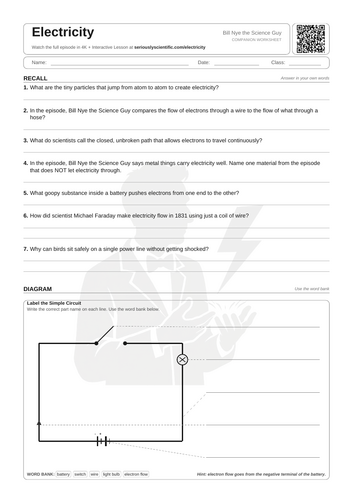
What’s Included Side A: Recall and DiagramSeven recall questions for students to complete while watching the episode, each tied to a specific demonstration: the battery powered circuit, the water pump analogy, the bumper cars, Faraday’s coil and magnet experiment, and why birds on power lines stay safe. One or two answer lines per question.
A simple closed circuit diagram (battery, switch, light bulb, connecting wires and electron flow arrows) for students to label using the word bank. Greyscale and photocopier friendly.
Side B: Short Answer, Apply Your Knowledge and Critical ThinkingFive short answer questions pushing students beyond recall, covering the difference between D.C. and A.C., voltage as electrical pressure, why bumper car riders are safe, watts as a unit of power, and what happens when a switch is opened.
Two extended Apply Your Knowledge prompts: students identify D.C. and A.C. devices at home and explain why a television cannot run on AA batteries, then use the Viking 21 solar electric car from the episode to explore why multiple solar cells are needed and why electricity must be stored in batteries.
One Critical Thinking prompt links the episode to everyday electrical safety, asking students to use their understanding of circuits, insulators and conductors to explain how features like rubber coatings, fuses and residual current devices keep people safe at home.
Answer Key (Page 3)Complete model answers for all fifteen questions plus the diagram, along with notes for educators covering classroom, homework and homeschool suggestions.
Topics CoveredStudents explore electrons as the particles that carry electric charge, and how they flow through conductors such as metals while being blocked by insulators such as rubber and plastic. The worksheet covers electrical circuits and the closed loop requirement for current to flow, plus the roles of batteries (chemical to electrical energy via electrolyte) and generators (mechanical to electrical energy via coil and magnet). Students distinguish Direct Current (D.C.) from Alternating Current (A.C.), and learn that voltage is electrical pressure, amperage is the rate of electron flow, and watts combine both to measure power.
Real world applications include bumper cars, power lines, the Grand Coulee Dam, solar cells and the 1994 Viking 21 electric hybrid car.
Something went wrong, please try again later.
This resource hasn't been reviewed yet
To ensure quality for our reviews, only customers who have downloaded this resource can review it
Report this resourceto let us know if it violates our terms and conditions.
Our customer service team will review your report and will be in touch.
£0.00