


This booklet takes students through the full narrative arc of natural selection — from what a species is, through Darwin’s theory, to real-world case studies and speciation — using gap-fill and scaffolded questions that make each step concrete rather than abstract. It’s packed with applied examples (giraffes, woolly mammoths, warfarin-resistant rats, peppered moths, antibiotic-resistant bacteria) so students see the same process playing out in different contexts, which is exactly what examiners reward.
Topics covered:
Knowledge retrieval on inheritance — dominant/recessive alleles, genotype, phenotype, homozygous/heterozygous
Defining a species — breeding to produce fertile offspring, with the horse/donkey/mule distinction
Evolution — change in inherited characteristics of a population over time
Darwin’s theory of evolution by natural selection — historical context, the five-step sequence
Applied examples of natural selection: the giraffe’s long neck, woolly mammoth evolution from a common ancestor, warfarin resistance in rats
Variation — genetic, environmental, and combined causes, with a sorting task
Mutations and their role in generating variation — most having no effect on phenotype, a few driving rapid change
The peppered moth — natural selection before and during the Industrial Revolution
Antibiotic resistance in bacteria — the step-by-step development of resistant populations, including MRSA
Speciation — geographical separation leading to two populations that can no longer interbreed
Key features:
Starts with a retrieval task on inheritance vocabulary — activates prior knowledge before new content begins, rather than treating the topic in isolation
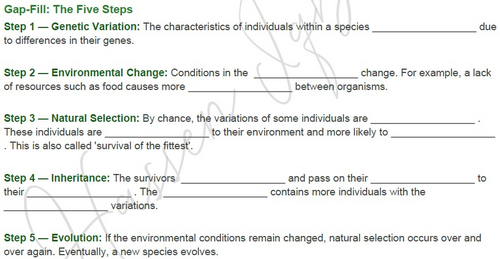
Five-step natural selection framework (variation → environmental change → selection → inheritance → evolution) taught explicitly, then applied repeatedly across different case studies
Three distinct real-world case studies (giraffe, mammoth, warfarin rats) plus two extended case studies (peppered moth, antibiotic resistance) — gives students enough repetition to internalise the pattern without it feeling repetitive
Gap-fills throughout every section with word banks, keeping the booklet accessible for EAL learners and students who struggle with recall under pressure
Sentence starters and scaffolded mark schemes built into longer-answer questions — models how to structure a response before students attempt it independently
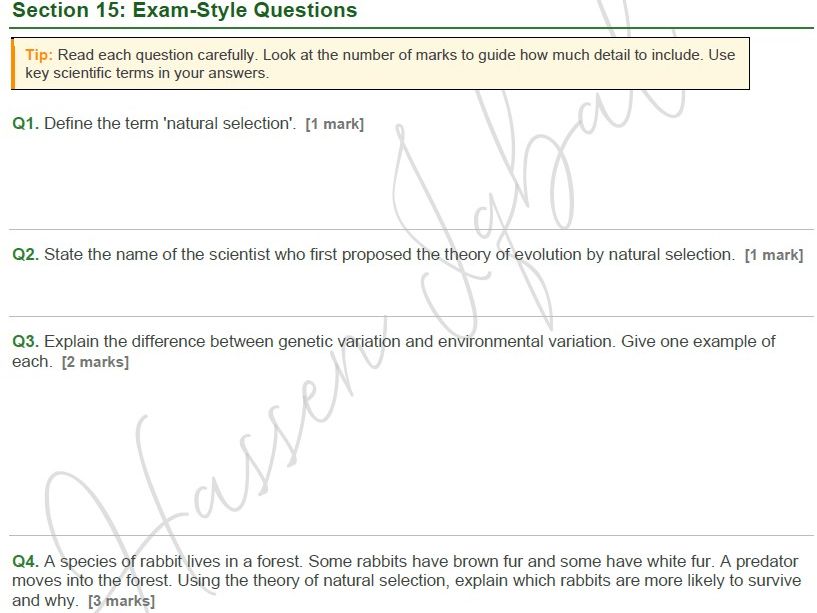
Exam-style questions at the end ranging from 1-mark definitions up to a 6-mark extended response on the peppered moth
Deeper thinking prompts embedded within sections (e.g. predicting what happens to a pest population over time) — pushes higher-ability students beyond recall
Variation sorting task that requires students to categorise examples as genetic, environmental, or both — a common exam question format
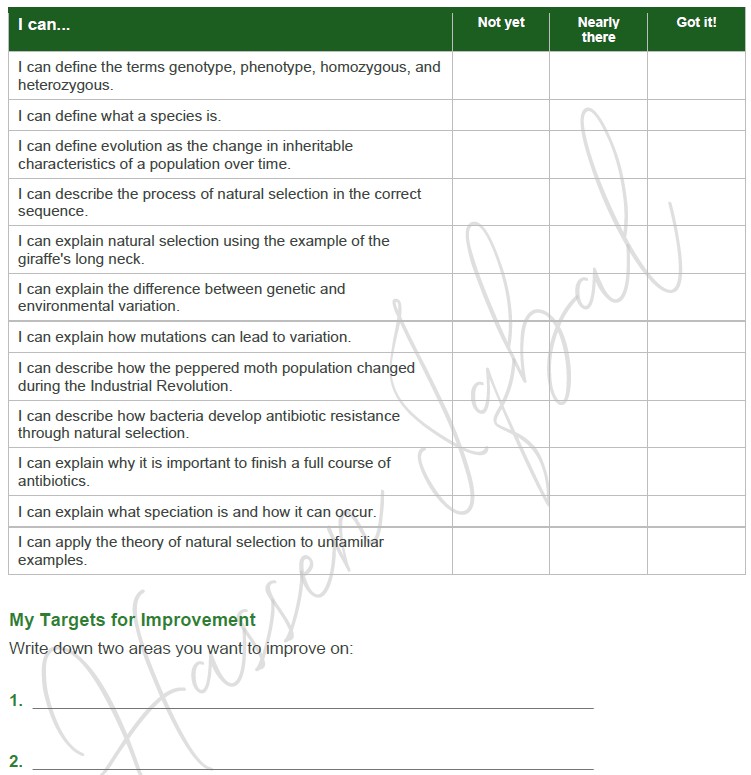
Self-assessment checklist with space for students to write specific improvement targets, not just tick boxes
Aligned to Edexcel Combined Science GCSE specification
Something went wrong, please try again later.
This resource hasn't been reviewed yet
To ensure quality for our reviews, only customers who have downloaded this resource can review it
Report this resourceto let us know if it violates our terms and conditions.
Our customer service team will review your report and will be in touch.
£0.00