


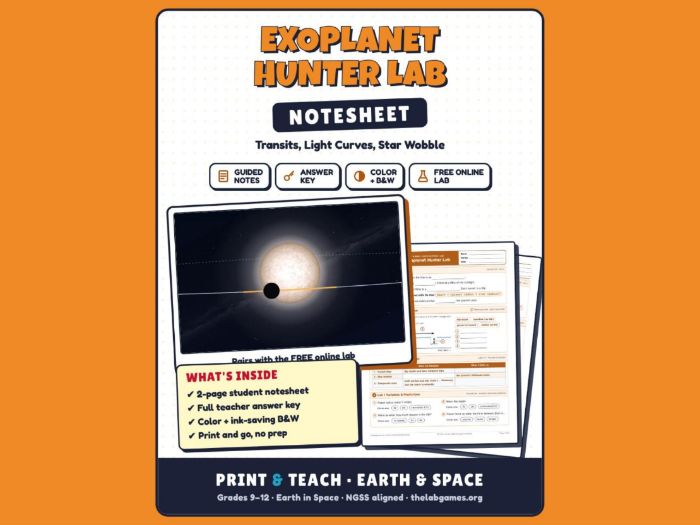
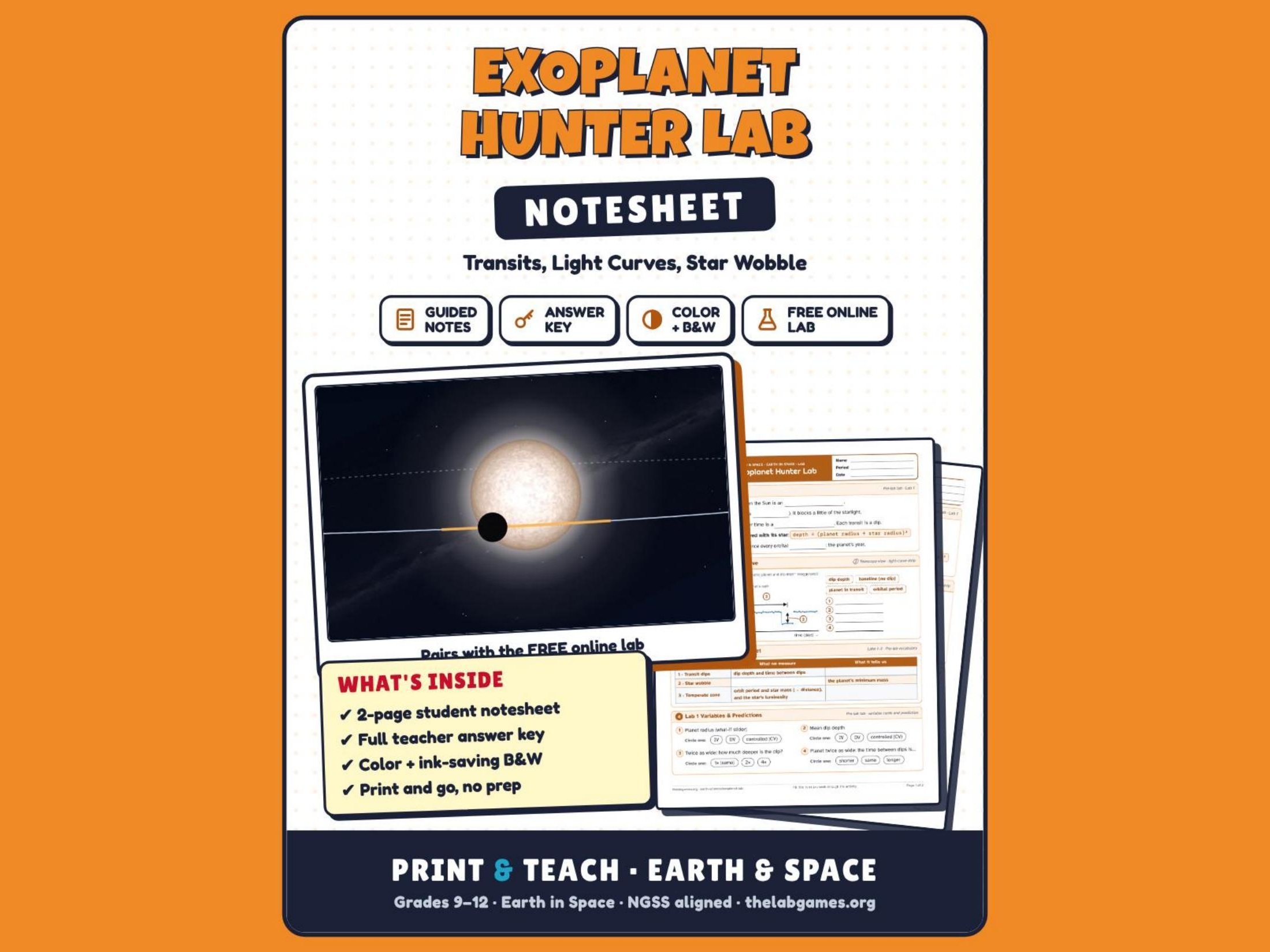
Hunt for planets around other stars. In this roomy, student-friendly 2-page notesheet, students fill in the background on exoplanets, transits and light curves, label a transit and its light curve (planet in transit, dip depth, orbital period, baseline), compare the three ways astronomers study a planet, and sort the variables and make predictions for the transit lab. On page 2 they record dip depth, planet radius and period for HD 209458 b, TRAPPIST-1 e and Kepler-186 f plus a what-if planet, read star-wobble speeds and a minimum mass, compare each orbit with a temperate-zone proxy, and write a claim, evidence and reasoning.
It pairs with Exoplanet Hunter Lab, a free online lab at thelabgames.org built on real NASA Exoplanet Archive planets, where transit dips give a planet’s size and year and the star’s wobble gives its minimum mass. Use it in class, for absent-student makeups, or on sub days. A complete teacher key is included.
What’s Included
- Student notesheet (2 pages) in full color AND black & white
- Teacher answer key (red answers) in full color AND black & white
What Students Do
- Background fill-in: exoplanets, transits, light curves, dip depth = (planet radius ÷ star radius)², orbital period
- A Transit and Its Light Curve: label the planet in transit, dip depth, orbital period and baseline
- Three Ways to Study a Planet: what transits, star wobble and the temperate zone measure and tell us
- Lab 1 Variables & Predictions: sort IV and DV, predict how a wider planet changes the dip and the period
- Lab 1 Transit Data: dip depth, planet radius and period for three real planets and a half-size what-if planet
- Labs 2 & 3: red and blue Doppler shifts, wobble speeds, minimum mass, and inside or outside the temperate-zone proxy, plus a Physics box on orbit tilt and m sin i
- Claim · Evidence · Reasoning: how dips reveal a planet’s size and year
Skills & Standards
- Exoplanet detection, transit method, light curves, transit depth, orbital period, radial velocity and the Doppler effect, minimum mass, Kepler’s third law, habitable (temperate) zone, inference limits
- Supports NGSS HS-ESS1-4, HS-PS4-3
- Grades 9–12 Earth and Space Science (with a Physics extension)
Great For
- Exoplanets and space exploration units
- Absent-student makeups
- Sub plans
- Lab stations
- Test review
Something went wrong, please try again later.
This resource hasn't been reviewed yet
To ensure quality for our reviews, only customers who have downloaded this resource can review it
Report this resourceto let us know if it violates our terms and conditions.
Our customer service team will review your report and will be in touch.
$0.00