


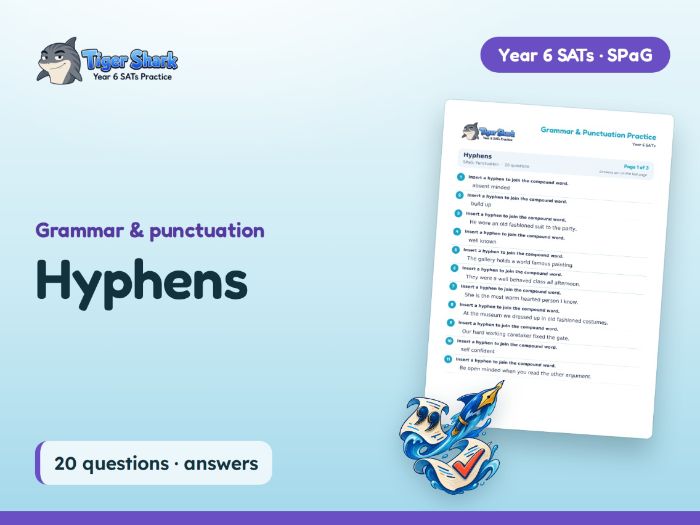
Year 6 SATs SPaG worksheet on hyphens: 20 questions in the style of the SATs, with answers. Free PDF.
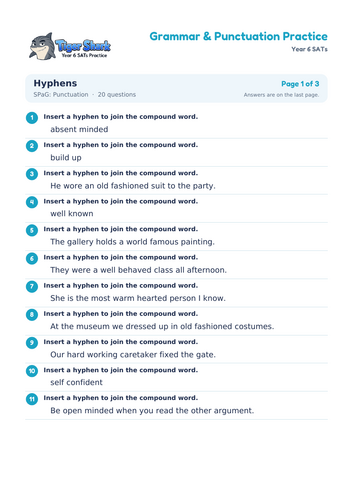
3-page A4 PDF from the Tiger Shark Education question bank (Punctuation): two pages of questions (insert the punctuation) and an answer page. Example questions: Insert a hyphen to join the compound word. absent minded / Insert a hyphen to join the compound word. build up
What is a hyphen? A hyphen joins words or parts of words together. It is used in compound adjectives before a noun (a well-known author, a man-eating shark), with some prefixes (co-ordinate, re-enter) and to avoid ambiguity. Without the hyphen, the meaning can change: a man eating shark versus a man-eating shark.
Common mistakes and tips: Children often confuse hyphens with dashes or add hyphens to every compound word. The ambiguity examples, such as man-eating shark, are the most memorable way to show why hyphens matter. In the SATs, children are typically asked where a hyphen should go to make the meaning clear.
Quick example to try: write ‘a man eating shark’ and ‘a man-eating shark’ on the board and ask pupils to draw each one. Then give them phrases such as ‘a little used car’ and ‘a twenty one year old student’ and ask where a hyphen would make the meaning clear.
Questions on this topic appear often in the SATs. The skill also counts in teacher assessment of writing at the end of Year 6, so children benefit from both practice in test style and from using it in their own writing.
Ways to use this worksheet: as a lesson starter or plenary, as a quick assessment before teaching a topic, for intervention groups, or as SATs revision homework. The answer page lets children self-mark. After marking, ask pupils to write two of their own sentences using the skill, so they apply it rather than just recognise it.
Using the correct terminology: the SATs use the terms in the National Curriculum glossary, and children need to recognise them quickly. Display the key term for this topic with a clear definition and an example, and use it consistently in lessons and feedback. When children explain their answers, encourage them to use the term in a full sentence. Short, regular retrieval practice, such as a two-minute quiz on terms from previous weeks, keeps knowledge fresh across the year. Because grammar topics build on one another, gaps from earlier years cause difficulties later, so this sheet is also useful for checking that Year 6 pupils have secure foundations from Years 3 to 5.
Something went wrong, please try again later.
This resource hasn't been reviewed yet
To ensure quality for our reviews, only customers who have downloaded this resource can review it
Report this resourceto let us know if it violates our terms and conditions.
Our customer service team will review your report and will be in touch.
£0.00