


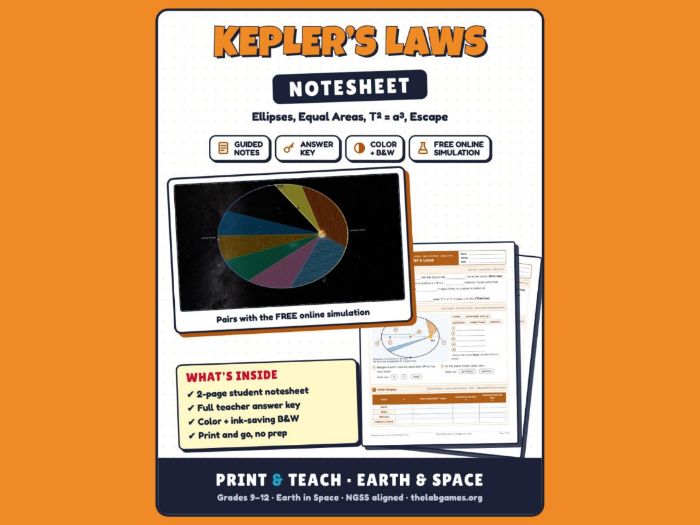
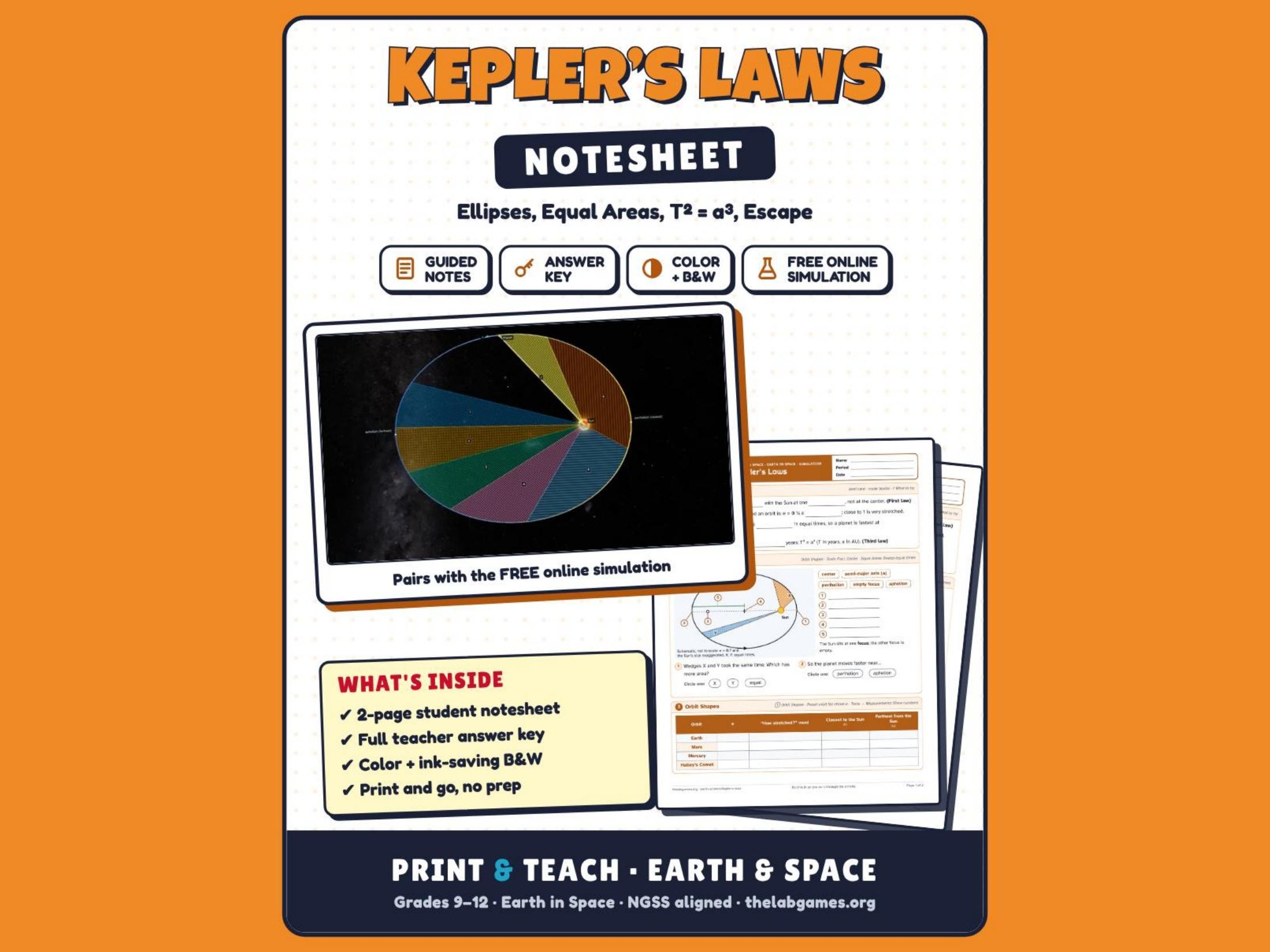
Help students discover the three patterns Johannes Kepler found in planetary motion. In this roomy, student-friendly 2-page simulation notesheet, students fill in the background on elliptical orbits, eccentricity, equal areas and longer years farther out, label the parts of an orbit (perihelion, aphelion, empty focus, center, semi-major axis) on a drawing with two equal-time wedges, and record the eccentricity, “how stretched” description and closest and farthest distances for Earth, Mars, Mercury and Halley’s Comet. On page 2 they compare speeds near and far from the Sun, build a period-and-distance table for five planets (with T² and a³ columns for physics classes), race Earth against Mars, sort launch speeds into crash, orbit and escape, and try a Physics and AP Physics box on v·r, escape speed and a heavier central star.
It pairs with Kepler’s Laws, a free online simulation at thelabgames.org that uses real NASA/JPL orbit data: students stretch orbits, sweep equal areas, race the planets and launch probes, then take a test at their level. Use it in class, for absent-student makeups, or on sub days. A complete teacher key is included.
What’s Included
- Student notesheet (2 pages) in full color AND black & white
- Teacher answer key (red answers) in full color AND black & white
What Students Do
- Background fill-in: Kepler’s first, second and third laws in plain language
- Parts of an Orbit: label perihelion, aphelion, the empty focus, the center and the semi-major axis, then compare two equal-time wedges
- Orbit Shapes: eccentricity, “how stretched” description and closest and farthest distances for four real orbits
- Equal Areas: speeds near and far from the Sun for Earth, Mercury and Halley’s Comet, and when Earth moves fastest
- Longer Years Farther Out: average distance and period for five planets, with T² and a³ for physics classes; the Earth–Mars race and Jupiter’s year
- Launch & Escape: what happens to a probe launched too slow, at circular speed, a bit faster and at escape speed
- Physics and AP Physics box: v·r at both ends of Mercury’s orbit, escape speed versus circular speed, and Earth’s period around a star with twice the Sun’s mass
Skills & Standards
- Kepler’s three laws, ellipses and foci, eccentricity, perihelion and aphelion, equal areas in equal times, orbital speed, T² = a³, circular and escape speed, angular momentum (Physics), T² = 4π²a³/GM (AP Physics)
- Supports NGSS HS-ESS1-4
- Grades 9–12 Earth and Space Science (also fits Physics and AP Physics 1)
Great For
- Earth in Space and gravitation units
- Absent-student makeups
- Sub plans
- Homework or stations
- Test review
Something went wrong, please try again later.
This resource hasn't been reviewed yet
To ensure quality for our reviews, only customers who have downloaded this resource can review it
Report this resourceto let us know if it violates our terms and conditions.
Our customer service team will review your report and will be in touch.
$0.00