


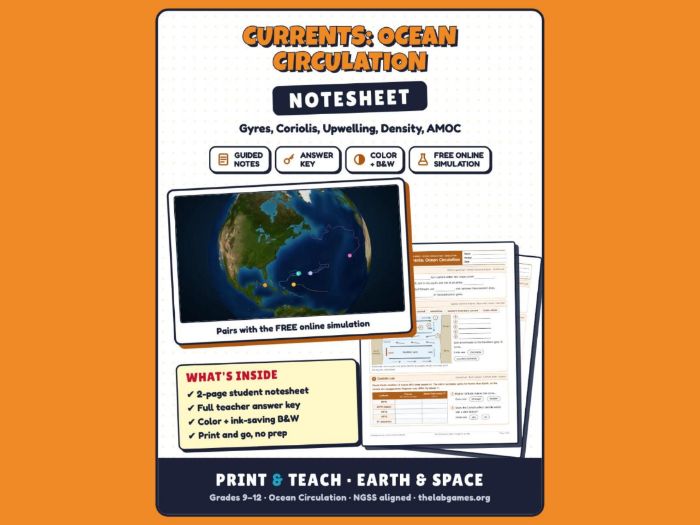
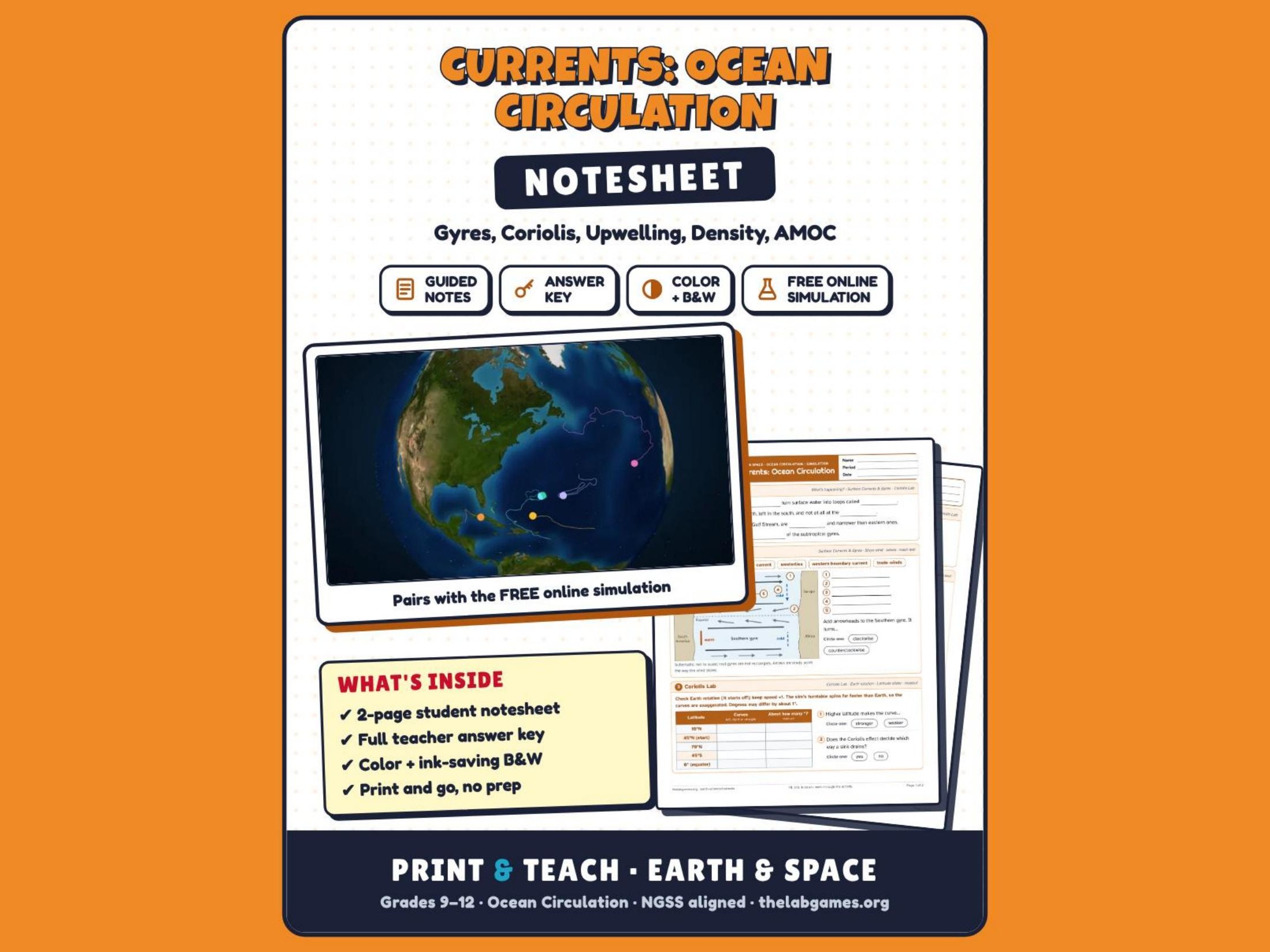
Students see what drives the ocean’s currents, from wind-driven surface gyres to the thousand-year global conveyor belt. In this roomy, student-friendly 2-page simulation notesheet, they fill in the background on gyres, the Coriolis effect, western boundary currents and garbage patches, label wind belts, boundary currents and a garbage patch on a schematic ocean basin, and draw which way the Southern Hemisphere gyre turns. They record how far a launched water parcel curves at different latitudes in a Coriolis turntable lab. On page 2 they find which layer real water masses settle in, show Ekman transport on a map of the California coast, explain upwelling at Peru and the effect of El Niño, and trace deep-water formation, the conveyor’s timescale, and how Greenland meltwater can weaken the AMOC. A marked AP Environmental Science block covers the Coriolis parameter and Sverdrup units.
It pairs with Currents: Ocean Circulation, a free online simulation at thelabgames.org built on real ocean current, wind, temperature and salinity data. Use it in class, for absent-student makeups, or on sub days. A complete teacher key is included.
What’s Included
- Student notesheet (2 pages) in full color AND black & white
- Teacher answer key (red answers) in full color AND black & white
What Students Do
- Background fill-in: winds, friction and the Coriolis effect make gyres; no deflection at the equator; fast western boundary currents; trash in gyre centers
- Gyres in One Ocean Basin: label the westerlies, trade winds, western and eastern boundary currents and a garbage patch, then add arrowheads to the Southern gyre
- Coriolis Lab: which way and about how many degrees a parcel curves at 10°N, 45°N, 70°N, 45°S and the equator, and whether the Coriolis effect drains sinks
- Density Lab: the layer each real water-mass preset settles in, and how fresh meltwater and extra salt change density
- Upwelling & El Niño: draw Ekman transport at California, find Peru’s upwelling wind, and predict El Niño’s effect on fish
- Conveyor Belt & the AMOC: where deep water forms, how long one loop takes, the meltwater level that drops the AMOC below 12 Sv, its slow recovery, and heat for NW Europe
- AP Environmental Science: the Coriolis parameter f = 2Ω sin φ and the AMOC’s transport in Sverdrups
Skills & Standards
- Surface currents, subtropical gyres, westerlies and trade winds, Coriolis effect and latitude, western boundary intensification, garbage patches, seawater density, temperature and salinity, water masses, Ekman transport, coastal upwelling, El Niño, thermohaline circulation, global conveyor belt, deep-water formation, AMOC, meltwater and climate
- Supports NGSS MS-ESS2-6, HS-ESS2-4, HS-ESS2-2
- Grades 9–12 Earth and Space Science, with an AP Environmental Science extension
Great For
- Ocean circulation and climate units
- Absent-student makeups
- Sub plans
- Computer lab days
- Test review
Something went wrong, please try again later.
This resource hasn't been reviewed yet
To ensure quality for our reviews, only customers who have downloaded this resource can review it
Report this resourceto let us know if it violates our terms and conditions.
Our customer service team will review your report and will be in touch.
$0.00