


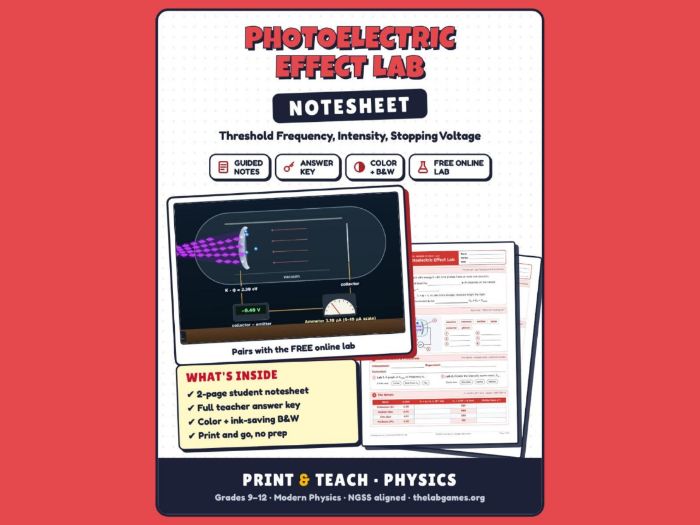
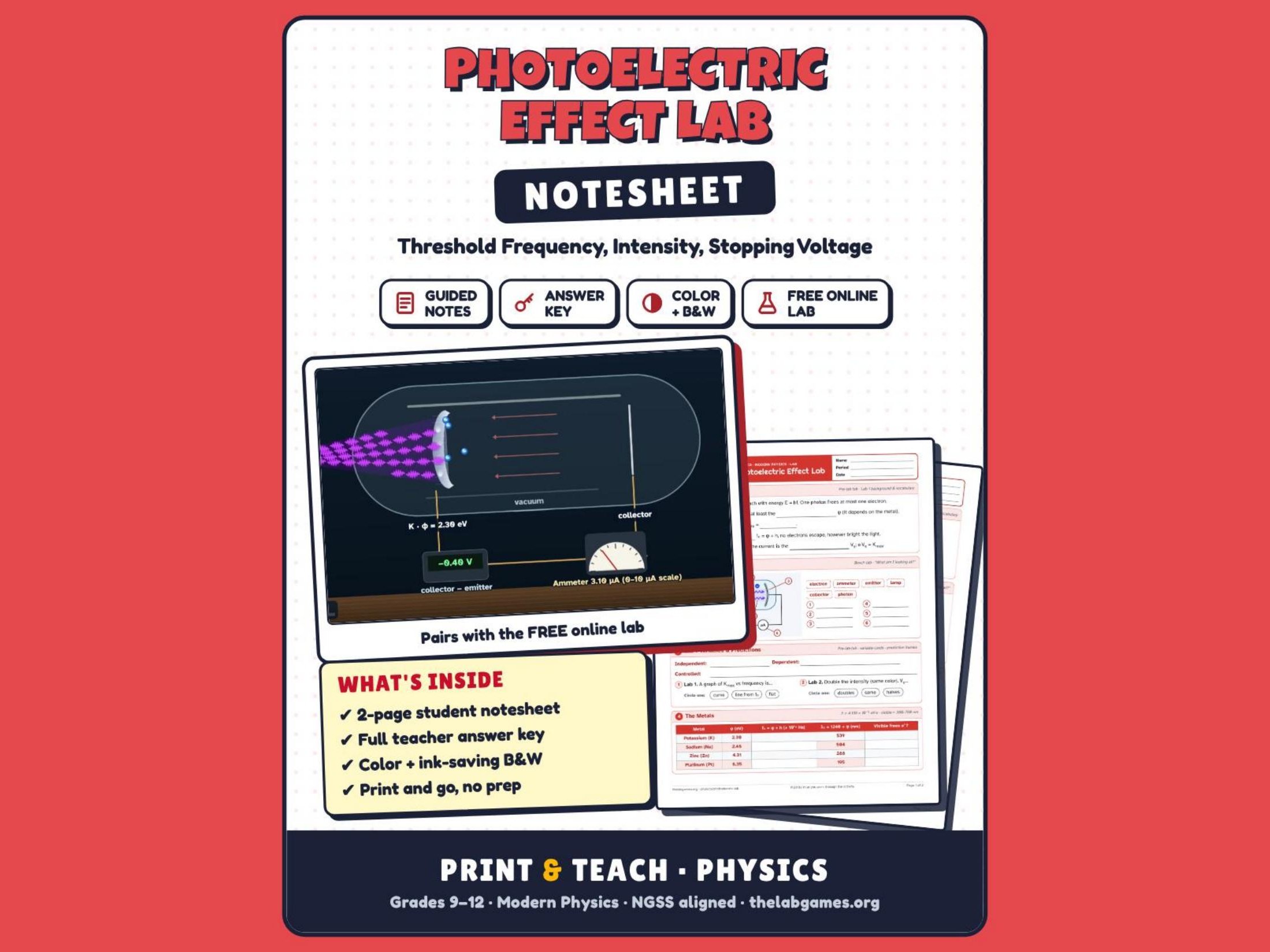
Students find out what really frees electrons from a metal: the color (frequency) of the light, not its brightness. This roomy, student-friendly 2-page notesheet has students label a photocell bench, set up variables and predictions, compare five metals’ work functions and threshold frequencies, record and graph maximum kinetic energy against frequency, test brighter light and reverse voltages, and write a claim, evidence and reasoning conclusion.
It pairs with the Photoelectric Effect Lab, a free online lab at thelabgames.org where students tune light from infrared to ultraviolet on five metals, find the threshold, and see that brighter light frees more electrons but not faster ones. Use it in class, for absent-student makeups, or on sub days. A complete teacher key with every value worked out is included.
What’s Included
- Student notesheet (2 pages) in full color AND black & white
- Teacher answer key (red answers) in full color AND black & white
What Students Do
- Background fill-in: photons, the work function, Kmax = hf − φ, the threshold frequency and the stopping voltage
- The Bench: label the lamp, photon, emitter, electron, collector and ammeter on the photocell circuit
- Lab 1 Variables & Predictions: independent, dependent and controlled variables, plus predictions for the Kmax graph and brighter light
- The Metals: threshold frequencies for potassium, sodium, zinc and platinum, and which ones visible light can free electrons from
- Lab 1 Data: a frequency table and a Kmax vs frequency graph for sodium that shows the threshold
- Labs 2 and 3 Data: saturation current and stopping voltage at four intensities (one below threshold), and current at four collector voltages
- Analysis: what doubling intensity changes, the stopping voltage from Lab 3, and an AP box that gets Planck’s constant and −φ from the graph
- Claim · Evidence · Reasoning: how maximum electron energy varies with frequency
Skills & Standards
- Photoelectric effect, photon energy E = hf, work function, threshold frequency, maximum kinetic energy, stopping voltage, photocurrent and saturation current, intensity vs frequency, particle model of light
- Supports NGSS HS-PS4-3
- AP Physics 2 box marked AP
- Grades 9–12 Physics and Chemistry
Great For
- Modern physics, quantum and atomic structure units
- Absent-student makeups
- Sub plans
- Lab write-ups
- Test review
Something went wrong, please try again later.
This resource hasn't been reviewed yet
To ensure quality for our reviews, only customers who have downloaded this resource can review it
Report this resourceto let us know if it violates our terms and conditions.
Our customer service team will review your report and will be in touch.
$0.00