


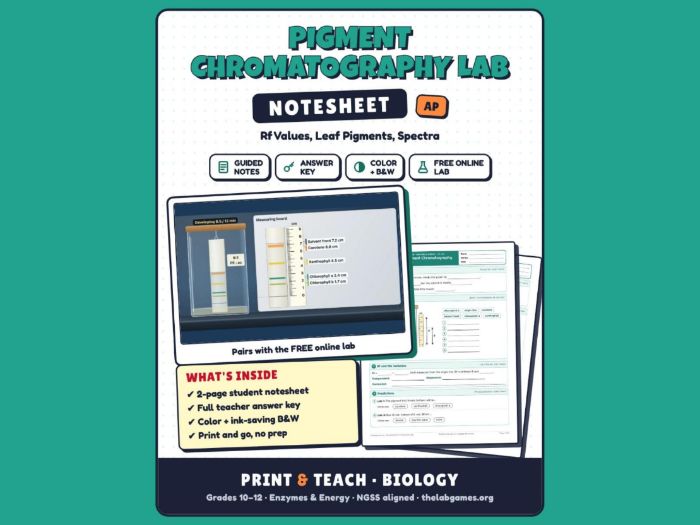
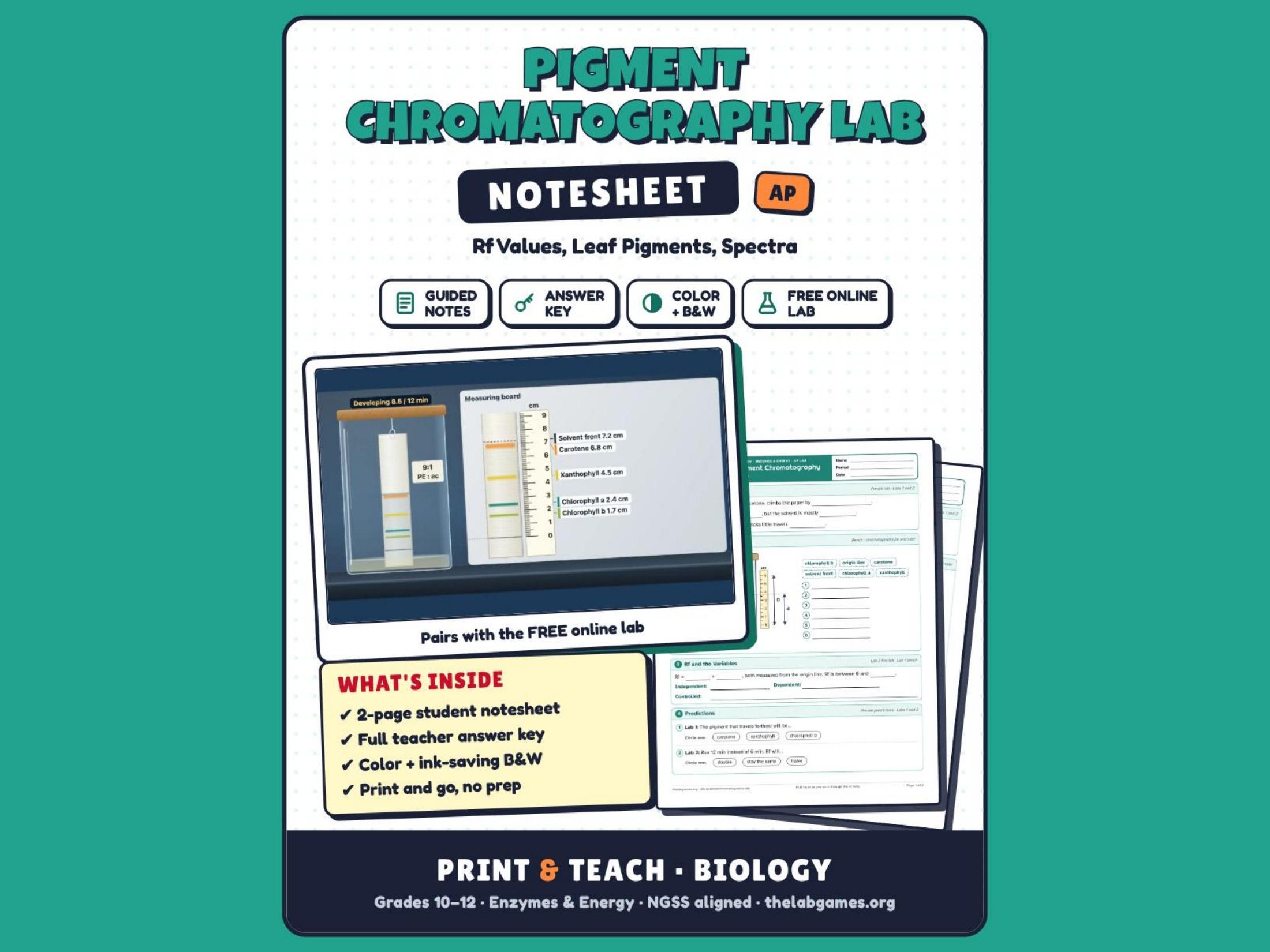
Separate the pigments in a spinach leaf and find out which colors of light they absorb. In this roomy, student-friendly 2-page AP lab notesheet, students fill in the background on capillary action and the polar paper versus the mostly nonpolar solvent, label a developed paper strip (solvent front, carotene, xanthophyll, chlorophyll a, chlorophyll b and origin line), write the Rf equation, name the variables and make predictions. On page 2 they record band distances for three development times, calculate Rf values and see that they stay the same, read the blue and red absorption peaks of each pigment, explain why leaves look green, and write a claim, evidence and reasoning.
It pairs with the Pigment Chromatography Lab, a free online lab at thelabgames.org where students develop paper strips in 9:1 petroleum ether : acetone, measure bands with a ruler hairline and scan each pigment in a spectrophotometer. Use it in class, for absent-student makeups, or on sub days. A complete teacher key is included.
What’s Included
- Student notesheet (2 pages) in full color AND black & white
- Teacher answer key (red answers) in full color AND black & white
What Students Do
- Background fill-in: capillary action, polar paper and a mostly nonpolar solvent, and which pigment travels farthest
- A Developed Strip: label the solvent front, four pigment bands and the origin line on a drawn-to-scale strip with a ruler and distance arrows
- Rf and the Variables: Rf = pigment distance ÷ solvent-front distance, plus independent, dependent and controlled variables
- Predictions: which pigment travels farthest, and whether Rf changes with development time
- Labs 1 & 2 Data: solvent-front and band distances at 4, 8 and 12 minutes, and Rf values for two strips
- Lab 3 Data: blue and red absorption peaks of carotene, xanthophyll and chlorophylls a and b, and why leaves look green
- Claim, Evidence, Reasoning for “Why do the pigments travel different distances up the paper?”
Skills & Standards
- Paper chromatography, mobile and stationary phases, polarity, capillary action, retention factor (Rf), solvent front, photosynthetic pigments, carotenoids and chlorophylls, absorption spectra, wavelength, why leaves are green
- Supports NGSS HS-LS1-5, HS-PS1-3
- Grades 10–12 AP Biology
Great For
- Photosynthesis units
- AP lab prep or a lab alternative
- Absent-student makeups
- Sub plans
- AP exam review
Something went wrong, please try again later.
This resource hasn't been reviewed yet
To ensure quality for our reviews, only customers who have downloaded this resource can review it
Report this resourceto let us know if it violates our terms and conditions.
Our customer service team will review your report and will be in touch.
$0.00