


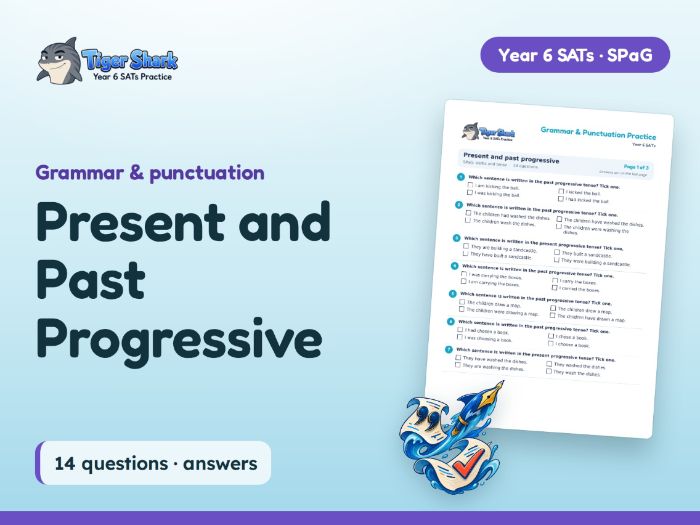
Year 6 SPaG worksheet on present and past progressive: 14 SATs-style questions with answers. Free printable PDF.
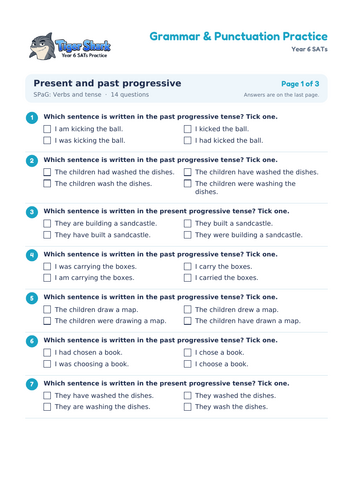
3-page A4 PDF from the Tiger Shark Education question bank (Verbs and tense): two pages of questions (tick one) and an answer page. Example questions: Which sentence is written in the past progressive tense? Tick one. / Which sentence is written in the past progressive tense? Tick one.
What is the progressive tense? The progressive (or continuous) form shows an action that is ongoing. The present progressive uses am, is or are plus an -ing verb (They are playing). The past progressive uses was or were plus an -ing verb (They were playing when it rained). It is often used to show an action interrupted by another.
Common mistakes and tips: Children commonly use was with plural subjects (we was playing) or forget the helping verb altogether (They playing). Others confuse the progressive with the present perfect. Point out the two parts every progressive verb needs: a form of be and an -ing verb. Checking subject–verb agreement fixes most errors.
Quick example to try: draw a timeline with a long bar for ‘reading’ and a short mark for ‘the doorbell rang’. Ask pupils to write the sentence that matches it: I was reading when the doorbell rang. Then swap in plural subjects and check they use were rather than was.
In the KS2 SATs, grammar and punctuation are tested in a separate paper of around 50 short questions, and this topic regularly appears. The questions on this sheet use the same styles as the test (circle, tick, underline, insert), so children practise the format as well as the knowledge.
Teaching ideas: model the first two questions together and talk through the reasoning, then let children complete the rest independently. Use the answers to group pupils for a follow-up session. For extra challenge, ask children to explain their answers in a full sentence using the correct grammatical terms.
Supporting all learners: for children who find grammar difficult, read the questions aloud and work through the first few together before they continue alone. Colour-coding word classes or clauses on mini whiteboards makes abstract ideas more concrete, and sorting word cards or building sentences from strips helps too. More confident pupils can write their own test-style questions for a partner, with the answers and a short explanation. Once each topic is secure, mix it with others, because the real test does not group questions by topic and pupils need to recognise what each question is asking them to do.
Something went wrong, please try again later.
This resource hasn't been reviewed yet
To ensure quality for our reviews, only customers who have downloaded this resource can review it
Report this resourceto let us know if it violates our terms and conditions.
Our customer service team will review your report and will be in touch.
£0.00