


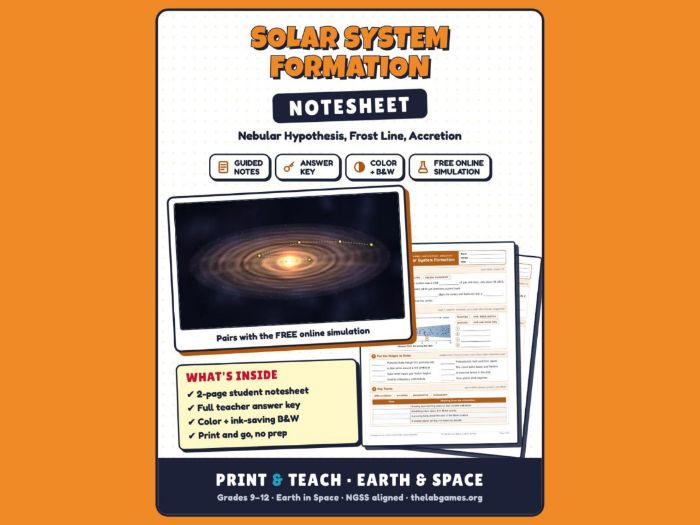
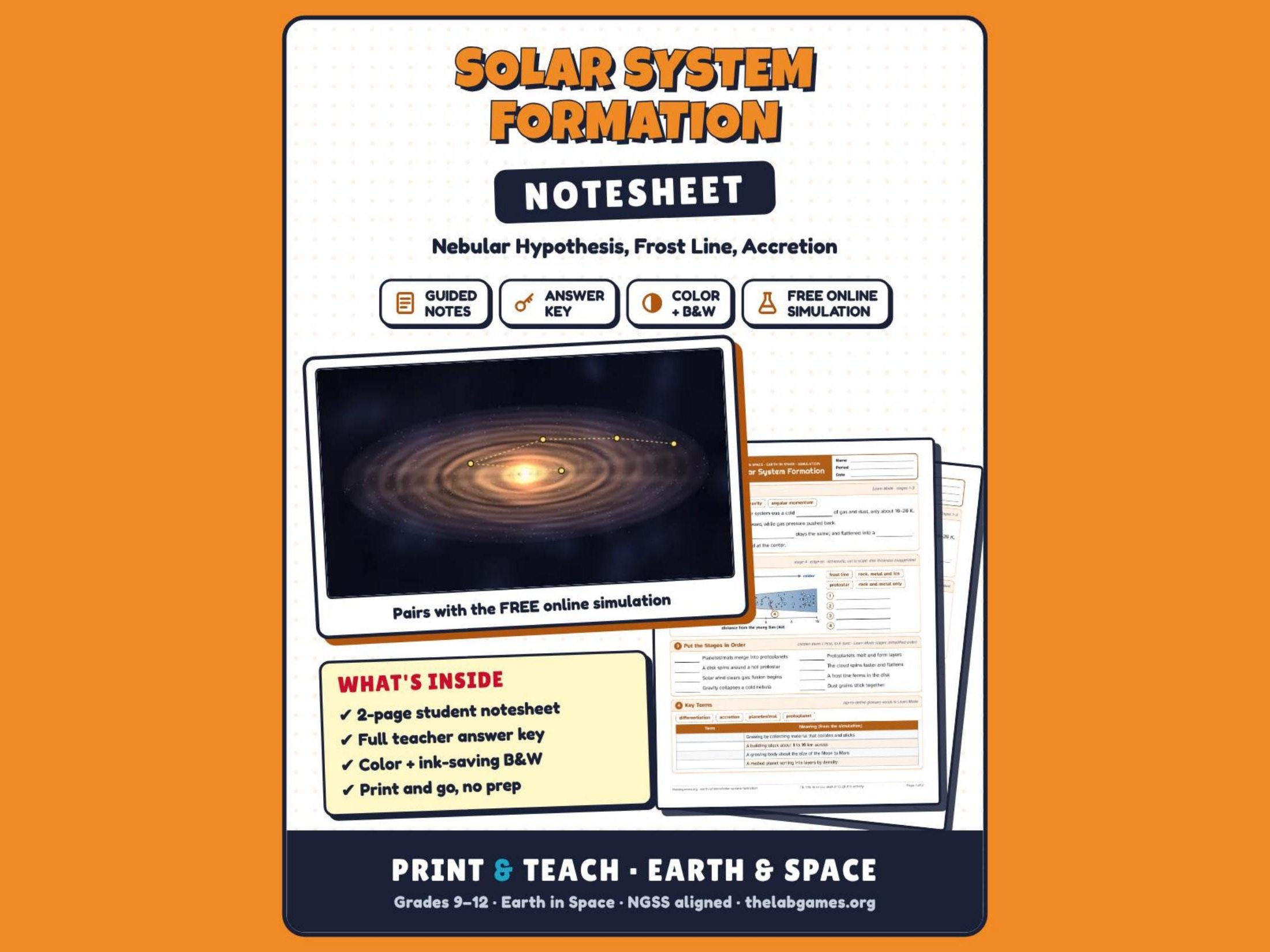
Walk students through how a cold cloud of gas and dust became the Sun and planets. In this roomy, student-friendly 2-page notesheet, students fill in the background on nebular collapse, gravity, angular momentum and the protoplanetary disk, label an edge-on disk with its protostar, frost line and the rocky and icy zones, put the eight stages of formation in order, and match key terms such as accretion, planetesimal, protoplanet and differentiation. On page 2 they probe the young disk’s temperature to find the frost line, build solar systems from small, Sun-sized and giant clouds and compare the stars they make, predict what happens when the simulation’s controls change, and explain why rocky planets formed close to the Sun and giant planets farther out.
It pairs with Solar System Formation, a free online simulation at thelabgames.org where students watch a nebula collapse into a spinning disk, grow dust into planets, ignite the Sun, build their own solar systems and then take a test. Use it in class, for absent-student makeups, or on sub days. A complete teacher key is included.
What’s Included
- Student notesheet (2 pages) in full color AND black & white
- Teacher answer key (red answers) in full color AND black & white
What Students Do
- Background fill-in: a cold nebula, gravity, angular momentum, the flattening disk and the protostar
- The Protoplanetary Disk: label the protostar, the frost line, the rock-and-metal zone and the rock, metal and ice zone
- Put the Stages in Order: number the eight stages from collapse to the solar wind and fusion
- Key Terms: match accretion, planetesimal, protoplanet and differentiation to their meanings
- Find the Frost Line: read the disk temperature and which solids can form at five distances from the young Sun
- Build Your Own Solar System: record the star type, mass, lifetime and frost line made by three different clouds
- Predict It: angular momentum, collisions, melting and differentiation, and an earlier solar wind
- Explain It: why rocky planets formed close in and giant planets formed beyond the frost line
Skills & Standards
- Nebular hypothesis, gravitational collapse, conservation of angular momentum, protoplanetary disks, the frost (snow) line, condensation of rock, metal and ice, accretion, planetesimals and protoplanets, differentiation, the solar wind, hydrogen fusion, star mass and lifetime
- Supports NGSS MS-ESS1-2, HS-ESS1-6
- Grades 9–12 Earth and Space Science
Great For
- Earth in Space and astronomy units
- Origin of the solar system lessons
- Absent-student makeups
- Sub plans
- Test review
Something went wrong, please try again later.
This resource hasn't been reviewed yet
To ensure quality for our reviews, only customers who have downloaded this resource can review it
Report this resourceto let us know if it violates our terms and conditions.
Our customer service team will review your report and will be in touch.
$0.00