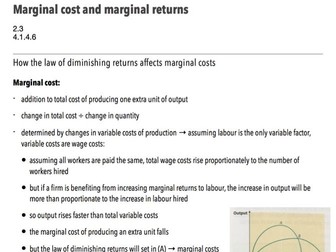
Clear, bullet point revision resource on Marginal Cost and Marginal Returns.
Looks at the relationship between marginal cost, average cost, marginal returns and average returns.
Brilliant resource for Year 12 and 13 A-Level Economics students.
Ideal for AQA specification but relevant to most economics courses.
Year 2 Economics.
Save time with these ready-made revision notes.
Perfect to revise from, featuring diagrams and information from AQA and GCP revision guides.
This is a comprehensive unit to teach and review Consumer Behaviour in Economics. Including concepts such as Consumer rational, Law of Diminishing Marginal Utility and the Equi-Marginal Principle.
Includes:
PowerPoint presentation- (31 Slides) A detailed self guided PowerPoint presentation. It is non-editable.
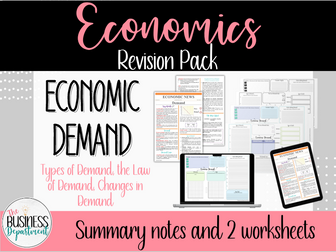
Summary Notes- Engaging summary notes to help students with understanding the Economics topic and revision. The product is created to look like a newspaper article with different sections. It includes keywords, easy to read bullet points, infographics and images.
Worksheet 1: Two page worksheet for revision of the theory behind consumer behaviour, the LDMU and the Equi-marginal principle. It has prompts and spaces to encourage the students to complete their own revision notes.
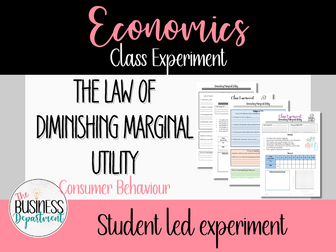
Worksheet 2: Two page class experiment to help introduce or revise the Law of Diminishing Marginal Utility. This involves student participation in various roles to create their own data table and graph. Students will need to analyse the information and form their own conclusions.
Worksheet 3: Three page worksheet to check student understanding of the Equi-Marginal Principle. Includes a definition question and 9 different scenarios. Students will read each scenario, complete the calculations and answer extra theory questions where relevant. Answer key included.
These are very popular with my senior/ Leaving Certificate students.
A quick and simple way of getting children to plan their writing and then use the plan when writing.
If like me, you find children in your class often write in sentences and often at length when planning. And if like me, you find that the children don’t look at their plan once they have written it and their writing does not then resemble anything in their plan. These resources will transfer your planning and writing lessons.
A child is given a strip which is stuck in place of the margin. They write in each box their ideas. As each box is only small, the children are encouraged to write notes.
When the children come to write the piece of writing they on the lines next to the each box so there is no need for the children to flip back between pages. Each paragraph then contains the information they planned for.
Text Types
This resource contains planning margins for the following types of writing:
Diaries,
Discussion texts,
Explanations,
Monologues,
Newspaper Articles.
Designed for Cambridge International curriculum, this comprehensive 12-page resource is ideal for students aged 14-16 and 16+. Crafted by an experienced teacher with 18 years of teaching accounting, it covers the entire syllabus for AS & AL 9706 Accounting, focusing on marginal costing. This ready-made, printable resource includes detailed teacher notes and student handouts, ensuring an efficient and effective teaching experience. Teachers will appreciate the structured content and ease of use, while students benefit from clear explanations and practical examples. Enhance your classroom with this expertly created, syllabus-aligned resource.
This PowerPoint revision booklet contains clear, concise revision slides for the AQA GCSE Geography Natural Hazard topic.
The booklet is designed for effective exam revision, with each slide focusing on one key concept from the specification.
SLIDES ARE FORMATTED FOR A4 FOR EASY PRINTING
Slides use:
Short, exam-focused bullet points
Clearly labelled diagrams
Highlighted key terms and processes
Simple cause-and-effect explanations
This layout supports independent study, retrieval practice, and last-minute revision, making it suitable for in-class revision, homework, or intervention groups.
Included topics:
Tectonic Plate Theory
Distribution of Volcanoes and Earthquakes
Types of Plate Margins
Earthquake Example: NEPAL AND NEW ZEALAND
Reasons why people live in areas of Tectonic hazards
Management to reduce effects of tectonic hazards
Suitable for:
AQA GCSE Geography
Year 9–11 students
Revision lessons, homework, and exam preparation
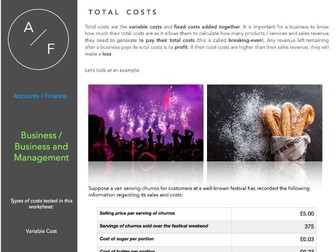
This worksheet contains revision notes and activities on how to calculate fixed costs, variable costs, total costs, average costs, marginal costs, direct costs and indirect costs)
All answers are included
The worksheet is colourful and creative throughout
This worksheet contains 7 pages of activities and took my students between 30 - 45 minutes to complete
Can be given as classwork / homework / revision
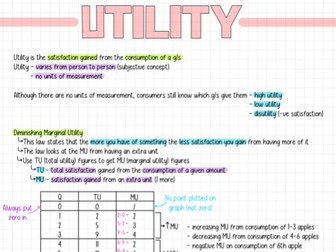
Complete CCEA A Level Economics notes on utility with definitions, explanations and diagrams
Details include:
Diminishing marginal utility
Marginal utility
AQA A-level chemistry unit 3.1.15 Amount of Substance - Lesson or Revision workbook with answers
This workbook covers a whole unit of work combining detailed information sections with Cornell Style notetaking so the books can be used while you teach and students can add their own notes and ideas down the margin.
Colour is used for the different types of sections to make the booklet more dyslexia friendly as I have found that chemistry notes and questions can often be very dense, and somewhat inaccessible for all students but particularly those who have dyslexia.
The booklet can also be produced as a revision guide for the topic and contains all the notes and practice past paper questions you would need to revise along with worked examples. Parent and student friendly containing answers to all questions.
This booklet is 34 pages long with answers to past paper questions provided at the back from page 27 onwards. It is provided in word and pdf.
Contents
How NMR works
The NMR spectrum
Interpreting 13C NMR spectra
Interpreting 1H NMR spectra
Explanation of spin coupling and multiplicity
Combining techniques
FREE | Summary notes for revision of Introduction to Economics.
• Engaging way for students to learn and revise the topic.
• Full colour pages in the form of a Newspaper article.
• Includes keywords, easy to follow bullet points, infographics and images.
These are very popular with my senior/ Leaving Certificate students. If you like this product please leave a review.
You may also be interested in:
Intro to Accounting | Complete Unit |Theory of concepts, bases & policies
Introduction to Accounting | True or False? worksheet | EDITABLE
Introduction to Accounting | Key definition worksheet | EDITABLE
Economics Revision | Strand 1 BUNDLE | Intro, Scarcity & Choice, Sustainability
Intro to Economics | Complete Unit | Scarcity, choice, opportunity cost | Basic Economic Problem
Economics | Complete Unit Market Equilibrium | Supply and Demand
Economics | Complete Unit |Consumer | Diminishing Marginal Utility | Equi-Marginal Principle |
Economics | Student experiment | Law of Diminishing Marginal Utility | Consumer
Business Revision | Unit 1 BUNDLE | People in Business, Contracts and Conflict |
Business Revision | Contract Law |
Business Revision | Industrial / Workplace Conflict | Industrial Relations |
Other Economics, Business and Accounting resources available in my store.
Comprehensive 17-page Revision Guide covering:
Supply & Demand
Excess Supply and Excess Demand
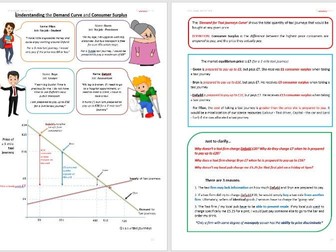
Producer Surplus and Consumer Surplus
The Income Effect, Substitution Effect and The Law of Diminishing Marginal Utility
Wonderfully colourful, superbly laid out, accessible diagrams and easy-to-understand explanations.
Chapter finishes with key terms / definitions.
This is a Powerpoint (and accompanying Notes/Key Terms sheet) that I created for my own teaching of the new (linear) AQA A-level Economics specification (7135). As I was also using the AQA-approved textbook (Powell & Powell, 2016) the two follow a similar route through the material.
Topics covered in this Powerpoint:
4.1.8.3 Public goods, private goods and quasi-public goods
• Pure public goods are non-rival and non-excludable and recognition of the significance of these characteristics.
• The difference between a public good and a private good.
• Circumstances when a public good may take on some of the characteristics of a private good and become a quasi-public good.
• The significance of technological change, eg. television broadcasting is now excludable.
• The free-rider problem.
• The tragedy of the commons
4.1.8.4 Positive and negative externalities in consumption and production
• Externalities exist when there is a divergence between private and social costs and benefits.
• Why negative externalities are likely to result in over-production and that positive externalities are likely to result in underproduction.
• Why the absence of property rights leads to externalities in both production and consumption and hence market failure.
• Students should be able to illustrate the misallocation of resources resulting from externalities in both production and consumption, using diagrams showing marginal private and social cost and benefit curves.
4.1.8.5 Merit and demerit goods
• The classification of merit and demerit goods depends upon a value judgement.
• Such products may be subject to positive and negative externalities in consumption.
• How under-provision of merit goods and over-provision of demerit goods may also result from imperfect information.
• Students should be able to illustrate the misallocation of resources resulting from the consumption of merit and demerit goods using diagrams showing marginal private and social cost and benefit curves.
• It should be understood that not all products that result in positive or negative externalities in consumption are either merit or demerit goods.
As well as the usual Key Terms sheet, there is a pre-lesson task so that students have looked over their Year 1/AS-level notes related to this topic.
An engaging student experiment in the form of a two page Worksheet to help students with understanding and/or revision of the Law of Diminishing Marginal Utility (LDMU)
This contains:
The students will complete an experiment individually or as a group and record the results. These results will be shown in a table and graph format.
The students will have to analyse the results and try and come to an agreed definition of the LDMU.
The worksheet helps students engage with the LDMU. It has prompts and spaces to encourage the students to complete their own revision notes.
You can PRINT the worksheet or send to students.
Colour and BW versions
This student activity is always very popular with my senior/ Leaving Certificate students.
These can be PRINTED out or sent to students to use on a DIGITAL device.
You may also be interested in:
Intro to Accounting | Complete Unit |Theory of concepts, bases & policies
Introduction to Accounting | True or False? worksheet | EDITABLE
Introduction to Accounting | Key definition worksheet | EDITABLE
Economics Revision | Strand 1 BUNDLE | Intro, Scarcity & Choice, Sustainability
Intro to Economics | Complete Unit | Scarcity, choice, opportunity cost | Basic Economic Problem
Economics | Complete Unit Market Equilibrium | Supply and Demand
Economics | Complete Unit |Consumer | Diminishing Marginal Utility | Equi-Marginal Principle |
Business Revision | Unit 1 BUNDLE | People in Business, Contracts and Conflict |
Business Revision | Contract Law |
Business Revision | Industrial / Workplace Conflict | Industrial Relations |
Other Economics, Business and Accounting resources available in my store.
Easy to follow PowerPoint Presentation (in a print friendly format), perfect for GCSE, A-Level and first year university students.
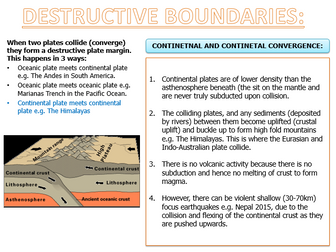
Includes notes on CONSTRUCTIVE, CONSERVATIVE AND DESTRUCTIVE plate margins, with DETAILED EXPLANATIONS ON ASSOCIATED LANDFORMS. Landforms include: fold mountains, island arcs, volcanic eruptions, mid-ocean ridges, sub-marine volcanoes and rift valleys. Examples of each landform are included too.
Each landform is provided a slide, with diagrams, step by step explanations and geographical key words. GREAT AS A REVISION RESOURCE FOR EXAM QUESTIONS.
University - Management Accounting - Revision Notes & Questions
274 pages
Ideal for students
Ideal for teachers and private tutors
Questions & Answers throughout
Exam style questions and illustrative answers
Direct costs
Indirect costs
Overheads
Product costs
Period costs
FIxed costs
Variable costs
Stepped fixed costs
Semi-variable costs
Opportunity costs
Sunk costs
Cost-Volume-Profit analysis
Contribution
Break even point
Sensitivity analysis
Contribution margin
Target sales
Margin of safety
Operating leverage
Special price decisions
Make or buy decisions
Limiting factors
Product costing
Standard costs
Absorption costing
Apportionment
Overhead rates
Under absorption
Over absorption
Marginal costing
Activity based costing
Price elasticity
Cost plus pricing
Target costing
Planning and budgetary control frameworks
Sales budget
Production budget
Purchases budget
Labour budget
Cash budget
Zero based budgeting
Activity based budgeting
Responsibility centres
Cost centres
Revenue centres
Profit centres
Investment centres
Variance analysis - materials (price and usage), labour (rate and efficiency), fixed production overhead, variable production overhead, sales, market share, market size
Flexed budgeting
Summary Notes
Engaging summary Notes to help students with understanding the topic and revision.
The product is created to look like a newspaper article with different sections. It includes keywords, easy to read bullet points, infographics and images.
It is a summary of the topic and as such is only an overview of the main contexts.
Worksheets x2
Activity to embed and review the theory and concepts.
Prompts and spaces to encourage the students to complete their own revision notes.
PRINTABLE and FILLABLE PDF included.
Colour/Black and White versions available for the worksheet.
These are very popular with my senior / Leaving Certificate students.
You may also be interested in:
Intro to Accounting | Complete Unit |Theory of concepts, bases & policies
Introduction to Accounting | True or False? worksheet | EDITABLE
Introduction to Accounting | Key definition worksheet | EDITABLE
Economics Revision | Strand 1 BUNDLE | Intro, Scarcity & Choice, Sustainability
Intro to Economics | Complete Unit | Scarcity, choice, opportunity cost | Basic Economic Problem
Economics | Complete Unit Market Equilibrium | Supply and Demand
Economics | Complete Unit |Consumer | Diminishing Marginal Utility | Equi-Marginal Principle |
Economics | Student experiment | Law of Diminishing Marginal Utility | Consumer
Business Revision | Unit 1 BUNDLE | People in Business, Contracts and Conflict |
Business Revision | Contract Law |
Business Revision | Industrial / Workplace Conflict | Industrial Relations |
Other Economics, Business and Accounting resources available in my store.
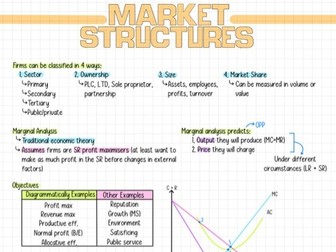
Complete CCEA A Level Economics notes on market structures with definitions, explanations and diagrams
Details include:
-objectives
-profit
-total, marginal + average revenue
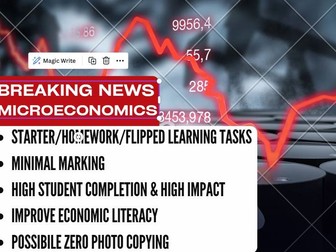
As a practising Economics teacher, I used this in my lesson as a ‘flipped learning’ resource. Students respond really well to them, and it has upped my homework completion ratio massively! It works equally well as a generic homework activity, a revision tool or a starter activity, however. Student feedback is very positive.
The four-page A4 worksheets can be used to introduce a particular topic.
Essentially I distribute the forthcoming task sheet and set as a homework, or just allow reading time as a starter of a lesson. I expect students to have read the text, read the key words and at least attempted the questions before the lesson. We then discuss the text and responses at the start of the lesson, before covering the topic in detail.
I really find them useful as they are excellent and easy homework tasks with limited marking - as marking takes place as the starter of the next lesson. If you prefer not to print them, you can distribute via Teams or even on OneNote (which is what I do), do reduce photocopying. Of course printing is an option, too.
The format of the worksheet is broadly: A thought provoking image, related to the topic in question. This can be used for discussion; a side of text, covering the key elements of the topic; for literacy purposes, definitions of three to five of the key terms featured in the text; Three multiple- choice questions which are generally pretty easy if the student has read the text; approximately three short answer questions; approximately two longer answer questions, open for discussion in the lesson.
These have been written specifically for Edexcel A-Level Economics, but they would work equally well for other exam boards, no problem at all.
One of my series of revision notes for the new AS and A Level AQA Business Studies course. Additional notes are available upon request and feedback will be much appreciated.


 Quick View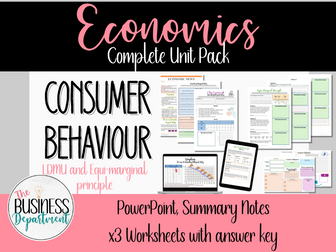
![[NOTES] Natural Hazards - AQA Geography](https://l.imgt.es/resource-preview-imgs/37a85a7f-b6c4-455e-9eda-55405243aae2%2FScreenshot20260201210940.crop_947x711_34%2C0.preview.png?profile=res-img-med-legacy-v2)