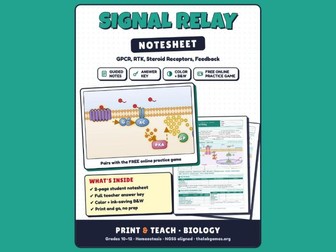
Cell Signaling Pathways Notesheet | GPCR, RTK, Steroid Receptors, Feedback + KeyQuick View
Thelabgames

Cell Signaling Pathways Notesheet | GPCR, RTK, Steroid Receptors, Feedback + Key

(0)
Students learn how a signal gets from a receptor to a response along three routes: epinephrine through a G protein-coupled receptor, cAMP and kinases to glycogen breakdown; a growth factor through a receptor tyrosine kinase and a kinase relay to transcription; and a steroid hormone that crosses the membrane and binds an intracellular receptor. They label a detailed three-route cell diagram, wire each route, predict which stages still work after a mutation or drug, count amplification events, and classify insulin, glucagon and oxytocin feedback loops. This 2-page notesheet pairs with Signal Relay, a free online practice game at thelabgames.org where students repair cell-communication pathways on a lab bench. It works for class, homework, makeups and sub days. What’s Included Student notesheet (2 pages) in full color AND black & white Teacher answer key (red answers) in full color AND black & white What Students Do Complete fill-in background notes on ligands, receptors, signal transduction, second messengers, intracellular receptors, amplification and feedback Label a three-route cell diagram (A–M): GPCR, G protein, adenylyl cyclase, cAMP, PKA, RTK dimer, phosphate groups, steroid hormone, intracellular receptor, nucleus and more Fill in a route table matching each ligand to its receptor, receptor location, relay and response, and finish a worked example Predict receptor, relay and response states for five interventions, and fill in a feedback table for insulin, glucagon and oxytocin Solve eight practice orders: two pathway tickets, three intervention reports, an amplification log and two feedback cases Review the most common mistakes as fill-in key ideas and log their game runs Skills & Standards Cell communication, reception, transduction and response, second messengers, phosphorylation cascades, amplification, phosphatases, negative and positive feedback Tracing upstream and downstream effects of mutations; multiplying stage gains Supports NGSS HS-LS1-2, HS-LS1-3 Grades 10–12 AP Biology Great For AP Biology Unit 4 (cell communication) notes Homework or stations alongside the online game Absent-student makeups Sub plans AP exam review
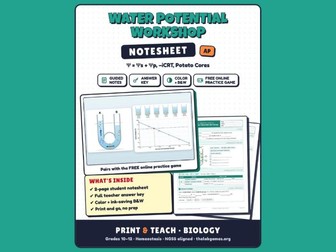
Water Potential Workshop Notesheet | Ψ = Ψs + Ψp, −iCRT, Potato Cores + KeyQuick View
Thelabgames

Water Potential Workshop Notesheet | Ψ = Ψs + Ψp, −iCRT, Potato Cores + Key

(0)
Make water potential calculations routine. In this roomy, student-friendly 2-page AP practice notesheet, students fill in the background on which way water moves, pure water at Ψ = 0 and turgor pressure, label a U-tube (selectively permeable membrane, ions from NaCl, sucrose molecules and water), complete the equations Ψ = Ψs + Ψp and Ψs = −iCRT with the ionization constants and kelvin conversion, and finish a worked U-tube example. On page 2 they solve four orders from the activity: a sucrose U-tube, a salt U-tube where forgetting i flips the answer, a plant cell with turgor pressure, and a potato core graph whose x-intercept gives the isotonic molarity and the cells’ water potential. It pairs with Water Potential Workshop, a free online practice game at thelabgames.org where students calculate water potential for U-tubes, plant cells and potato cores and predict which way water moves. Use it in class, for absent-student makeups, or on sub days. A complete teacher key is included. What’s Included Student notesheet (2 pages) in full color AND black & white Teacher answer key (red answers) in full color AND black & white What Students Do Background fill-in: water moves from higher to lower Ψ, pure water has Ψ = 0, solutes lower Ψ, and turgor pressure is a positive Ψp Inside the U-Tube: label the selectively permeable membrane, an ion, a sucrose molecule and a water molecule The Equations: Ψ = Ψs + Ψp, Ψs = −iCRT, ionization constants for sucrose, NaCl and CaCl₂, R = 0.0831 L·bar/(mol·K) and T in kelvin Worked Example: water potential of 0.30 M NaCl at 22 °C and which way water moves across the membrane Osmosis Bench Orders: two U-tubes, a plant cell with turgor pressure, and a potato core x-intercept problem with work space Key Ideas and My Runs: direction of water movement, the effect of i, and a log for tracking practice scores Skills & Standards Water potential, solute potential, pressure potential, turgor pressure, ionization constant, osmosis, tonicity, isotonic point, x-intercept of a best-fit line, kelvin conversion, units of pressure (bar, MPa) Supports NGSS HS-LS1-3 Grades 10–12 AP Biology (Unit 2 cell structure and function, water potential) Great For Membrane transport and osmosis units AP math skills practice Absent-student makeups Sub plans AP exam review
Elodea Photosynthesis Lab Notesheet | Light Intensity, Wavelength + KeyQuick View
Thelabgames

Elodea Photosynthesis Lab Notesheet | Light Intensity, Wavelength + Key

(0)
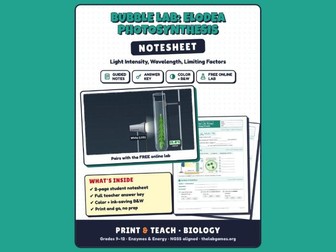
Students count oxygen bubbles from an Elodea sprig to measure the rate of photosynthesis. In this roomy, student-friendly 2-page lab notesheet they fill in the background on chlorophyll, splitting water, bicarbonate as the CO2 source and the inverse square law, label the bench and a chloroplast (thylakoids and stroma), and name the variables and make predictions. On page 2 they record three trials at five lamp distances, calculate relative light intensity, graph rate against distance, compare seven colors of light, look at light vs CO2 as limiting factors and the compensation point, and write a claim, evidence and reasoning. It pairs with the Bubble Lab: Elodea Photosynthesis, a free online lab at thelabgames.org. Use it in class, for absent-student makeups, or on sub days. A complete teacher key is included. What’s Included Student notesheet (2 pages) in full color AND black & white Teacher answer key (red answers) in full color AND black & white What Students Do Background fill-in: the photosynthesis equation, splitting water, what more bubbles means, bicarbonate as the CO2 supply, and the inverse square law The Bench and the Chloroplast: label the lamp, O2 bubbles, cut end of the stem, bicarbonate solution, thylakoids and stroma Variables & Predictions: independent, dependent and controlled variables for Guided 1, plus three circle-the-prediction questions Guided 1 Data: three trials at 10, 20, 30, 50 and 75 cm, relative light intensity (10 ÷ d)², averages and a rate-vs-distance graph Guided 2: average bubbles per minute for seven LED colors, the most and fewest, and why green is not zero Guided 3 (AP): bubble rates at 0.1 % and 1 % bicarbonate from 5 to 100 cm, what limits the rate, and where the bubbles stop Claim, Evidence, Reasoning for “How does lamp distance affect the rate of photosynthesis?” Skills & Standards Photosynthesis, light intensity and the inverse square law, wavelength and pigments, limiting factors, light compensation point, chloroplast structure, averaging trials, graphing Supports NGSS HS-LS1-5, HS-LS2-5, MS-LS1-6 AP Biology extension: limiting factors and the light compensation point Grades 9–12 Biology (with an AP Biology section) Great For Photosynthesis labs Absent-student makeups Sub plans Lab stations Test review
Organelles Notesheet | Cell Parts, Jobs & Cell Types + KeyQuick View
Thelabgames

Organelles Notesheet | Cell Parts, Jobs & Cell Types + Key

(0)
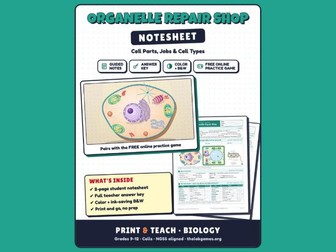
Students learn what each cell part does and which cells have it, then use that to fix “sick” cells. They label a detailed animal cell, plant cell and bacterium side by side (nucleus with its double envelope and pores, rough ER joined to the nucleus, Golgi stacks, mitochondria with cristae, chloroplasts with grana, central vacuole, cell wall, nucleoid, plasmids, flagellum), fill in a parts chart of jobs and cell types, and solve repair orders: read a symptom, name the broken part, and avoid the classic traps (plants need mitochondria too, bacteria have no mitochondria or nucleus, animal cells have no wall). An AP section covers the endomembrane path, endosymbiosis and compartmentalization. It pairs with the free online Organelle Repair Shop practice game at thelabgames.org, where students tap the broken part on a customer cell and swap in a working one. Good for class, makeups and sub days. What’s Included Student notesheet (2 pages) in full color AND black & white Teacher answer key (red answers) in full color AND black & white What Students Do Complete fill-in background notes on eukaryotes vs prokaryotes, membrane-bound organelles and ribosomes Name three cell types (animal, plant, prokaryote) on a drawn repair bench and find 16 labeled parts (A–P) Finish the game’s repair steps and a worked example (a cell that can’t ship proteins) Match each of 16 parts to its letter and job and mark which cell types have it Solve eight repair orders: two repairs, three trap orders, a secretion order, a name-the-part order and a cell-type order AP: fill in the export path from nucleus to membrane and solve pathway, endosymbiosis and compartmentalization orders Review common mistakes as fill-in key ideas and log their game runs Skills & Standards Organelle structure and function; plant vs animal vs prokaryotic cells; cell size The protein export path: ribosome, rough ER, Golgi, vesicles, cell membrane Supports NGSS HS-LS1-2 AP Biology extension: endomembrane system, endosymbiosis, compartmentalization Grades 9-12 Biology and AP Biology Great For Guided notes alongside the online game Absent-student makeups Sub plans Cell structure unit review Differentiation (General and AP sections)
Microscope Lab Notesheet | Parts, Wet Mounts, Magnification + KeyQuick View
Thelabgames

Microscope Lab Notesheet | Parts, Wet Mounts, Magnification + Key

(0)
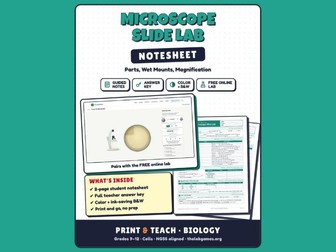
Students learn the parts of a compound light microscope, prepare wet-mount slides of a newsprint letter “e”, two crossed hairs, cheek cells stained with methylene blue and onion skin stained with iodine, and bring each one into focus at 4×, 10× and 40×. Along the way they work out total magnification, see why the field of view shrinks as power goes up, discover that the image is upside down and backwards, and compare plant and animal cells. This 2-page notesheet pairs with the free online Microscope Slide Lab at thelabgames.org. It works for class lab days, absent-student makeups and sub days. What’s Included Student notesheet (2 pages) in full color AND black & white Teacher answer key (red answers) in full color AND black & white What Students Do Complete fill-in background notes on total magnification, wet mounts, stains and the inverted image Name 14 lettered parts on a side-view microscope diagram (the lab’s 12 plus the body tube and revolving nosepiece) and complete each part’s job Put the wet-mount steps in order and record the stain for each specimen and what it shows Fill in a table of total magnification, field diameter, diaphragm setting and which focus knobs to use at 4×, 10× and 40× Sort variables as IV, DV or controlled and circle predictions Sketch the letter “e” at three powers and the hairs, cheek cells and onion cells, labelling what they see Record focus, diaphragm level, nucleus, cell wall, chloroplasts and cell shape for all four slides Answer questions on stage movement, the field of view and an onion-cell size estimate Answer analysis questions on the coarse knob, lighting, stains and chloroplasts, then write a claim, evidence and reasoning conclusion comparing plant and animal cells Skills & Standards Compound light microscope parts and care, total magnification, field of view, wet-mount slides, staining Plant vs animal cells: cell wall, nucleus, chloroplasts; estimating cell size from the field of view Grades 9–12 Biology (also works for middle school life science) Great For Lab days with the online Microscope Slide Lab Prep before a hands-on microscope lab Absent-student lab makeups Sub days Cells unit notes
Science Word Parts Notesheet | Prefixes, Roots, Suffixes, Cell Vocabulary + KeyQuick View
Thelabgames

Science Word Parts Notesheet | Prefixes, Roots, Suffixes, Cell Vocabulary + Key

(0)
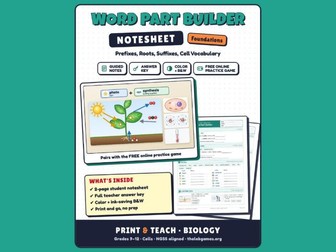
Help students crack long science words by their parts. This roomy, picture-first 2-page notesheet starts with a short fill-in on prefixes, roots and suffixes, works through thermo- + -meter step by step, and gives a picture Part Key where students fill in the meanings of eleven common parts (chloro-, bio-, poly-, mono-, astro-, -synthesis, -ase, -ose, -logy, -scope, -stasis). Two look-alike pairs (endo-/exo-, micro-/macro-) show how one part changes a word. On page 2 students build “cytoplasm” and “heterotroph” from part chips (one chip is extra), split “bacteriophage” and “hydrolysis” where the new part starts, and pick each word’s meaning. Every question has at most three choices. It pairs with Word Part Builder, a free online practice game at thelabgames.org where students snap prefixes, roots and suffixes into science words, pick the meaning, then split new words. Use it in class, for absent-student makeups, or on sub days. A complete teacher key is included. What’s Included Student notesheet (2 pages) in full color AND black & white Teacher answer key (red answers) in full color AND black & white What Students Do Background fill-in: prefix, root and suffix, and photo- + -synthesis Worked Example: thermo- (heat) + -meter (measuring tool) = a tool that measures temperature Part Key: write the meaning of eleven word parts, each with a picture, from a word bank Look-Alike Parts: endocytosis vs exocytosis and micro- vs macro- Workshop Orders: build cytoplasm and heterotroph, split bacteriophage and hydrolysis, and pick each meaning Watch For: reading order (photo + synthesis) and dropped vowels (endo | cyt | osis) My Runs: a log for tracking practice scores Skills & Standards Greek and Latin word parts in biology and chemistry, prefixes, roots and suffixes, using word parts to predict meaning, cell vocabulary (cytoplasm, heterotroph, autotroph, bacteriophage, macrophage, endocytosis), hydrolysis, look-alike word parts Supports NGSS HS-LS1-2 Grades 9–12 Biology (Foundations level: picture-first on-ramp) Great For The start of a cells unit Vocabulary support and English learners Students who need a picture-first start Absent-student makeups Sub plans
Cell Vocabulary Picture Notesheet | Organelles, Biomolecules + KeyQuick View
Thelabgames

Cell Vocabulary Picture Notesheet | Organelles, Biomolecules + Key

(0)
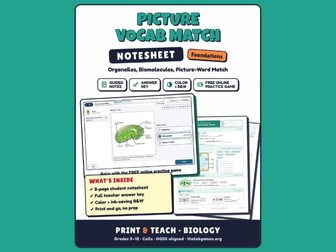
Help students learn cell and biomolecule words by seeing them first. This roomy, picture-first 2-page notesheet starts with a short fill-in on the three kinds of picture questions, then students label six parts of a drawn plant cell (chloroplast, vacuole, nucleolus, Golgi apparatus, ribosome, cell membrane), work through a “name the picture” example with a chloroplast, and learn what to look for in a channel protein and a nucleotide. On page 2 students name a picture (prokaryotic cell), find the picture that shows a word (Golgi apparatus, phospholipid), fill a blank in a sentence (disaccharide), and decide whether an animal cell is an example of a prokaryotic cell. Every question has at most three choices. It pairs with Picture Vocab Match, a free online practice game at thelabgames.org where students match science words to pictures, pick the picture that shows a word and fill blanks in sentences. Use it in class, for absent-student makeups, or on sub days. A complete teacher key is included. What’s Included Student notesheet (2 pages) in full color AND black & white Teacher answer key (red answers) in full color AND black & white What Students Do Background fill-in: the three question kinds (name the picture, find the picture, fill the blank) Cell Parts: label six parts of a plant cell drawing from a word bank Worked Example: name a chloroplast from its picture and the feature that gives it away What to Look For: the key feature of a channel protein and a nucleotide Word Orders: name a prokaryotic cell, find the Golgi apparatus and a phospholipid among three pictures, and fill the blank with “disaccharide” Watch For: look-alike words, examples and non-examples, and a quick prokaryote check My Runs: a log for tracking practice scores Skills & Standards Science vocabulary from pictures, organelles (chloroplast, vacuole, nucleolus, Golgi apparatus, ribosome, cell membrane), prokaryotic vs eukaryotic cells, channel proteins, nucleotides, disaccharides, phospholipids, examples and non-examples Supports NGSS HS-LS1-2 Grades 9–12 Biology (Foundations level: picture-first on-ramp) Great For Cell and biomolecule units Students who need a picture-first start English learners and vocabulary support Absent-student makeups Sub plans
Protein Structure Notesheet | Folding, Active Sites, Mutations, Denaturing + KeyQuick View
Thelabgames

Protein Structure Notesheet | Folding, Active Sites, Mutations, Denaturing + Key

(0)
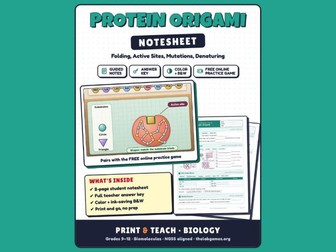
How does a chain of amino acids become a working protein? In this roomy, student-friendly 2-page notesheet, students fill in the background on amino acids, sequence, shape, active sites and substrates, label a diagram of the four levels of protein structure (primary, secondary with an α-helix and a β-pleated sheet, tertiary with a hydrophobic core and a disulfide bridge, and quaternary hemoglobin), sort amino-acid side chains by their properties, and read an active-site pocket in a worked example. On page 2 they work four folding orders built from the activity’s own generator: match a substrate to a pocket and judge three amino-acid changes from the observed shape and binding evidence. An AP box covers denaturing and sickle hemoglobin. It pairs with Protein Origami, a free online practice game at thelabgames.org where students fit substrates to active sites, judge what an amino-acid change does and (AP) explain denaturing and sickle hemoglobin. Use it in class, for absent-student makeups, or on sub days. A complete teacher key is included. What’s Included Student notesheet (2 pages) in full color AND black & white Teacher answer key (red answers) in full color AND black & white What Students Do Background fill-in: amino acids, sequence, folded shape, active site and substrate How a Chain Becomes a Protein: label primary, secondary, tertiary and quaternary structure, an α-helix and a β-pleated sheet Side Chains Matter: classify amino-acid side chains as nonpolar, polar, charged, disulfide-forming or helix-breaking, and place nonpolar R groups in a folded protein Worked Example: read an active-site pocket’s shape and spot its look-alike Folding Orders: a substrate-fit order and three amino-acid substitutions judged from shape and binding evidence AP Extension: denaturing keeps peptide bonds intact; the sickle-cell substitution is a change in primary structure My Runs: a log for tracking practice scores Skills & Standards Protein structure (primary, secondary, tertiary, quaternary), amino acids and R groups, hydrophobic core, disulfide bonds, enzyme active sites and substrates, structure and function, mutations and substitutions, denaturation, sickle-cell hemoglobin Supports NGSS HS-LS1-1 Grades 9–12 Biology (with an AP Biology extension) Great For Biomolecules and enzymes units Absent-student makeups Sub plans Homework or stations Test review
Food Tests Notesheet | Benedict's, Iodine, Biuret, Sudan III, Controls + KeyQuick View
Thelabgames

Food Tests Notesheet | Benedict's, Iodine, Biuret, Sudan III, Controls + Key

(0)
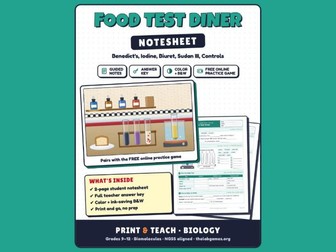
Students learn to pick the right food test and read what it really shows. In this roomy, student-friendly 2-page notesheet, students fill in the background on test specificity, sucrose versus lactose and why Benedict’s must be heated, label a water-bath setup and put the Benedict’s color ladder in order, complete a reference table of each test’s target and positive and negative results, and finish a worked example showing that a blue sucrose tube means “reducing sugar not detected,” not “no carbohydrate.” On page 2 they work four diner orders built from the activity’s own generator: choose the test and preparation, predict the result, decide whether the target was detected, and explain why. An AP box covers positive and negative controls and what a controlled negative result supports. It pairs with Food Test Diner, a free online practice game at thelabgames.org where students run a diner’s test counter, choose Benedict’s, iodine, Biuret, Sudan III or the brown paper test, and interpret each result. Use it in class, for absent-student makeups, or on sub days. A complete teacher key is included. What’s Included Student notesheet (2 pages) in full color AND black & white Teacher answer key (red answers) in full color AND black & white What Students Do Background fill-in: each test has one target, sucrose is non-reducing, milk has lactose, Benedict’s needs heat and an unheated tube is inconclusive The Benedict’s Test: label the water bath, hot plate and test tube, and order the color ladder from blue to brick-red Pick the Right Test: what Benedict’s, iodine, Biuret, Sudan III and the brown paper test detect, with their positive results How to Solve an Order: the steps and a worked sucrose example Diner Orders: four orders (sucrose, bread, milk, potato) with test choice, predicted result, detected / not detected / inconclusive, and the reason AP Extension: glucose positive and water negative controls, and what a controlled negative result supports My Runs: a log for tracking practice scores Skills & Standards Biomolecules (carbohydrates, proteins, lipids), reducing and non-reducing sugars, starch, indicator tests, positive and negative controls, interpreting negative results Supports NGSS HS-LS1-6 Grades 9–12 Biology (with an AP Biology extension) Great For Biomolecules and macromolecules units Pre-lab before a real food-test lab Absent-student makeups Sub plans Test review
Macromolecules Notesheet | Dehydration Synthesis, Hydrolysis & Monomers + KeyQuick View
Thelabgames

Macromolecules Notesheet | Dehydration Synthesis, Hydrolysis & Monomers + Key

(0)
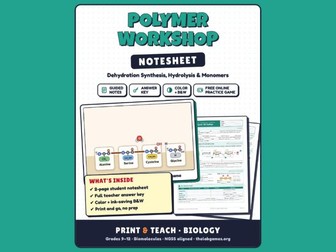
Students learn how cells build carbohydrates, proteins, nucleic acids and fats from monomers by dehydration synthesis, and break them apart by hydrolysis. They label two glucose joining into maltose (every atom drawn), count one water per bond (n − 1, and 3 for a triglyceride), match each class to its monomers, bonds and elements, and then fill workshop-style orders: build a chain, split a disaccharide, digest a fat, decide whether a cell is making or taking apart, and identify a mystery polymer. It pairs with the free online Polymer Workshop practice game at thelabgames.org, where students fill customers’ orders on a molecular workbench. Good for class, makeups and sub days. What’s Included Student notesheet (2 pages) in full color AND black & white Teacher answer key (red answers) in full color AND black & white What Students Do Complete fill-in background notes on macromolecules, polymers, monomers, dehydration synthesis, hydrolysis and triglycerides Label a drawing of two α-glucose joining into maltose: the monomer, the –OH and –H that leave, the water, the glycosidic bond, the disaccharide and both reaction arrows; finish the formula C12H22O11 Finish the workshop’s three steps for filling an order and a worked example (a starch strand of 3: 2 bonds, 2 waters) Complete a reference table of each class’s monomers, bond, elements and key facts, plus the three disaccharides Solve practice orders: build a chain, build a sequence, split lactose, break a glycogen chain, build and digest a triglyceride, making vs taking apart, elements, and a mystery polymer AP: identify starch, glycogen and cellulose from their structure and job, and name the glycosidic, peptide, ester and phosphodiester bonds Review the most common mistakes as fill-in key ideas and log their game runs Skills & Standards Monomers and polymers, dehydration synthesis and hydrolysis, counting water molecules (n − 1), triglycerides, elements in each class of macromolecule Supports NGSS HS-LS1-6 AP Biology extension: glycosidic (α-1,4, α-1,6, β-1,4), peptide, ester and phosphodiester bonds; starch vs glycogen vs cellulose Grades 9–12 Biology and AP Biology Great For Guided notes alongside the online game Absent-student makeups Sub plans Biomolecules unit review Differentiation (General and AP sections)
Macromolecule Food Tests Notesheet | Iodine, Benedict's, Biuret, Sudan III + KeyQuick View
Thelabgames

Macromolecule Food Tests Notesheet | Iodine, Benedict's, Biuret, Sudan III + Key

(0)
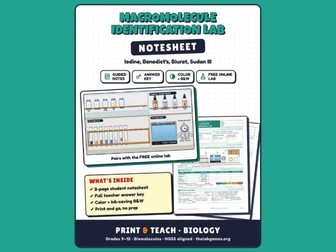
Students use indicator reagents to find starch, reducing sugars, proteins and lipids in foods. They learn what each test detects, which test needs heat, and what positive and negative results look like. They run a known sample and a water control for each reagent, then test common foods (apple juice, milk, egg white, potato, honey, peanut). Finally they identify mystery unknowns and explain the chemistry behind each color change. This 2-page notesheet pairs with the free online Macromolecule Identification Lab at thelabgames.org. It works for class lab days, absent-student makeups and sub days. What’s Included Student notesheet (2 pages) in full color AND black & white Teacher answer key (red answers) in full color AND black & white What Students Do Complete fill-in notes on macromolecules and indicator reagents: carbohydrates, proteins, lipids and nucleic acids Label a diagram of the virtual lab bench: sample jar, dropper bottle, pipette, test tube, hot water bath, temperature dial, brown paper and spot plate Fill in a reagent reference table for Lugol’s iodine, Benedict’s, Biuret, Sudan III and the brown-paper grease-spot test: what each detects, whether it needs heat, the positive result and the water-control result Read the Benedict’s color scale (blue, green, yellow, orange, brick red) and learn why sucrose tests negative Identify positive and negative (water) controls, the independent and dependent variables and the controlled variables, and circle predictions Lab A: record the starting color, final color and result (+, trace or −) for 8 tubes: a known positive and a water control for each reagent Lab B: predict and record results for 3 foods across all 4 tests, then list the macromolecules present Lab C: complete an expected-results table for 6 candidates and identify three mystery unknowns Explain the chemistry behind each test: the starch-iodine helix, Cu²⁺ to Cu₂O, copper and peptide bonds, and a nonpolar dye dissolving in lipid Write a claim, evidence and reasoning conclusion Skills & Standards Carbohydrates (starch, reducing and non-reducing sugars), proteins, lipids, indicator reagents, positive and negative controls Observing and recording qualitative data, controlled experiments, claim-evidence-reasoning writing Science practice: planning and carrying out investigations Supports NGSS HS-LS1-6 Grades 9–12 Biology Great For Lab days with the online Macromolecule Identification Lab Absent-student lab makeups Sub days Biomolecules unit notes Food test lab prep before a wet lab
Macromolecules Lab Notesheet | Digestion, Hydrolysis, Fats & Protein Shape + KeyQuick View
Thelabgames

Macromolecules Lab Notesheet | Digestion, Hydrolysis, Fats & Protein Shape + Key

(0)
Students digest a meal on a virtual workbench: they choose the right enzyme for bread starch, gluten, steak protein and fat, butter fat, apple sugar and apple fibre, then record each food part’s macromolecule, monomers, bonds broken, waters used and elements, and graph the waters. They label a triglyceride drawn in skeletal form (glycerol, ester bonds, a saturated tail and a kinked cis-unsaturated tail), compare melting points of fats with 0 to 6 C=C double bonds (including a trans fat), and finish with a claim, evidence and reasoning. An AP section follows lysozyme as heat and pH unfold it and traces sickle-cell hemoglobin from GAG → GTG to sickled cells. This 2-page notesheet pairs with the free online Macromolecule Builder lab at thelabgames.org. It works for class lab days, absent-student makeups and sub days. What’s Included Student notesheet (2 pages) in full color AND black & white Teacher answer key (red answers) in full color AND black & white What Students Do Complete fill-in background notes on macromolecules, monomers, dehydration synthesis, hydrolysis, digestion and enzyme specificity Label a skeletal drawing of a triglyceride (glycerol, ester bond, saturated and unsaturated fatty acids, cis C=C double bond), give its elements and waters, and decide whether it is a polymer Complete a reference table of each macromolecule’s monomers, bond, digesting enzyme and elements, and explain why cellulose (β-1,4) is not digested Sort the Lab 1 variables as IV, DV or controlled and circle predictions for all three labs Record the Lab 1 meal data table for seven food parts and bar-graph the waters used Answer analysis questions on enzyme specificity, n − 1 waters, one water per bond, elements and what cells do with monomers Lab 2: record C=C double bonds and melting points for six triglycerides, graph melting point vs C=C, and explain kinks, packing and trans fats AP: record lysozyme % folded vs temperature, activity vs pH and % of HbS cells sickled vs O₂, and connect each to protein structure Write a claim, evidence and reasoning conclusion Skills & Standards Monomers and polymers, dehydration synthesis and hydrolysis, digestion and enzyme specificity, elements in each macromolecule, triglycerides, saturated vs unsaturated (cis and trans) fats and melting point Data tables, bar graphs and line graphs, claim-evidence-reasoning Supports NGSS HS-LS1-6, HS-LS1-1, HS-PS1-3 AP Biology extension: glycosidic, ester, peptide and phosphodiester bonds; levels of protein structure; denaturation by heat and pH; the sickle-cell mutation Grades 9–12 Biology and AP Biology Great For Lab days with the online Macromolecule Builder Absent-student lab makeups Sub days Biomolecules and digestion unit notes Differentiation (General and AP sections)
Properties of Water Notesheet | Hydrogen Bonds + KeyQuick View
Thelabgames

Properties of Water Notesheet | Hydrogen Bonds + Key

(0)
Students learn why water behaves the way it does, starting from the molecule. They label a bent, polar water molecule (δ− oxygen, δ+ hydrogens, 104.5° angle), draw the dashed hydrogen bonds between three molecules, and see how one molecule can form up to four hydrogen bonds. Then they connect each demo to its mechanism: a paper clip held up by surface tension, water climbing higher in a narrower tube, water warming less than a solid block, ice floating, and salt dissolving while oil forms its own layer. Page 2 has practice orders like the game’s, including drawing hydration shells around Na+ and Cl− and deciding which links are true hydrogen bonds. A harder section covers ΔT = Q ÷ (m × c), capillary height ratios, and why hydrogen bonds are not covalent bonds. It pairs with the free online Water Works practice game at thelabgames.org, where students predict what water will do on a demo bench and then place the hydrogen bonds that explain it. Good for class, makeups and sub days. What’s Included Student notesheet (2 pages) in full color AND black & white Teacher answer key (red answers) in full color AND black & white What Students Do Complete fill-in background notes on polarity, partial charges, covalent vs. hydrogen bonds, cohesion and adhesion Label a three-molecule water model (covalent O–H bond, δ− oxygen, δ+ hydrogen, 104.5° angle, hydrogen bond), draw every valid hydrogen bond, and count the bonds Count the four hydrogen bonds one water molecule can make (2 from its H atoms, 2 to its O) Finish the game’s steps plus worked examples for ΔT = Q ÷ (m × c) and capillary rise ∝ 1 ÷ radius Fill in a results-and-mechanism table for the five bench demos: paper clip, capillary tubes, heating, ice and salt/oil Solve practice orders on each demo, draw hydration shells around Na+ and Cl−, and judge which links are hydrogen bonds Hardest and AP orders: calculate temperature increases, find a capillary height ratio, and say what the dashed links represent Review common mistakes as fill-in key ideas and log their game runs Skills & Standards Water polarity, partial charges, hydrogen bonds vs. covalent bonds Cohesion, adhesion, surface tension, capillary action, specific heat and thermal buffering, density of ice, water as a solvent (ion–dipole hydration) Supports NGSS HS-PS1-3, HS-LS1-6 AP Biology extension: properties of water from hydrogen bonding, quantitative heat and capillary comparisons Grades 9-12 Biology and AP Biology Great For Guided notes alongside the online game Biomolecules or chemistry-of-life unit review Absent-student makeups Sub plans Differentiation (General and harder/AP sections)
Wave Properties Notesheet | Wavelength, Frequency, v = fλ & Radio Waves + KeyQuick View
Thelabgames

Wave Properties Notesheet | Wavelength, Frequency, v = fλ & Radio Waves + Key

(0)
Help students read waves like a pro. This roomy, student-friendly 2-page notesheet covers the parts of a wave, transverse and longitudinal waves, frequency and period, and the wave equation v = fλ. Students label a wave on an oscilloscope grid, read its wavelength and amplitude, fill in the wave equation and unit prefixes, and follow a worked radio-station example before trying four practice requests. It pairs with Radio DJ, a free online practice game at thelabgames.org where students run the night shift at a radio station: reading the scope, tuning the dials and answering callers’ wave questions. Use it in class, for absent-student makeups, or on sub days. A complete teacher key with every value worked out is included. What’s Included Student notesheet (2 pages) in full color AND black & white Teacher answer key (red answers) in full color AND black & white What Students Do Background fill-in: waves carry energy, transverse vs longitudinal, frequency in hertz, and what the medium does Label and Read the Scope: label crest, trough, wavelength and amplitude on a wave, spot the crest-to-trough trap, and read λ and A off the grid The Wave Equation: rearrange v = fλ and T = 1 ÷ f, use the speeds of sound and radio, and fill in the kilo, mega and milli prefixes Worked Example: find the wavelength of a 100.0 MHz FM station Practice Requests: count waves on a scope to find frequency, tune an FM dial from a wavelength, find the wavelength of middle C, and (AP) find a note’s wavelength after it enters water Key Ideas: frequency vs wavelength, amplitude vs loudness, sound vs radio in empty space, and which waves are longitudinal My Runs: a log for tracking practice scores Skills & Standards Wavelength, amplitude, crest and trough, frequency and period, wave speed (v = fλ), transverse and longitudinal waves, sound vs electromagnetic waves, unit prefixes Supports NGSS HS-PS4-1, HS-PS4-5 Grades 9–12 Physics (with an AP Physics 2 practice problem) Great For Waves and sound units Absent-student makeups Sub plans Homework or stations Test review
Stomata & Guard Cells Notesheet | Transpiration, ABA, Carbon vs Water + KeyQuick View
Thelabgames

Stomata & Guard Cells Notesheet | Transpiration, ABA, Carbon vs Water + Key

(0)
Students learn how a leaf trades carbon gained for water lost. They label a detailed leaf cross-section (cuticle, epidermis, palisade and spongy mesophyll, air spaces, guard cells and stomata on the lower surface) and compare open and closed stomata in surface view, then trace how guard cells open (K⁺ in, water in by osmosis, turgor rises) and close in a drought (ABA, K⁺ out, water out, turgor falls) as negative feedback. Next they use the activity’s leaf-budget model to plan stomatal openings for a morning, midday and evening and check carbon uptake against the water supply. It pairs with the free online Stomata Control Room practice game at thelabgames.org, where students set a model leaf’s stomatal openings, run the leaf cycle and balance carbon against water. Good for class, makeups and sub days. What’s Included Student notesheet (2 pages) in full color AND black & white Teacher answer key (red answers) in full color AND black & white What Students Do Complete fill-in background notes on stomata, guard cells, transpiration, K⁺, osmosis, ABA and negative feedback Label 8 parts of a leaf cross-section and identify open vs closed stomata and turgid vs flaccid guard cells Complete the opening and closing chains for guard cells, plus the light/dark and upper/lower-surface facts Fill in the model’s opening factor table and finish the Briefing’s worked leaf cycle Plan and check three leaf cycles (light check, heat wave, drought), find what went wrong in a failed plan, and work out the cost of opening in the dark Choose the drought-feedback result and (AP) its guard-cell mechanism AP: calculate carbon gained per water spent for each plan and explain which is lowest Review common mistakes as fill-in key ideas and log their game runs Skills & Standards Stomata and guard cells, transpiration, osmosis and turgor, ABA, negative feedback, the CO₂-water trade-off Leaf structure; using a simple model to balance two budgets Supports NGSS HS-LS1-3 AP Biology extension: carbon-to-water ratio and the ion and water mechanism of drought closure Grades 9–12 Biology and AP Biology Great For Guided notes alongside the online game Absent-student makeups Sub plans Homeostasis and plant structure units Differentiation (General and AP parts)
Cell Signaling Notesheet | Reception, Transduction, Response, cAMP + KeyQuick View
Thelabgames

Cell Signaling Notesheet | Reception, Transduction, Response, cAMP + Key

(0)
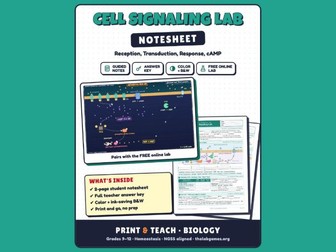
Students follow epinephrine from a liver cell’s surface receptor to glucose release. They label a detailed diagram of the β-adrenergic pathway (GPCR, G protein, adenylyl cyclase, cAMP, PDE, PKA, phosphorylase kinase, glycogen phosphorylase, glycogen, GLUT2) and mark the reception, transduction and response stages. Then they learn how the signal is switched off, predict what happens when a step is blocked, and sort the four signal types. In the labs they record a dose-response curve and find the Kd and saturation, compare cAMP after a hormone pulse in normal, PDE-inhibited and G-protein-stuck-on cells, and test how bacteria use quorum sensing to glow only in a crowd. This 2-page notesheet pairs with the free online Cell Signaling Lab at thelabgames.org. It works for class lab days, absent-student makeups and sub days. What’s Included Student notesheet (2 pages) in full color AND black & white Teacher answer key (red answers) in full color AND black & white What Students Do Complete fill-in background notes on ligands, GPCRs, G proteins, second messengers, kinases, phosphorylation cascades and amplification Label a liver-cell signaling diagram (A–M) and name the three stages: reception, transduction and response Fill in how a signal is switched off (GTP hydrolysis, PDE, phosphatases), predict the result of blocked or stuck steps, and match the endocrine, paracrine, autocrine and synaptic signal types Sort the Lab 1 variables as IV, DV or controlled and circle predictions Record a 7-dose data table and graph receptor occupancy against epinephrine dose (AP: occupancy from Kd and steady-state cAMP) Record cAMP over time after a hormone pulse for three matched cells and explain signal termination (AP: fraction of cAMP kept) Record signal and light for wild-type and mutant bacteria at seven culture densities (AP: total light and a signal rescue) Write a claim, evidence and reasoning conclusion Skills & Standards Cell communication, signal transduction, second messengers, amplification, signal termination, quorum sensing Reading data tables, graphing a saturation curve, ratios and percent change Supports NGSS HS-LS1-2, HS-LS1-3 Grades 9–12 Biology and AP Biology Great For Lab days with the online Cell Signaling Lab Absent-student lab makeups Sub days Homeostasis and cell communication unit notes AP Biology Unit 4 review
Membrane Transport Notesheet | Diffusion, Channels, Pumps, Vesicles + KeyQuick View
Thelabgames

Membrane Transport Notesheet | Diffusion, Channels, Pumps, Vesicles + Key

(0)
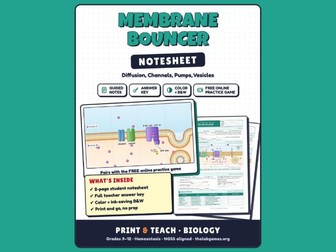
Students learn to send each molecule through the right “door” of a cell: the phospholipid bilayer (simple diffusion), a channel or carrier protein (facilitated diffusion, with aquaporins for water), a pump that spends ATP (active transport), or a vesicle (endocytosis and exocytosis). They label a membrane cross-section with all four doors, read dot counts to decide whether a molecule is going down or against its gradient, and use molecule ID cards (size, charge and polarity) to pick the door. Practice tickets mirror the game’s customers, from O₂ and Na⁺ to a bacterium and insulin. An AP section covers the Na⁺/K⁺ pump’s 3:2 ratio, sodium-glucose cotransport and the kinds of vesicle transport. It pairs with the free online Membrane Bouncer practice game at thelabgames.org, where students work the door of a cell. Good for class, makeups and sub days. What’s Included Student notesheet (2 pages) in full color AND black & white Teacher answer key (red answers) in full color AND black & white What Students Do Complete fill-in background notes on the bilayer, transport proteins, vesicles, gradients, and passive vs active transport Name the four doors and label seven parts (A–G) of a membrane picture with molecules shown on each side Finish the game’s door-picking steps and a worked example (K⁺ moving back into a nerve cell) Use molecule ID cards (O₂, estrogen, water, glucose, Na⁺, LDL) to pick a door and say why Solve eight door tickets: pick the door, the way the molecule moves, and the kind of transport AP: the Na⁺/K⁺ pump’s ratio, cotransport (secondary active transport), and phagocytosis, pinocytosis, receptor-mediated endocytosis and exocytosis Review common mistakes as fill-in key ideas and log their game runs Skills & Standards Cell membrane structure; simple diffusion, facilitated diffusion, osmosis through aquaporins, active transport, endocytosis and exocytosis Reading concentration gradients AP Biology extension: Na⁺/K⁺ pump, cotransport, kinds of endocytosis Supports NGSS HS-LS1-2, HS-LS1-3 Grades 9–12 Biology and AP Biology Great For Guided notes alongside the online game Absent-student makeups Sub plans Cell membrane and homeostasis unit review Differentiation (General and AP sections)
Body Systems Relay Notesheet | Organ System Interactions + KeyQuick View
Thelabgames

Body Systems Relay Notesheet | Organ System Interactions + Key

(0)
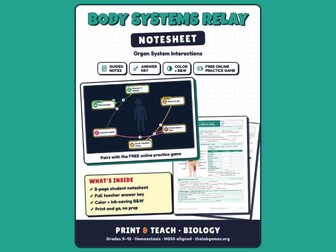
Students learn to spot which organ systems are working together in real-life situations. They match 13 organs on a labeled front-view body map to the 11 organ systems and each system’s job (transport, exchange, control, movement, defense, reproduction), learn the clue words that point to each system, and follow a worked example. Then they build relay teams for situations like a hot-pan reflex, a startle response, calcium from milk, oxygen from the alveoli to muscle mitochondria and the CO₂ breathing reflex. An AP section adds ADH and renin–aldosterone feedback chains. It pairs with the free online Body Systems Relay practice game at thelabgames.org, where students pick the team of systems for each customer’s situation and watch the relay show what each system does. Good for class, makeups and sub days. What’s Included Student notesheet (2 pages) in full color AND black & white Teacher answer key (red answers) in full color AND black & white What Students Do Complete fill-in background notes on the 11 organ systems, the relay idea and gas exchange by diffusion Match 13 organs on a labeled body map to their organ systems and name each system’s job Fill in the game’s steps (with the hormone vs non-hormone gland trap) and a worked sprint example Build relay teams for seven practice situations with 2, 3 and 4 interacting systems AP: build teams for ADH water balance and the renin–aldosterone pathway and name the feedback type Review the game’s hint cards as fill-in key ideas and log their game runs Skills & Standards Organ system structure and function; interacting body systems Homeostasis, negative feedback, nerve and hormone signals Supports NGSS HS-LS1-2 AP Biology extension: feedback loops and hormone chains Grades 9–12 Biology and AP Biology Great For Guided notes alongside the online game Body systems and homeostasis unit notes Absent-student makeups Sub days Quick review before a body systems test
Surface Area to Volume Ratio Notesheet | Cell Size & Shape + KeyQuick View
Thelabgames

Surface Area to Volume Ratio Notesheet | Cell Size & Shape + Key

(0)
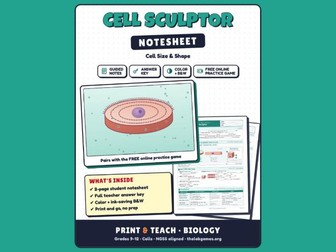
Students learn why cells stay small and how shape, microvilli, membrane folds and cell division change a cell’s surface-area-to-volume ratio (SA:V). They compare four model cells drawn to scale with the same 64 µm³ of cytoplasm (cube, sphere, flat disc and rod), finish a worked example where one 4 µm cube divides into eight 2 µm cubes and SA:V doubles, and complete a formula card for every shape and tool. Page 2 has real work orders from the game: pick the shape that meets the SA:V need without going over the membrane budget, divide cells, add microvilli and folds, and an AP section that predicts total area, volume per cell and SA:V with exact geometry. It pairs with the free online Cell Sculptor practice game at thelabgames.org, where students design model cells for research clients and run an uptake test. Good for class, makeups and sub days. What’s Included Student notesheet (2 pages) in full color AND black & white Teacher answer key (red answers) in full color AND black & white What Students Do Complete fill-in background notes on surface area, volume, SA:V and its units (µm⁻¹) Name four to-scale model cells of equal volume, label microvilli, a membrane fold and the nucleus, find each SA:V and rank the shapes Finish the briefing’s steps and the 4 µm cube to eight 2 µm cubes worked example Complete a formula card: cube, sphere, closed cylinder, microvillus, fold and division Solve seven practice orders: choose a shape, check a cube by hand, stay under the membrane budget, divide into equal cells, choose how many cells, add microvilli and folds, and record the measured SA:V AP: predict total area, volume per cell and SA:V for divided cubes, divided spheres and a flat cell with microvilli Review common mistakes as fill-in key ideas and log their game runs Skills & Standards Surface area to volume ratio, why cells are small, cell shape and structure-function Microvilli, membrane folds and cell division as ways to raise SA:V Surface area and volume of cubes, spheres and cylinders; units Supports NGSS HS-LS1-2 AP Biology extension: exact predictions of area, volume per cell and SA:V Grades 9-12 Biology and AP Biology Great For Guided notes alongside the online game Absent-student makeups Sub plans Cell structure unit review Math-in-science practice
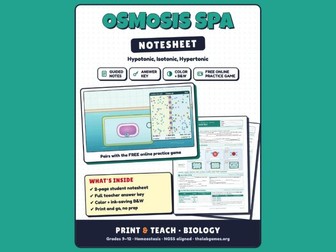
Osmosis & Tonicity Notesheet | Hypotonic, Isotonic, Hypertonic + KeyQuick View
Thelabgames

Osmosis & Tonicity Notesheet | Hypotonic, Isotonic, Hypertonic + Key

(0)
Students learn to name a bath by comparing it with the cell (hypotonic, isotonic, hypertonic), to tell which way water moves, and to predict what happens to an animal cell (lysis, no change, crenation) and a plant cell (turgid, flaccid, plasmolyzed). They label six drawn soaks of a red blood cell and an Elodea cell, read the membrane close-up’s water counters, and then solve spa tickets that mirror the game: naming baths, predicting results, real cases like a paramecium in pond water, mixing a bath to order, and the classic traps. An AP section covers solute potential (Ψs = −iCRT), water potential (Ψ = Ψs + Ψp) and reading a potato-core graph. It pairs with the free online Osmosis Spa practice game at thelabgames.org, where students run a spa for cells and watch each soak happen. Good for class, makeups and sub days. What’s Included Student notesheet (2 pages) in full color AND black & white Teacher answer key (red answers) in full color AND black & white What Students Do Complete fill-in background notes on osmosis, solutes, tonicity and the five results Name the bath and the result for six drawn soaks (red blood cell and Elodea cell in three baths) Finish the game’s four solving steps and a worked example (a red blood cell in pure water) Classify everyday baths (pond water, normal saline, seawater, pickle brine) and read net water movement from the close-up window’s counters Solve eight spa tickets: name the bath, predict, a paramecium case, mix a bath, and four trap tickets AP: calculate Ψs for NaCl and sucrose, find a cell’s Ψ and the direction of water flow, and find the isotonic molarity and Ψ from a potato-core graph Review common mistakes as fill-in key ideas and log their game runs Skills & Standards Osmosis, tonicity, lysis, crenation, turgor, plasmolysis, contractile vacuoles AP Biology extension: solute potential, pressure potential and water potential Supports NGSS HS-LS1-3 Grades 9–12 Biology and AP Biology Great For Guided notes alongside the online game Absent-student makeups Sub plans Cell membrane and homeostasis unit review Differentiation (General and AP sections)
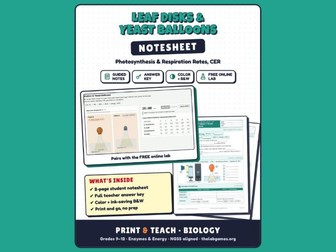
Leaf Disk & Yeast Balloon Lab Notesheet + KeyQuick View
Thelabgames

Leaf Disk & Yeast Balloon Lab Notesheet + Key

(0)
Students measure photosynthesis with floating leaf disks and cellular respiration with yeast balloons. In this roomy, student-friendly 2-page lab notesheet they complete both equations, fill in the background on vacuum-sunk disks, bicarbonate, oxygen and carbon dioxide (and why yeast in a sealed flask switch to fermentation), label both stations, and name the independent, dependent and control groups with predictions. On page 2 they record floating disks each minute, find the time for half the disks to float, record balloon circumference and length, calculate each flask’s rate, graph both balloons, write a claim, evidence and reasoning, and answer two check questions. It pairs with Leaf Disks & Yeast Balloons, a free online lab at thelabgames.org. Use it in class, for absent-student makeups, or on sub days. A complete teacher key is included. What’s Included Student notesheet (2 pages) in full color AND black & white Teacher answer key (red answers) in full color AND black & white What Students Do Background fill-in: both equations, sinking and floating leaf disks, bicarbonate as the CO2 source, balloon growth as a rate, and fermentation as the main source of the balloon gas The Two Stations: label the lamp, floating and sunk leaf disks, bicarbonate solution, balloon and yeast in sugar water Variables & Predictions: independent, dependent and control group for each station, plus two predictions Station 1: floating disks in the light and dark syringes for 15 minutes and the minutes for 5 disks to float Station 2: balloon circumference and length every 5 minutes, rate = (C25 − C0) ÷ 25 for both flasks, and a circumference-vs-time graph Claim, Evidence, Reasoning for “How did sugar affect the rate of cellular respiration?” Check Your Understanding: why the dark disks stayed sunk and which reactant the control flask was missing Skills & Standards Photosynthesis and cellular respiration inputs and outputs, gas production, control groups, rate from data, graphing, CER writing Supports NGSS HS-LS1-5, HS-LS1-7, MS-LS1-6, MS-LS1-7 Grades 9–12 Biology Great For Cell energy units Absent-student makeups Sub plans Lab stations Test review