


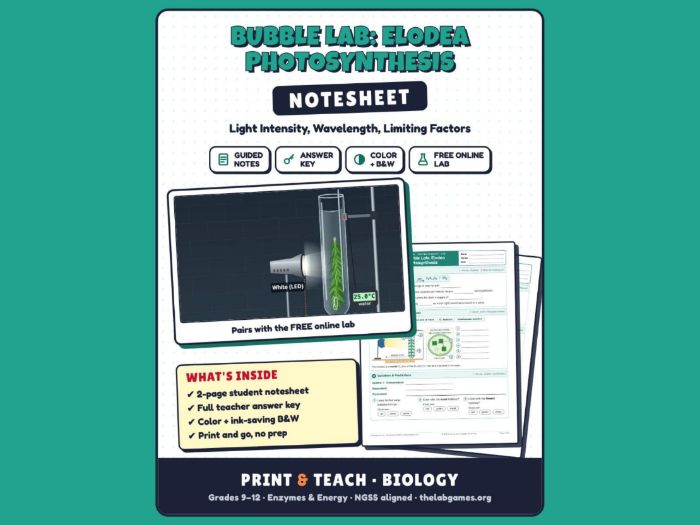
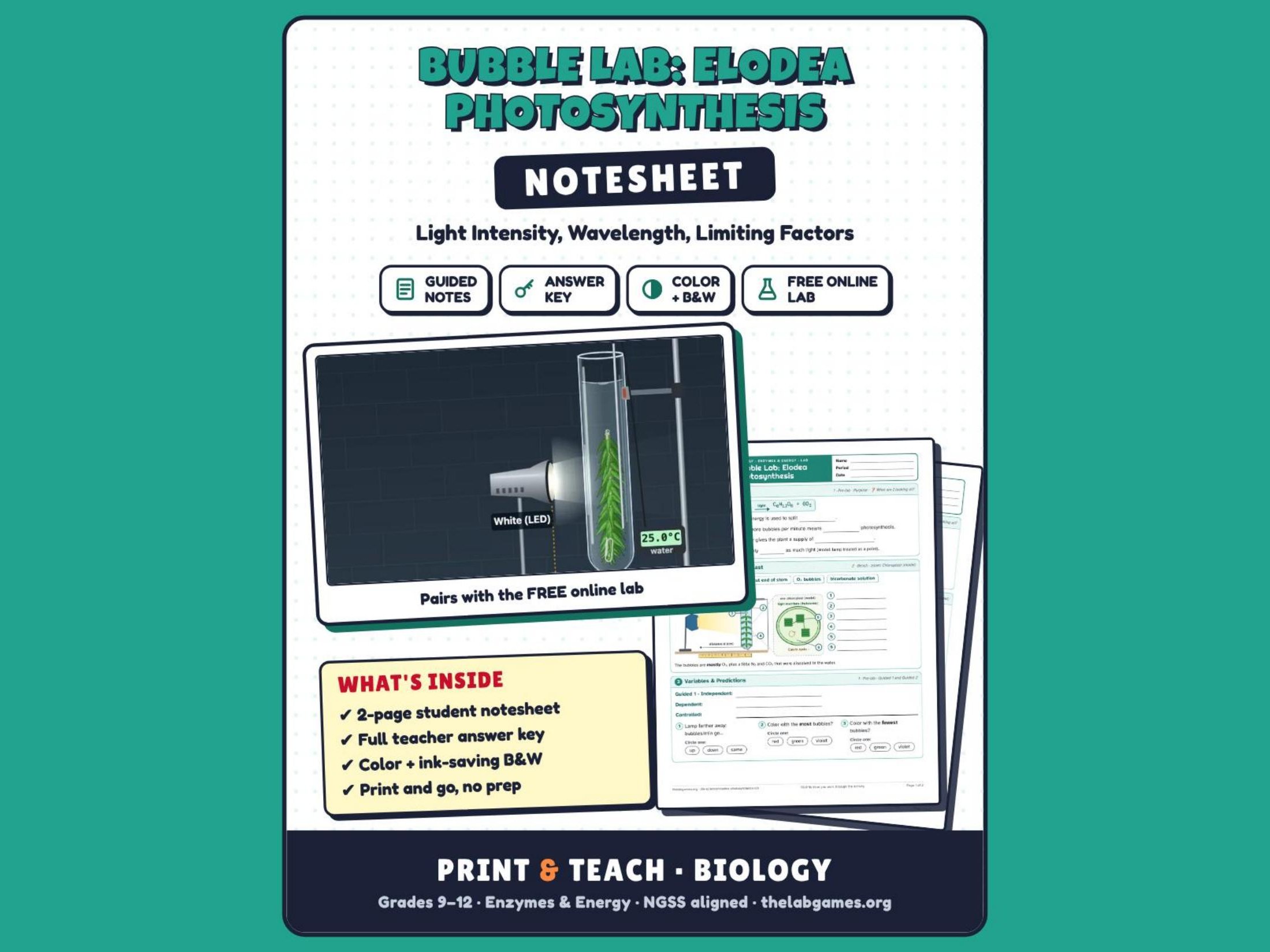
Students count oxygen bubbles from an Elodea sprig to measure the rate of photosynthesis. In this roomy, student-friendly 2-page lab notesheet they fill in the background on chlorophyll, splitting water, bicarbonate as the CO2 source and the inverse square law, label the bench and a chloroplast (thylakoids and stroma), and name the variables and make predictions. On page 2 they record three trials at five lamp distances, calculate relative light intensity, graph rate against distance, compare seven colors of light, look at light vs CO2 as limiting factors and the compensation point, and write a claim, evidence and reasoning.
It pairs with the Bubble Lab: Elodea Photosynthesis, a free online lab at thelabgames.org. Use it in class, for absent-student makeups, or on sub days. A complete teacher key is included.
What’s Included
- Student notesheet (2 pages) in full color AND black & white
- Teacher answer key (red answers) in full color AND black & white
What Students Do
- Background fill-in: the photosynthesis equation, splitting water, what more bubbles means, bicarbonate as the CO2 supply, and the inverse square law
- The Bench and the Chloroplast: label the lamp, O2 bubbles, cut end of the stem, bicarbonate solution, thylakoids and stroma
- Variables & Predictions: independent, dependent and controlled variables for Guided 1, plus three circle-the-prediction questions
- Guided 1 Data: three trials at 10, 20, 30, 50 and 75 cm, relative light intensity (10 ÷ d)², averages and a rate-vs-distance graph
- Guided 2: average bubbles per minute for seven LED colors, the most and fewest, and why green is not zero
- Guided 3 (AP): bubble rates at 0.1 % and 1 % bicarbonate from 5 to 100 cm, what limits the rate, and where the bubbles stop
- Claim, Evidence, Reasoning for “How does lamp distance affect the rate of photosynthesis?”
Skills & Standards
- Photosynthesis, light intensity and the inverse square law, wavelength and pigments, limiting factors, light compensation point, chloroplast structure, averaging trials, graphing
- Supports NGSS HS-LS1-5, HS-LS2-5, MS-LS1-6
- AP Biology extension: limiting factors and the light compensation point
- Grades 9–12 Biology (with an AP Biology section)
Great For
- Photosynthesis labs
- Absent-student makeups
- Sub plans
- Lab stations
- Test review
Something went wrong, please try again later.
This resource hasn't been reviewed yet
To ensure quality for our reviews, only customers who have purchased this resource can review it
Report this resourceto let us know if it violates our terms and conditions.
Our customer service team will review your report and will be in touch.
$4.00