


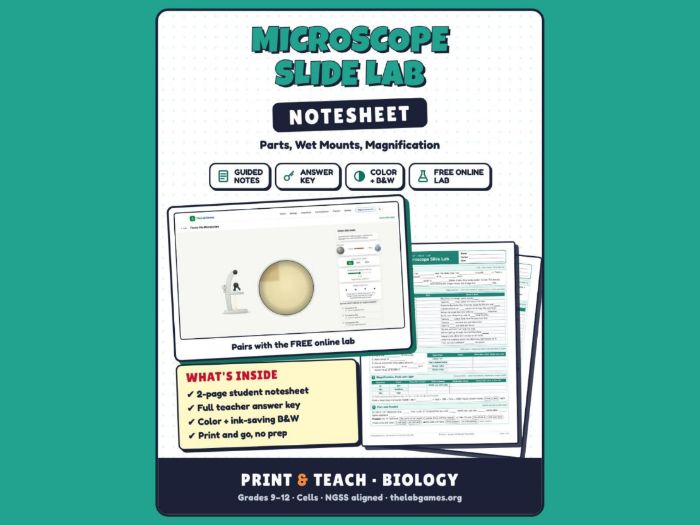
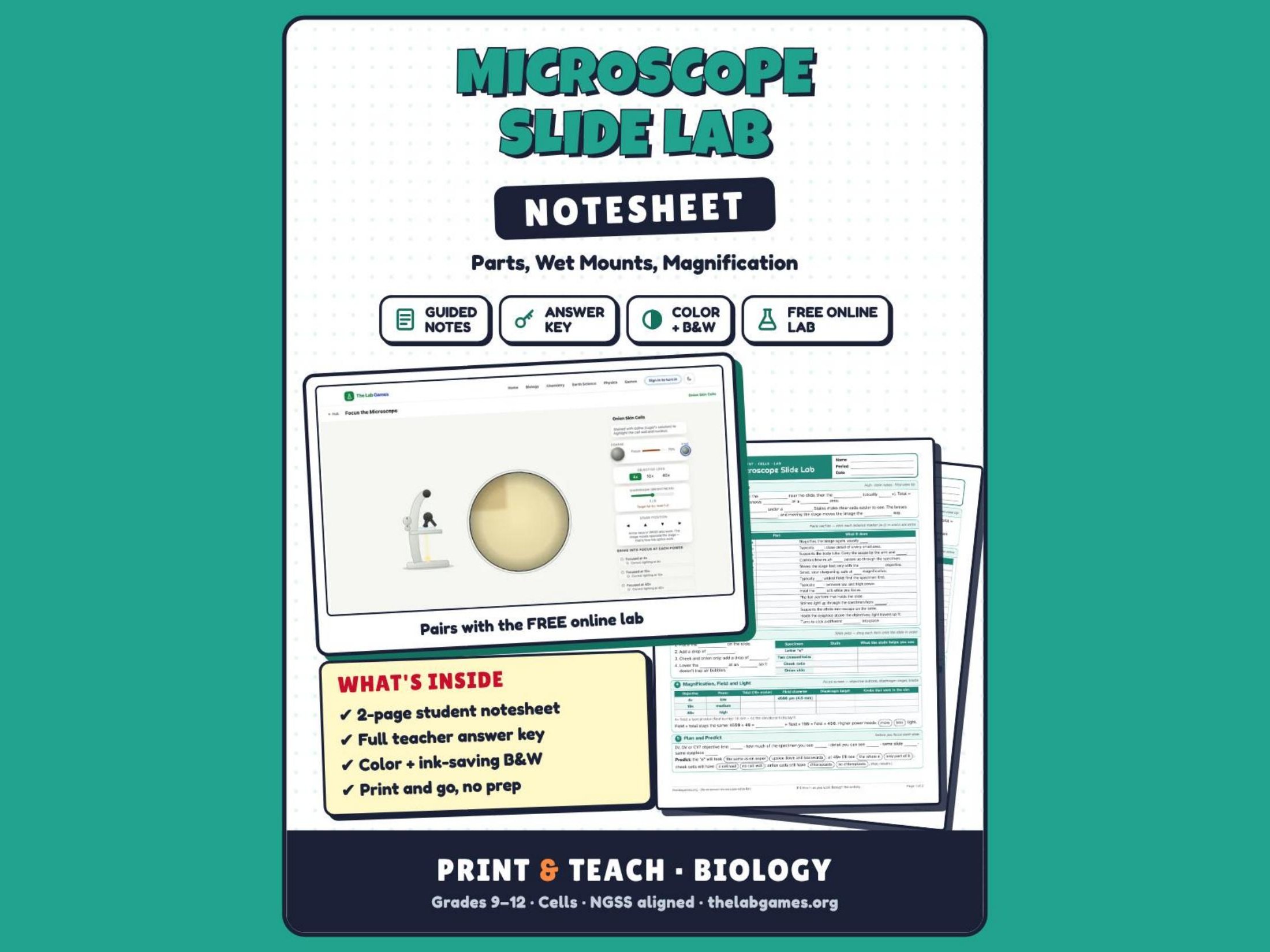
Students learn the parts of a compound light microscope, prepare wet-mount slides of a newsprint letter “e”, two crossed hairs, cheek cells stained with methylene blue and onion skin stained with iodine, and bring each one into focus at 4×, 10× and 40×. Along the way they work out total magnification, see why the field of view shrinks as power goes up, discover that the image is upside down and backwards, and compare plant and animal cells.
This 2-page notesheet pairs with the free online Microscope Slide Lab at thelabgames.org. It works for class lab days, absent-student makeups and sub days.
What’s Included
- Student notesheet (2 pages) in full color AND black & white
- Teacher answer key (red answers) in full color AND black & white
What Students Do
- Complete fill-in background notes on total magnification, wet mounts, stains and the inverted image
- Name 14 lettered parts on a side-view microscope diagram (the lab’s 12 plus the body tube and revolving nosepiece) and complete each part’s job
- Put the wet-mount steps in order and record the stain for each specimen and what it shows
- Fill in a table of total magnification, field diameter, diaphragm setting and which focus knobs to use at 4×, 10× and 40×
- Sort variables as IV, DV or controlled and circle predictions
- Sketch the letter “e” at three powers and the hairs, cheek cells and onion cells, labelling what they see
- Record focus, diaphragm level, nucleus, cell wall, chloroplasts and cell shape for all four slides
- Answer questions on stage movement, the field of view and an onion-cell size estimate
- Answer analysis questions on the coarse knob, lighting, stains and chloroplasts, then write a claim, evidence and reasoning conclusion comparing plant and animal cells
Skills & Standards
- Compound light microscope parts and care, total magnification, field of view, wet-mount slides, staining
- Plant vs animal cells: cell wall, nucleus, chloroplasts; estimating cell size from the field of view
- Grades 9–12 Biology (also works for middle school life science)
Great For
- Lab days with the online Microscope Slide Lab
- Prep before a hands-on microscope lab
- Absent-student lab makeups
- Sub days
- Cells unit notes
Something went wrong, please try again later.
This resource hasn't been reviewed yet
To ensure quality for our reviews, only customers who have purchased this resource can review it
Report this resourceto let us know if it violates our terms and conditions.
Our customer service team will review your report and will be in touch.
$4.00