Completing the square
Year 10 – Solving Quadratics by Completing the Square (IGCSE Edexcel Maths)
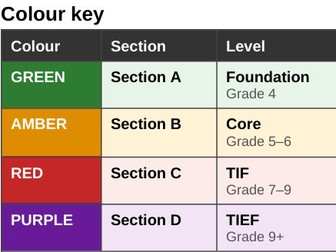
This worksheet develops students’ ability to complete the square and use it to analyse and solve quadratic equations. Students write quadratics in completed square form and use it to find turning points. They work backwards from a sketch to find the equation of a quadratic, and solve quadratics exactly, giving answers in simplified surd form. In the final sections, they use completing the square to prove results, find unknown constants, describe graph transformations and solve real-life maximum and minimum problems. The work is split into five colour-coded sections from Grade 5 to Grade 9, so students can start at the right level and move on.
Green – Practice (Grade 5)
Students write expressions such as x² + 6x + 5 in the form (x + p)² + q. From the completed form they state the turning point, decide whether it is a minimum or maximum, and find the y-intercept.
Amber – Further Practice (Grade 6)
Students complete the square when the x coefficient is odd, giving fractional answers. Using sketches with a turning point given, they find the equation of the quadratic and where the graph crosses the axes, including one curve with a maximum point. They also spot and correct a common sign error when reading a turning point.
Red – Developing Understanding (Grades 6–7)
Students solve quadratics by completing the square, giving answers in surd form. They simplify surds such as √12 = 2√3 and give answers in the form (a ± √b)/2, including where a ≠ 1. They also give answers to 2 decimal places.
TIF – Problem Solving (Grades 7–8)
Students complete the square when a ≠ 1 and write expressions in the form q − (x − p)² to find maximum points. They find unknown constants in identities and prove that an expression is always positive. They also find the values of k for which an equation has no real roots, describe a translation of y = x² as a vector, and solve an area problem with an exact surd answer.
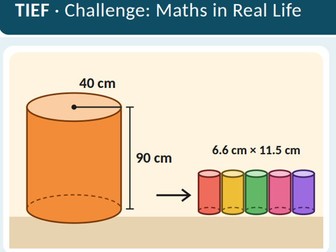
TIEF – Challenging Real-Life Problems (Grades 8–9)
Students apply completing the square to real contexts:
finding the maximum height of a ball and when it lands
the selling price that gives a café the greatest profit
the largest area of a fenced pen
whether a boat can pass under a bridge arch
the width of a phone screen in exact surd form using Pythagoras
the turning point of a family of curves