


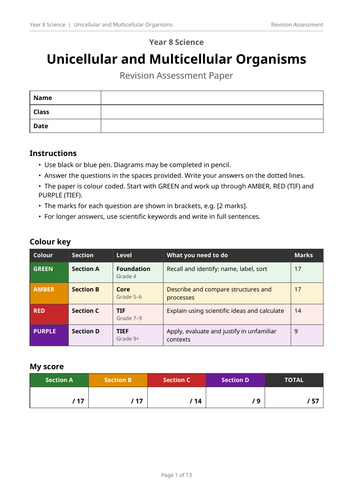
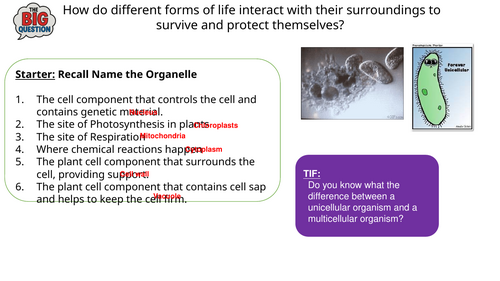
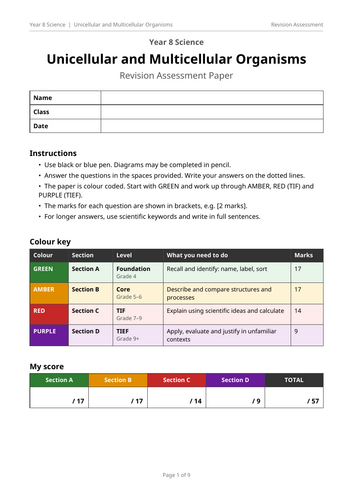
Year 8 Science revision assessment on Unicellular and Multicellular Organisms, written in the style of ExamPro exam questions. It’s worth 57 marks over 12 pages, with 8 pages of questions and 4 pages of mark scheme. It’s based on your lesson slides and the Amoeba and Euglena information sheet.
It checks whether students can compare unicellular and multicellular organisms and explain how unicellular organisms like Amoeba and Euglena survive. It covers the lesson’s success criteria: naming examples, identifying structures, comparing the two groups, linking structure to survival, and explaining how diffusion limits cell size.
How it’s organised
The paper is split into four colour-coded sections that match the lesson’s grade bands. Students start at Green and work up as far as they can.
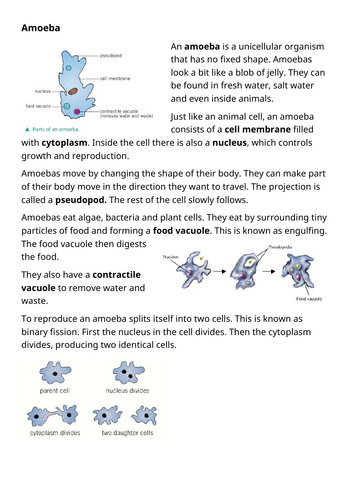
Green, Section A (Foundation, Grade 4), 17 marks. Recall and identification: matching cell parts to their functions, the meaning of “unicellular”, sorting organisms into unicellular and multicellular, completing sentences about multicellular organisms, labelling an Amoeba diagram, where Euglena live, and naming binary fission.
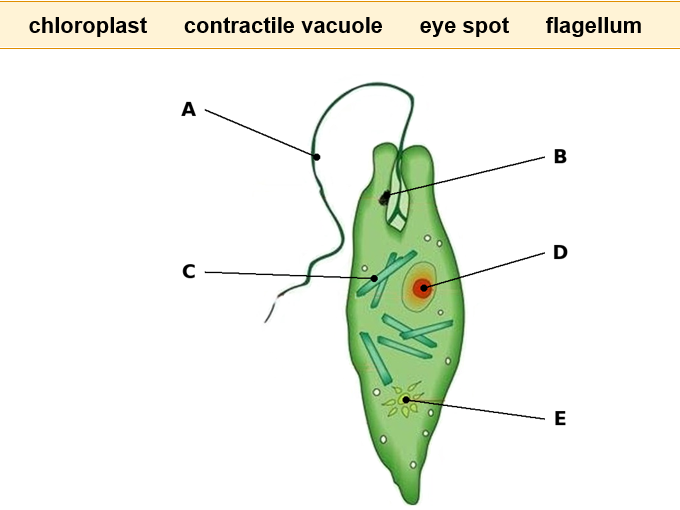
Amber, Section B (Core, Grade 5–6), 17 marks. Describing and comparing: labelling a Euglena diagram, completing a comparison table, and describing how an Amoeba feeds, how a Euglena moves towards light, what the contractile vacuole does, the stages of binary fission, and two differences between Amoeba and Euglena.
Red, Section C (TIF, Grade 7–9), 14 marks. Explaining and calculating: why Euglena need chloroplasts, and why multicellular organisms survive losing some cells but unicellular organisms don’t. It also includes a surface area to volume calculation with cubes and a 4-mark explanation of why Amoebas can’t grow to the size of whales, using the words diffusion, surface area, volume and distance.
Purple, Section D (TIEF, Grade 9+ extension), 9 marks. Applying knowledge to new situations: predicting and explaining how Euglena respond in a half-covered test tube, and a 6-mark “Lost in the Pond” question on whether an Amoeba or a Euglena is more likely to survive a week in a dark pond.
Something went wrong, please try again later.
This resource hasn't been reviewed yet
To ensure quality for our reviews, only customers who have purchased this resource can review it
Report this resourceto let us know if it violates our terms and conditions.
Our customer service team will review your report and will be in touch.
£3.00