


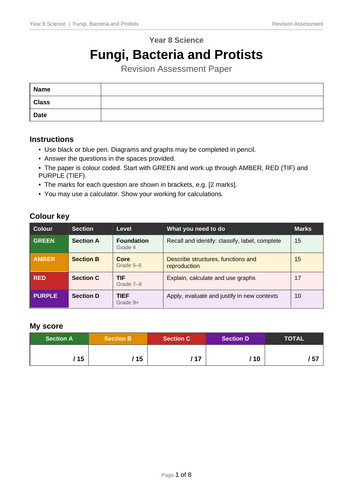
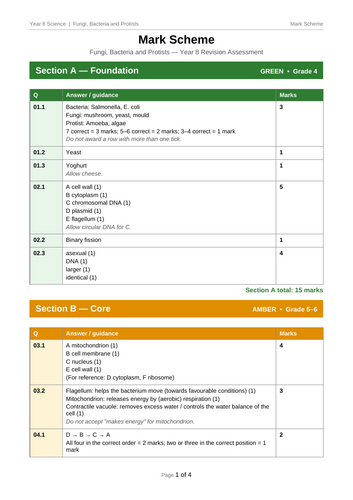
Year 8 Science revision assessment on Fungi, Bacteria and Protists, written in the style of ExamPro exam questions. It’s worth 57 marks and comes as two separate PDFs: an 8-page question paper and a 4-page mark scheme. It’s based on your Fungi, Bacteria and Yeast lesson slides, the budding and binary fission support slides, and the ordering worksheet.
It checks whether students can explain how the structures of bacteria, fungi and protists help them survive, and how yeast and bacteria reproduce. It covers the lesson’s success criteria: recalling examples, identifying cell parts, describing budding and binary fission, explaining what key structures do, everyday uses of microbes, and calculating population growth from a graph.
How it’s organised
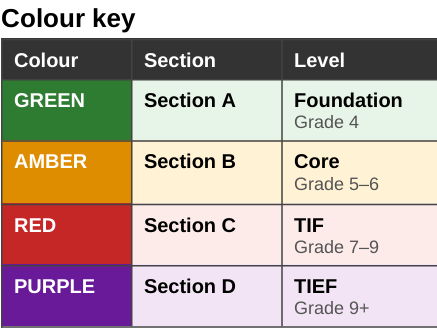
The paper is split into four colour-coded sections that match the lesson’s grade bands. Students start at Green and work up as far as they can.
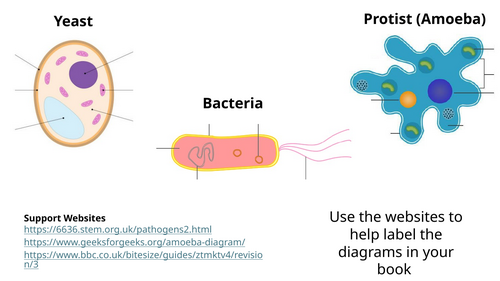
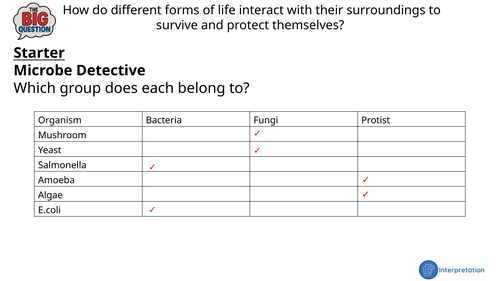
Green, Section A (Foundation, Grade 4), 15 marks. Recall and identification: sorting mushroom, Salmonella, Amoeba, yeast, E. coli, algae and mould into bacteria, fungi or protists, which microbe makes bread rise, a food made using bacteria, labelling a bacterial cell, naming binary fission, and completing sentences about binary fission.
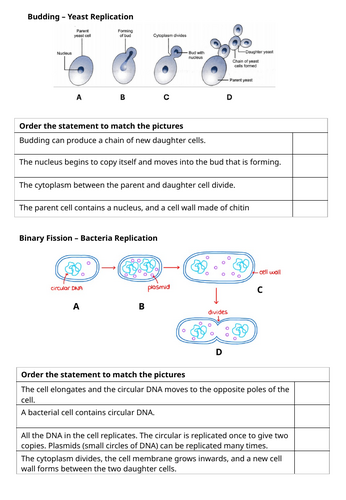
Amber, Section B (Core, Grade 5–6), 15 marks. Describing structures and reproduction: labelling a yeast cell, giving the functions of the flagellum, mitochondrion and contractile vacuole, and putting the stages of budding and binary fission in order (from your worksheet). It also asks for one similarity and one difference between the two processes, and why asexual reproduction produces identical cells.
Red, Section C (TIF, Grade 7–9), 17 marks. Explaining and calculating: a population growth graph where students describe the pattern, calculate the increase, calculate the rate of growth, predict the population and link the curve to binary fission. It also includes calculating how many bacteria grow on rice left out for 4 hours, why this is dangerous, and which microbe is best adapted to rotting fruit.
Purple, Section D (TIEF, Grade 9+ extension), 10 marks. Applying knowledge to new situations: a 6-mark question on whether a lab should grow bacteria or yeast to get microorganisms as quickly as possible, and a 4-mark question on harmful algal blooms (red tides) in UAE waters, covering why they spread so fast and how to reduce them.
Something went wrong, please try again later.
This resource hasn't been reviewed yet
To ensure quality for our reviews, only customers who have purchased this resource can review it
Report this resourceto let us know if it violates our terms and conditions.
Our customer service team will review your report and will be in touch.
£3.00