


Following a full read of the play, this series of lessons will support the teaching of the key characters in An Inspector Calls. It has been organised so as to look at a character every 2 lessons. This can be delivered as early GCSE teaching with Year 10 or for revision with Year 11.
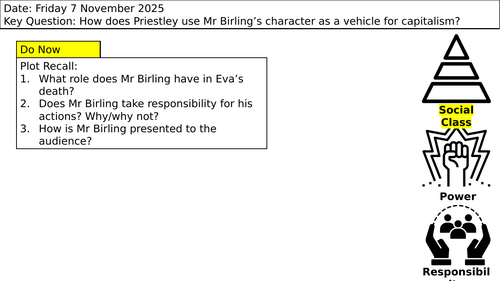
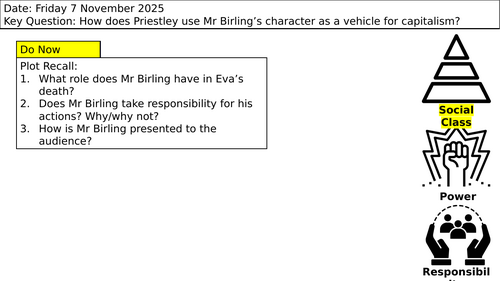
1 - How does Priestley use Mr Birling’s character as a vehicle for capitalism?
2 - How does Mr Birling view his role in Eva Smith’s downfall?
3 - How does Priestley present Sheila’s emotional journey and moral awakening?
4 - How does Sheila represent Priestley’s moral and social views?
5 - How does Gerald’s social position influence his actions?
6 - How does Priestley present Gerald’s relationship with Eva/Daisy?
7 - How does Mrs Birling represent upper-class prejudices?
8 - How does Priestley use dramatic irony to expose Mrs Birling’s flaws?
9- How does Priestley present Eric’s emotional journey and sense of guilt?
10 - How does Preistley use Eric and Gerald to represent different response to guilt and responsibility?
11 - How does Priestley convey his societal criticisms through The Inspector?
12 - How does Priestley present the Inspector in the opening of the play?
Get this resource as part of a bundle and save up to 34%
A bundle is a package of resources grouped together to teach a particular topic, or a series of lessons, in one place.
Something went wrong, please try again later.
This resource hasn't been reviewed yet
To ensure quality for our reviews, only customers who have purchased this resource can review it
Report this resourceto let us know if it violates our terms and conditions.
Our customer service team will review your report and will be in touch.
£2.30