


Animated circular motion PowerPoint for Edexcel GCSE Physics and Combined Science, Higher tier: centripetal force and orbits (spec 2.20–2.21).
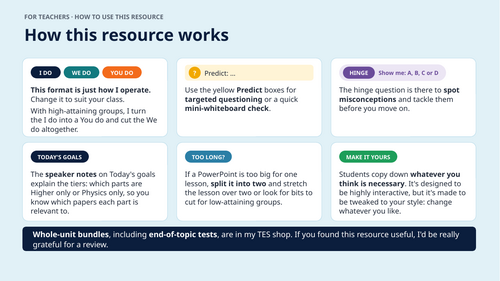
This PowerPoint is Lesson 9 of 12 in Topic 2, Motion and Forces, written for KS4 Higher tier classes taking Edexcel GCSE Physics (1PH0) or Combined Science (1SC0), and it takes about 60 minutes. All of this content is Higher only, and every slide says so. Every slide reveals on click, so velocity and force arrows appear one at a time around the circle. The deck is fully editable.
What the lesson covers
Spec 2.20: why constant speed in a circle means a changing velocity
Spec 2.20: why an object moving in a circle is accelerating, and the velocity along the tangent
Spec 2.21: the resultant force towards the centre, and how Newton’s first law explains it
Spec 2.21: why the speed stays constant when the force is at 90° to the velocity
Spec 2.21: what provides the centripetal force: tension, gravity, friction and normal contact force
Spec 2.21: what happens if the force stops, such as a string breaking
Spec 2.20 and 2.21: orbits, where gravity is the centripetal force, and why there is no outward force
What’s inside the 32 slides
A retrieval starter on the core practical from Lesson 8
A recap of speed, velocity and force as vectors from Lessons 1 and 6
Three concept blocks, each with a hinge question and an I do / We do / You do sequence of Edexcel-style exam questions
An exam-answer slide on linking direction, velocity and acceleration in one chain
Model answers on the Moon, a hammer thrower and a satellite in orbit
Mini-whiteboard quick-fire checks, a summary slide and an exit ticket
Common mistakes covered
Students often write “constant velocity” when they mean constant speed, and many think there is an outward force. Every explanation in the lesson follows the same steps. The direction changes, so the velocity changes, so the object accelerates, so there must be a resultant force towards the centre. A car going round a bend shows why passengers feel pushed outwards even though no outward force acts.
Part of a complete unit
This is Lesson 9 of 12 in my Edexcel GCSE Physics Motion and Forces unit. Foundation groups can skip it and move straight to Lesson 10.
Previous lesson: Acceleration Core Practical Lesson | Edexcel GCSE Physics https://www.tes.com/teaching-resource/resource-13690677
Next lesson: Momentum & Newton’s Third Law Lesson | Edexcel GCSE [https://www.tes.com/teaching-resource/resource-13690691
The full unit: all 12 lessons, a revision lesson and two end of topic tests in the Motion and Forces Unit bundle https://www.tes.com/teaching-resource/motion-and-forces-unit-edexcel-gcse-physics-13695559
Last updated: November 2026
Something went wrong, please try again later.
This resource hasn't been reviewed yet
To ensure quality for our reviews, only customers who have purchased this resource can review it
Report this resourceto let us know if it violates our terms and conditions.
Our customer service team will review your report and will be in touch.
£3.50