


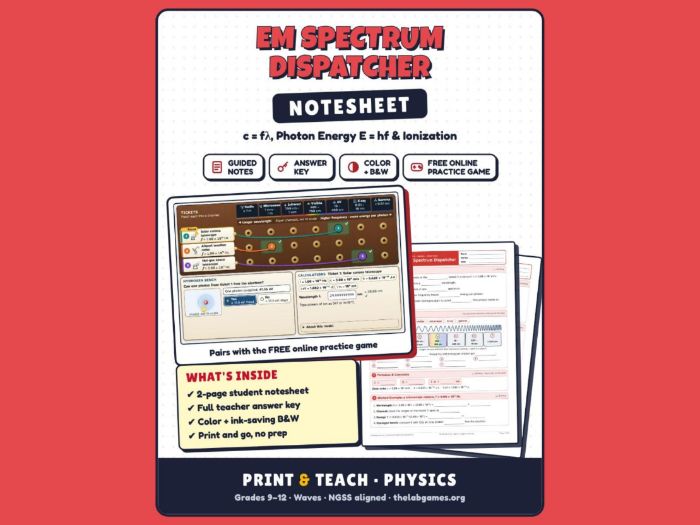

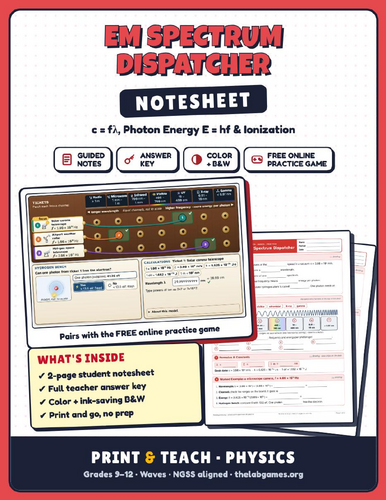
Help students see the whole electromagnetic spectrum as one family of waves. This roomy, student-friendly 2-page notesheet has students label the seven parts of the spectrum in order with their wavelength ranges, use c = fλ to turn a frequency into a wavelength, and use E = hf to find the energy of one photon. A worked example walks through one device from frequency to channel to the hydrogen ionization test.
It pairs with EM Spectrum Dispatcher, a free online practice game at thelabgames.org where students run a switchboard, patch each device into its spectrum channel and test whether one photon can ionize hydrogen. Use it in class, for absent-student makeups, or on sub days. A complete teacher key with every value worked out is included.
What’s Included
- Student notesheet (2 pages) in full color AND black & white
- Teacher answer key (red answers) in full color AND black & white
What Students Do
- Background fill-in: the speed of light, frequency vs wavelength, one continuous spectrum, photon energy and ionization
- Label the Switchboard: name the seven bands from radio to gamma using their wavelength ranges, and describe how wavelength, frequency and photon energy change across the spectrum
- Formulas & Constants: fill in λ = c ÷ f, E = hf and the metre-to-nanometre conversion
- Worked Example: a 6.00 × 10¹⁴ Hz camera, from wavelength to band to photon energy in eV
- Practice Tickets: place a radar in its band, find an infrared wavelength in nm, decide whether a UV photon ionizes hydrogen, and (AP) calculate photon energy in eV for extreme UV
- Key Ideas: frequency vs wavelength, energy per photon vs brightness, and why not all UV is ionizing
- My Runs: a log for tracking practice scores
Skills & Standards
- Electromagnetic spectrum order and wavelength ranges, c = fλ, photon energy E = hf, electronvolts, ionizing vs non-ionizing radiation
- Supports NGSS HS-PS4-4, HS-PS4-5
- Grades 9–12 Physics (with an AP Physics 2 practice problem)
Great For
- Waves and light units
- Absent-student makeups
- Sub plans
- Homework or stations
- Test review
Something went wrong, please try again later.
This resource hasn't been reviewed yet
To ensure quality for our reviews, only customers who have purchased this resource can review it
Report this resourceto let us know if it violates our terms and conditions.
Our customer service team will review your report and will be in touch.
$2.49