


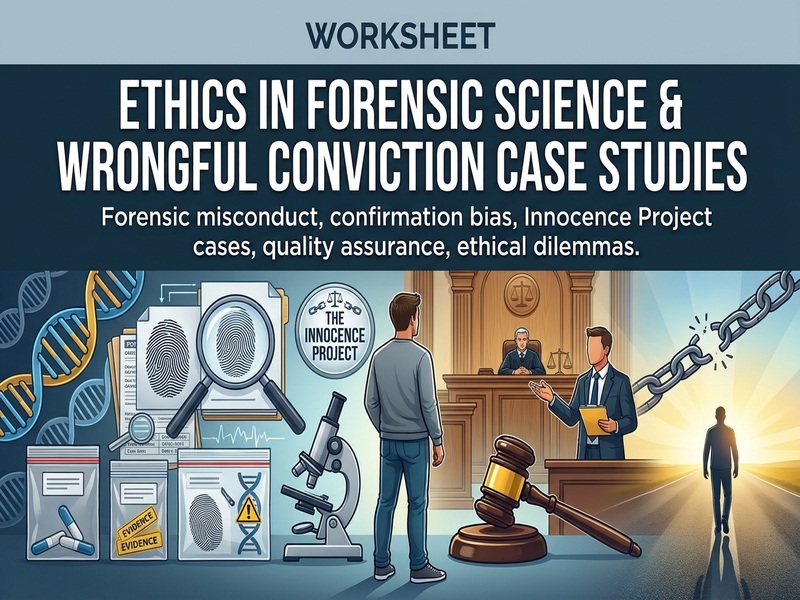
Take your Forensic Science, Criminal Justice, or CTE Law Enforcement class beyond basic crime scene investigation with this rigorous, 67-page Applied Theory Manual, Case Study Workbook, and Instructor Resource Suite!
Why do forensic scientists make mistakes? How do cognitive bias, “junk science,” and crime lab misconduct lead to wrongful convictions—and how does modern DNA technology overturn them?
Designed for Grades 11–12, CTE Criminalistics, Pre-Law, and Introductory Undergraduate programs, this comprehensive, no-prep curriculum bridges the gap between empirical laboratory science, cognitive psychology, quality assurance, and constitutional law. Students step into the role of forensic auditors and legal investigators using the proprietary Four-Pillar Integrity Audit (FIA) framework to dissect landmark real-world scandals and mock case files.
WHAT’S INCLUDED IN THIS 67-PAGE COMPREHENSIVE RESOURCE:
PART 1: Applied Theory Manual & Landmark Case Reconstructions (Pages 1–22)
Introduction & The Four-Pillar Integrity Audit (FIA): Explores the clash between the adversarial legal system and empirical scientific method.
Chapter 1: The Human Factor (Cognitive & Confirmation Bias): Deep dive into top-down processing, contextual contamination, ACE-V fingerprint circular reasoning, and Linear Sequential Unmasking (LSU) mitigation protocols.
Chapter 2: Forensic Misconduct & Systemic Malfeasance: Examines dry-labbing, testimonial overreach, Brady v. Maryland violations, and 3 in-depth real-world case reconstructions:
Case Study 2.1: The Massachusetts Drug Lab Scandals (Annie Dookhan & Sonja Farak)
Case Study 2.2: The Manufactured Serology of Fred Zain
Case Study 2.3: The Brandon Mayfield FBI Fingerprint Error
Chapter 3: Quality Assurance, Standardization & Accreditation: Covers ISO/IEC 17025, blind proficiency testing, the landmark NAS (2009) and PCAST (2016) reports, invalidated disciplines (bite marks & microscopic hair), Daubert gatekeeping, and the Innocence Project DNA exoneration framework (RFLP vs. STR & mtDNA).
Chapter Checkpoints: Built-in review prompts at the end of every chapter.
PART 2: 10-Worksheet Student Casework Audit Workbook (Pages 23–42)
Features 100 rigorous analytical prompts (fill-in-the-blank, scenario diagnostics, transcript re-writes, SOP redesigns, and essay prompts) across 10 focused worksheets:
Worksheet 1: Epistemic Bias & Cognitive Traps in Forensic Evidence Analysis
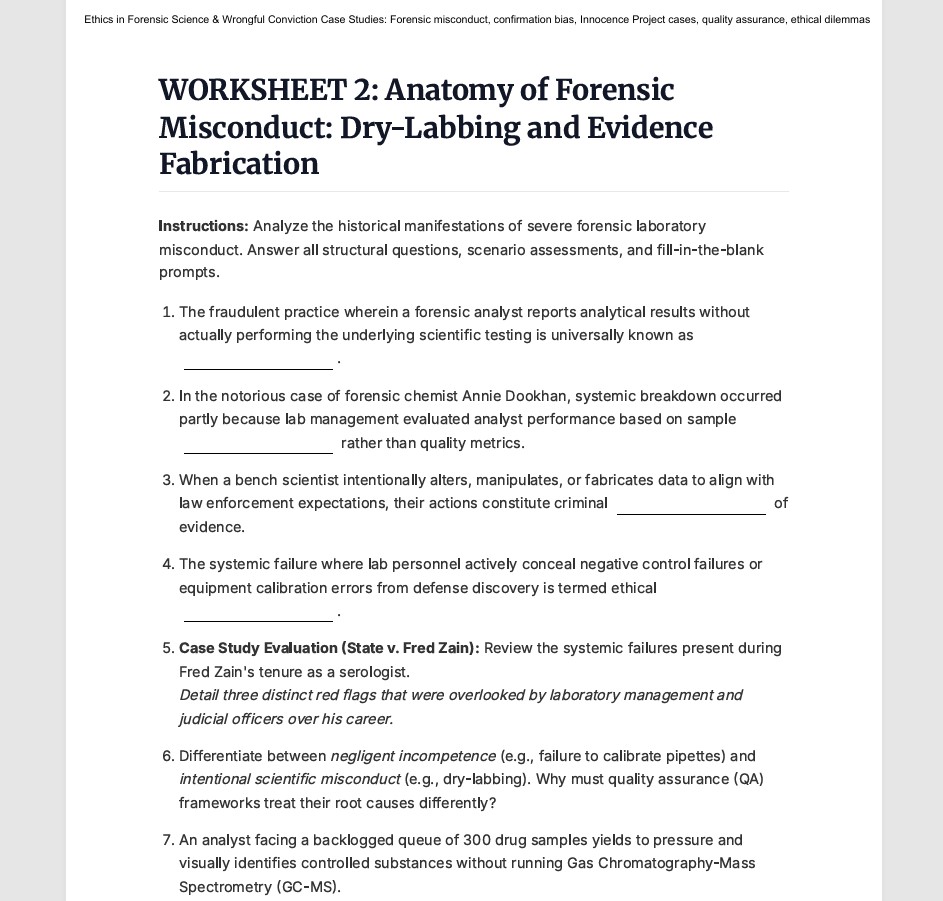
Worksheet 2: Anatomy of Forensic Misconduct: Dry-Labbing & Evidence Fabrication
Worksheet 3: The Innocence Project Methodology & Post-Conviction DNA Exonerations
Worksheet 4: Invalidated Forensic Disciplines: Microscopic Hair & Bite Mark Analysis
Worksheet 5: Quality Assurance, ISO/IEC 17025 Accreditation & SOP Adherence (Includes drafting a Non-Conformance Report)
Worksheet 6: Ethical Dilemmas in Expert Witness Testimony & The “CSI Effect”
Worksheet 7: Comprehensive Mock Case Audit: State v. Raymond DeLaCruz
Worksheet 8,9,10
Something went wrong, please try again later.
This resource hasn't been reviewed yet
To ensure quality for our reviews, only customers who have purchased this resource can review it
Report this resourceto let us know if it violates our terms and conditions.
Our customer service team will review your report and will be in touch.
$52.00