

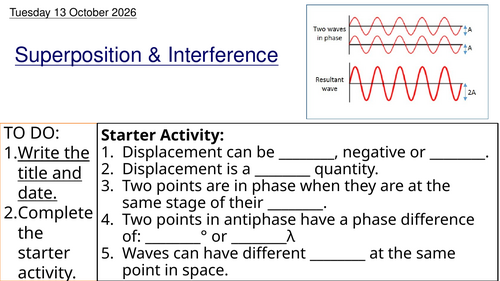

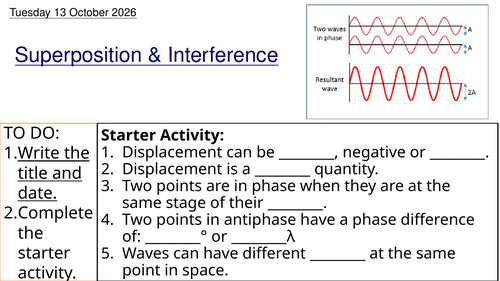
This Pearson BTEC Applied Science Unit 1 Physics PowerPoint covers superposition and interference, including constructive and destructive interference and coherence.
Designed for the Waves in Communication topic, this comprehensive lesson develops students’ understanding of how waves interact when they overlap. The principle of superposition states that the resultant displacement at any point is equal to the sum of the individual wave displacements. Students explore how this principle explains interference and the formation of interference patterns.
The PowerPoint includes a starter activity with answers, clearly defined learning objectives, key scientific terminology, detailed explanations, diagrams and worked examples. Students learn to calculate resultant displacement by combining positive and negative displacements and distinguish between constructive and destructive interference, including complete and partial cancellation.
The lesson also examines the relationship between phase difference and interference, explaining how waves in phase produce maximum constructive interference, while equal-amplitude waves in antiphase produce complete destructive interference. Students investigate coherent sources, understanding why a constant phase difference and equal frequency are necessary for stable interference patterns.
Practical demonstrations using a ripple tank and slinky help students visualise wave superposition and interference. Comparison activities, structured calculations, practice questions and homework provide further opportunities to develop understanding and apply scientific principles.
The resource concludes with 10 Check Your Understanding questions and answers, providing opportunities for assessment, consolidation and exam preparation.
This resource is suitable for classroom teaching, practical demonstrations, independent learning and revision for students studying Pearson BTEC Applied Science Unit 1 Physics.
File format: Editable PowerPoint (.pptx), allowing teachers to adapt the content to their teaching requirements.
Resource date: October 2026.
Get this resource as part of a bundle and save up to 34%
A bundle is a package of resources grouped together to teach a particular topic, or a series of lessons, in one place.
Bundle
Unit 1 Waves in Communication Bundle Physics Pearson BTEC Applied Science
This Pearson BTEC Applied Science Unit 1 Physics bundle contains 19 editable PowerPoint lessons covering Section C: Waves in Communication (C1, C2 and C3). It provides a comprehensive teaching sequence, progressing from fundamental wave properties to modern communication technologies, with opportunities to develop theoretical, mathematical and practical skills. A wave is an oscillation or disturbance that transfers energy without a net transfer of matter. The bundle explores how waves behave, interact and transmit information, linking scientific principles to everyday and technological applications. C1: Working with Waves (13 lessons) covers wave characteristics, period, frequency, wave graphs, the wave equation, transverse and longitudinal waves, sound, ultrasound and echolocation. Further lessons explore displacement, phase difference, superposition, interference, path difference, coherence, diffraction and diffraction gratings. Students also investigate emission spectra, identification of elements, stationary waves, resonance, musical instruments and waves on strings. C2: Waves in Communication (3 lessons) covers reflection, refraction, refractive index, critical angle, total internal reflection and optical fibres. Students explore analogue and digital signals, signal attenuation, noise, sampling, quantisation, binary encoding, broadband communication and wavelength division multiplexing. C3: Use of Electromagnetic Waves in Communication (3 lessons) covers the electromagnetic spectrum, frequency and wavelength calculations, satellite communication, mobile phone networks, Bluetooth, Wi-Fi and infrared. Students also investigate the inverse square law, wave intensity and signal strength through worked calculations and practical applications. This bundle contains 19 editable PowerPoint (.pptx) presentations. Resources feature structured teaching content, scientific diagrams, worked calculations, student activities, comparison exercises, practice questions and accompanying answers, with practical investigations and examination-style questions included where appropriate. Updated in November 2026, this bundle is suitable for classroom teaching, practical investigations, examination preparation, revision, cover lessons and independent study. It is designed to support the complete Section C teaching content of Pearson BTEC Level 3 National Applied Science – Unit 1: Principles and Applications of Science I.
£24.99
Bundle
C1 Working with Waves Bundle Unit 1 Physics Pearson BTEC
This Pearson BTEC Applied Science Unit 1 Physics – C1: Working with Waves bundle contains 13 editable PowerPoint lessons covering wave properties, behaviour and applications. It provides a structured teaching sequence, progressing from fundamental wave characteristics to interference, diffraction, stationary waves and resonance. A wave is an oscillation or disturbance that transfers energy without a net transfer of matter. The bundle begins by introducing the fundamental features of waves, including amplitude, wavelength, frequency, period and wave speed. Students develop their mathematical skills through wave graphs, unit conversions and calculations involving the wave equation. Transverse and longitudinal waves are compared, alongside applications involving sound, ultrasound and echolocation. Subsequent lessons explore displacement, phase difference, superposition, constructive and destructive interference, path difference and coherence. Students develop their understanding of how waves interact and apply these principles to different physical situations. The bundle also covers diffraction and diffraction gratings, including their application in analysing light. Students explore emission spectra and how characteristic spectral lines can be used to identify elements. The final lessons focus on stationary waves, resonance, musical instruments and waves on strings, developing students’ understanding of nodes, antinodes, harmonics and the relationships between wave frequency, wavelength and the properties of vibrating strings. This bundle contains 13 editable PowerPoint (.pptx) presentations, providing structured teaching content, scientific explanations, diagrams and opportunities to develop mathematical and analytical skills. The individual presentations can be adapted to suit different teaching approaches, lesson timings and student abilities. This resource bundle is suitable for classroom teaching, examination preparation, revision, cover lessons and independent study within Pearson BTEC Level 3 National Applied Science – Unit 1 Physics, C1: Working with Waves.
£17.49
Something went wrong, please try again later.
This resource hasn't been reviewed yet
To ensure quality for our reviews, only customers who have purchased this resource can review it
Report this resourceto let us know if it violates our terms and conditions.
Our customer service team will review your report and will be in touch.
£2.00