


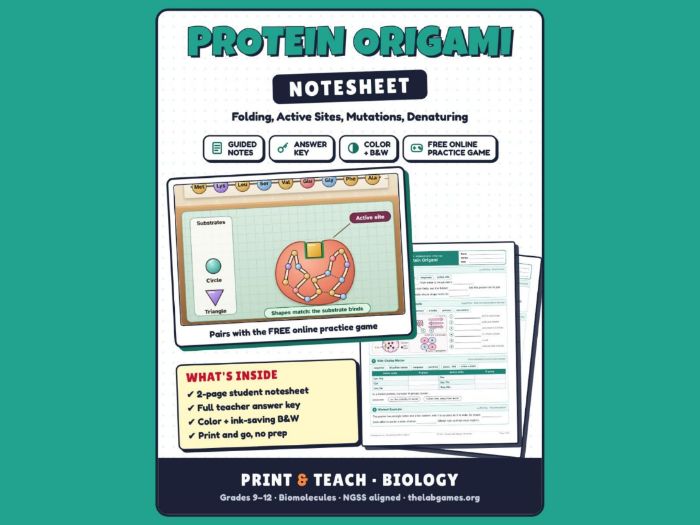
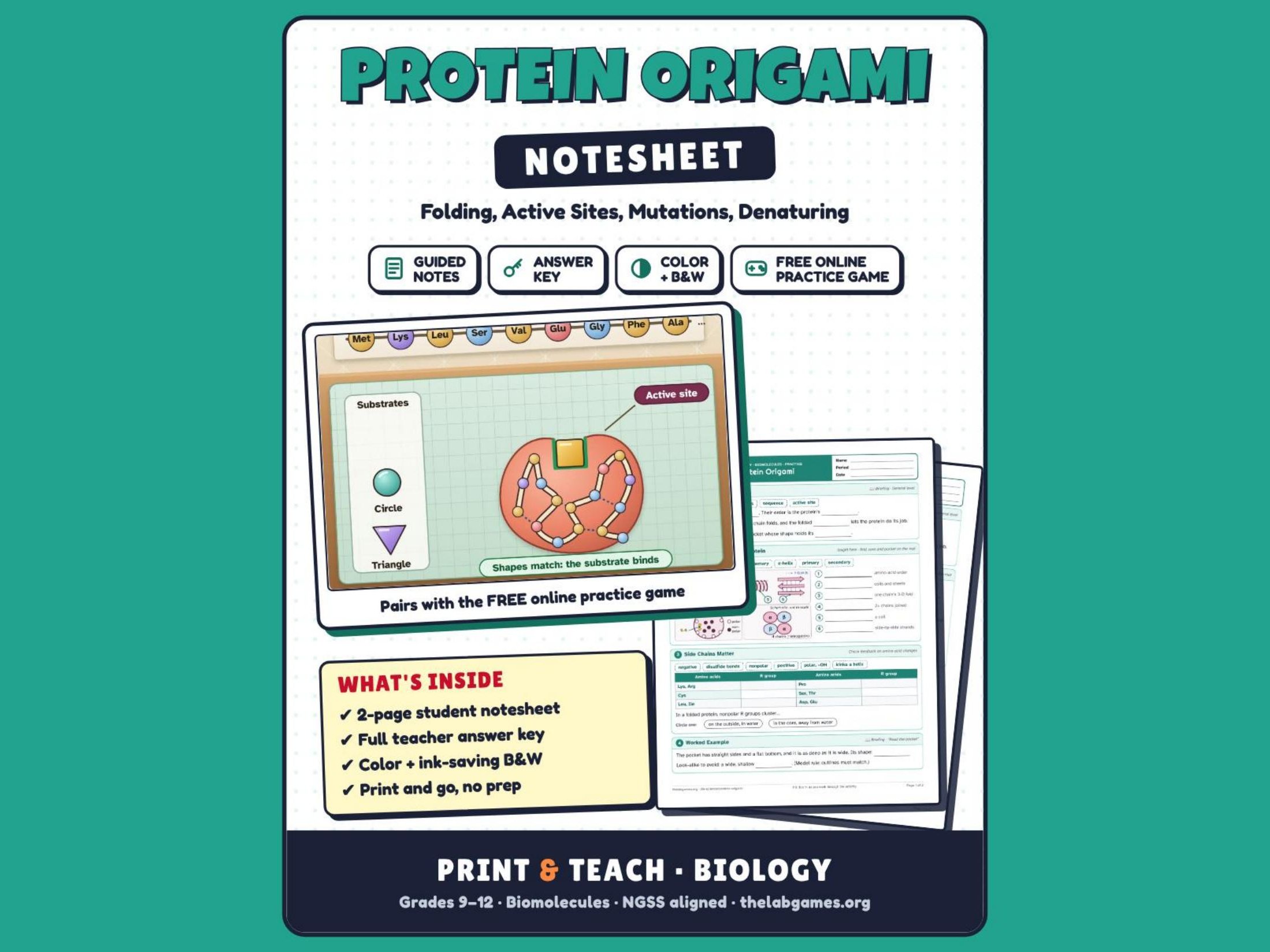
How does a chain of amino acids become a working protein? In this roomy, student-friendly 2-page notesheet, students fill in the background on amino acids, sequence, shape, active sites and substrates, label a diagram of the four levels of protein structure (primary, secondary with an α-helix and a β-pleated sheet, tertiary with a hydrophobic core and a disulfide bridge, and quaternary hemoglobin), sort amino-acid side chains by their properties, and read an active-site pocket in a worked example. On page 2 they work four folding orders built from the activity’s own generator: match a substrate to a pocket and judge three amino-acid changes from the observed shape and binding evidence. An AP box covers denaturing and sickle hemoglobin.
It pairs with Protein Origami, a free online practice game at thelabgames.org where students fit substrates to active sites, judge what an amino-acid change does and (AP) explain denaturing and sickle hemoglobin. Use it in class, for absent-student makeups, or on sub days. A complete teacher key is included.
What’s Included
- Student notesheet (2 pages) in full color AND black & white
- Teacher answer key (red answers) in full color AND black & white
What Students Do
- Background fill-in: amino acids, sequence, folded shape, active site and substrate
- How a Chain Becomes a Protein: label primary, secondary, tertiary and quaternary structure, an α-helix and a β-pleated sheet
- Side Chains Matter: classify amino-acid side chains as nonpolar, polar, charged, disulfide-forming or helix-breaking, and place nonpolar R groups in a folded protein
- Worked Example: read an active-site pocket’s shape and spot its look-alike
- Folding Orders: a substrate-fit order and three amino-acid substitutions judged from shape and binding evidence
- AP Extension: denaturing keeps peptide bonds intact; the sickle-cell substitution is a change in primary structure
- My Runs: a log for tracking practice scores
Skills & Standards
- Protein structure (primary, secondary, tertiary, quaternary), amino acids and R groups, hydrophobic core, disulfide bonds, enzyme active sites and substrates, structure and function, mutations and substitutions, denaturation, sickle-cell hemoglobin
- Supports NGSS HS-LS1-1
- Grades 9–12 Biology (with an AP Biology extension)
Great For
- Biomolecules and enzymes units
- Absent-student makeups
- Sub plans
- Homework or stations
- Test review
Something went wrong, please try again later.
This resource hasn't been reviewed yet
To ensure quality for our reviews, only customers who have purchased this resource can review it
Report this resourceto let us know if it violates our terms and conditions.
Our customer service team will review your report and will be in touch.
$2.49