


This 50-minute KS4 Biology lesson introduces quadrats and population estimation in a clear, structured, and SEN-friendly way. Created for students in an SEN Secondary School (Autism provision).
Students build understanding through explicit teaching, scaffolded maths, practical investigation, regular checking for understanding, and a final plenary that demonstrates that population estimation using quadrats actually works.
If you do not have access to a field, students can simulate sampling indoors using two coloured post-it notes / scrunched paper to represent daisies and buttercups.
Lesson Structure:
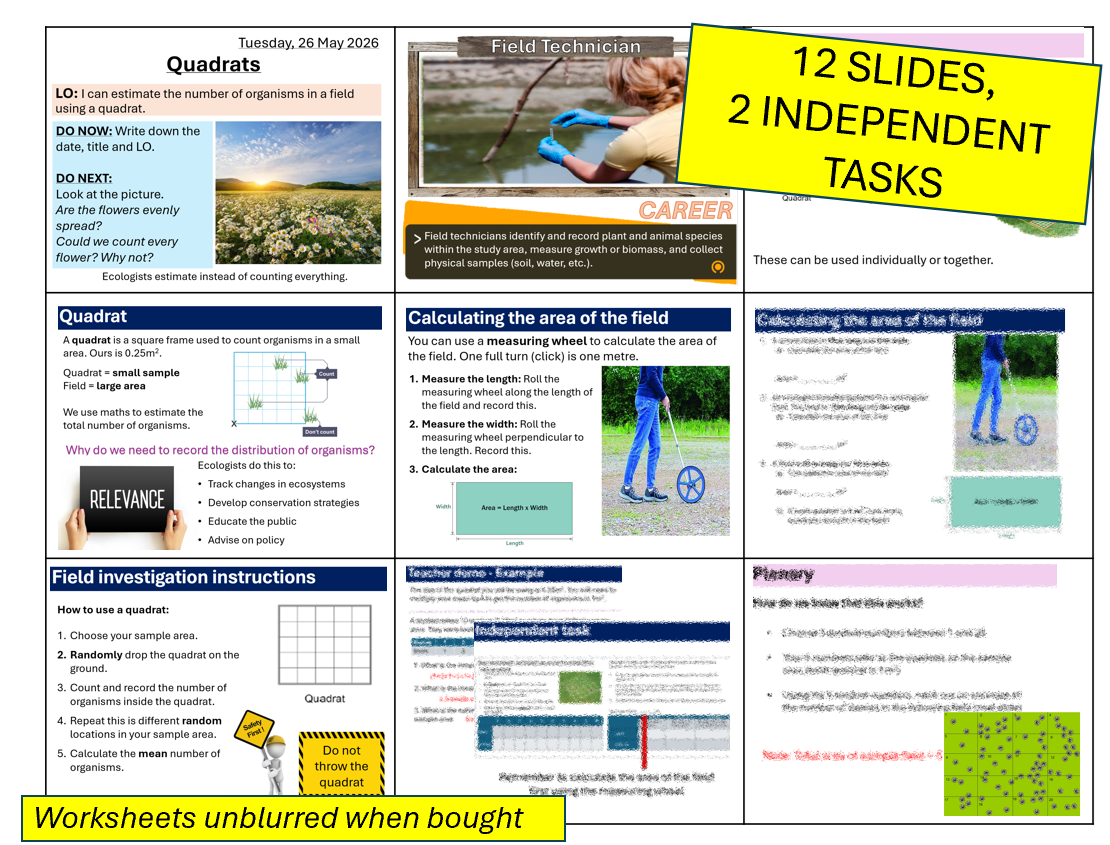
Starter – Why can’t we count everything?
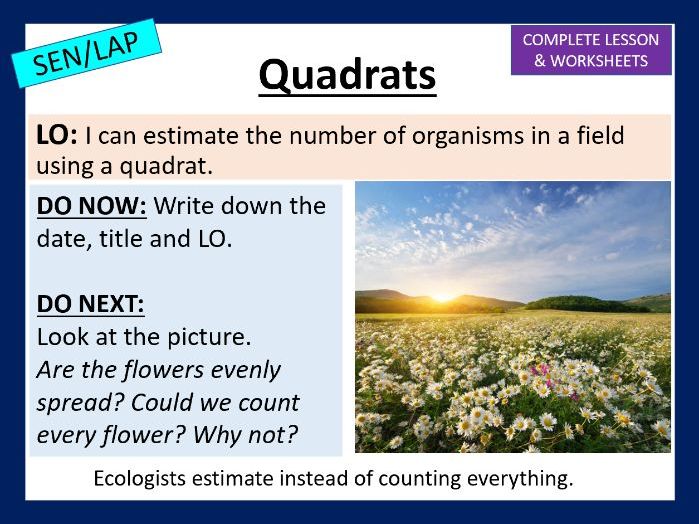
Students discuss whether organisms in a field are evenly spread and whether it would be practical to count every flower individually, introducing the need for estimation.
Career Link – Ecologist / Field Technician:
Students learn how ecologists estimate organism numbers in real ecosystems and why this is important for conservation, monitoring ecosystems, and scientific research.
Explicit Teaching – Quadrat Sampling:
Students are introduced to:
What a quadrat is
Why ecologists use sampling
How to calculate the area of a field using a measuring wheel
Why mean values are used
How population estimation works mathematically
Regular checking for understanding is built in throughout.
Activity 1 – Area Calculations:
Students practise calculating the area of sample fields before applying this to ecological sampling.
Teacher Demo – Worked Example:
Students are guided step-by-step through estimating a snail population using 10 sample quadrats, helping break down the maths into manageable stages.
Independent Practical Investigation:
Students use quadrats to sample daisies and buttercups (or daisies only), collect data, calculate a mean, scale to 1m², and estimate total population size.
Plenary – Proof That Sampling Works:
This lesson ends with a powerful plenary where students choose 5 random quadrat numbers from a model field and use sampling to estimate the number of daisies. They then compare their estimate to the actual total shown on the board, helping students see that sampling methods produce realistic and scientifically valid estimates.
Includes:
Fully resourced PowerPoint
2 worksheet versions (daisies + buttercups OR daisies only)
All resources unblurred when bought
SEN-friendly scaffolded learning
Practical alternative for indoor classrooms without field access
Something went wrong, please try again later.
This resource hasn't been reviewed yet
To ensure quality for our reviews, only customers who have purchased this resource can review it
Report this resourceto let us know if it violates our terms and conditions.
Our customer service team will review your report and will be in touch.
£2.95