


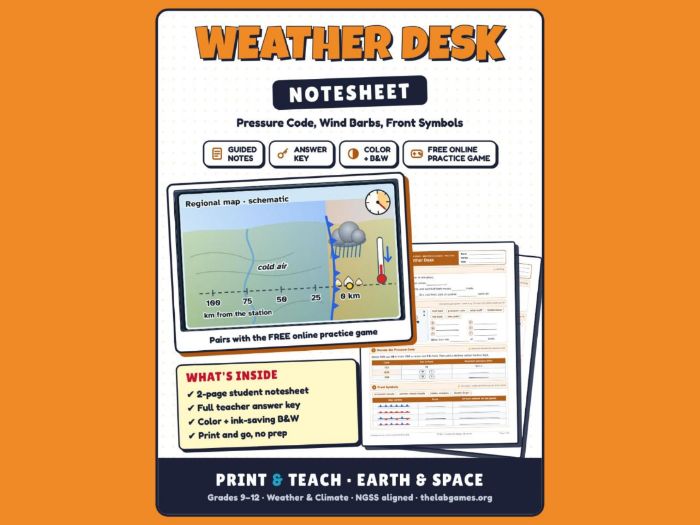
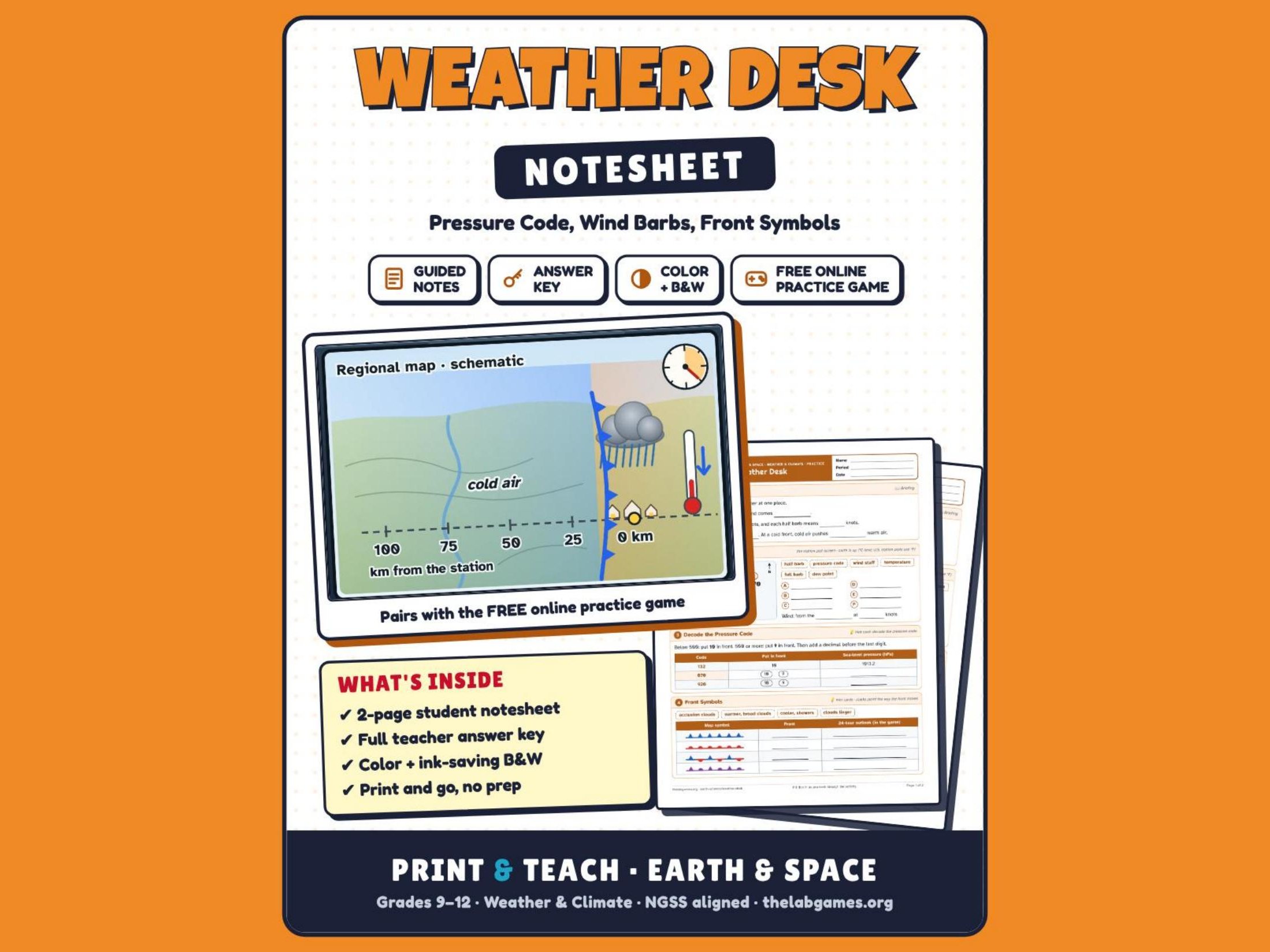
Help students read a weather map like a forecaster. In this roomy, student-friendly 2-page notesheet, students label the parts of a station model, decode three-digit pressure codes into hectopascals, read wind direction and speed from the staff and barbs, and match the four front symbols to their names and 24-hour outlooks. They then work four forecast orders: decode a plot, name a front, decide whether a front arrives within 24 hours from distance ÷ speed, and (AP) find an arrival time.
It pairs with Weather Desk, a free online practice game at thelabgames.org where students decode station plots, name fronts and put a forecast on air. Use it in class, for absent-student makeups, or on sub days. A complete teacher key is included.
What’s Included
- Student notesheet (2 pages) in full color AND black & white
- Teacher answer key (red answers) in full color AND black & white
What Students Do
- Background fill-in: what a station model shows, which way the wind staff points, what full and half barbs mean, and what happens at a cold front
- Label the Station Model: temperature, dew point, pressure code, wind staff, full barb and half barb, plus the wind’s direction and speed
- Decode the Pressure Code: when to put 10 or 9 in front, and the sea-level pressure in hPa
- Front Symbols: name the cold, warm, stationary and occluded fronts from their map symbols and give each one’s 24-hour outlook
- Forecast Orders: decode a station plot, name a front and its outlook, decide whether a distant front arrives within 24 hours, and (AP) calculate an arrival time
- Key Ideas: wind direction from the staff, the pressure-gradient force, hectopascals and millibars, and forecasts as tendencies
- My Runs: a log for tracking practice scores
Skills & Standards
- Weather maps, station models, sea-level pressure, hectopascals and millibars, wind barbs and knots, air masses, cold, warm, stationary and occluded fronts, forecasting with distance ÷ speed
- Supports NGSS MS-ESS2-5 (high school review)
- Grades 9–12 Earth Science (with AP Environmental Science extension problems)
Great For
- Weather and climate units
- Absent-student makeups
- Sub plans
- Homework or stations
- Test review
Something went wrong, please try again later.
This resource hasn't been reviewed yet
To ensure quality for our reviews, only customers who have purchased this resource can review it
Report this resourceto let us know if it violates our terms and conditions.
Our customer service team will review your report and will be in touch.
$2.49