


TES lesson description
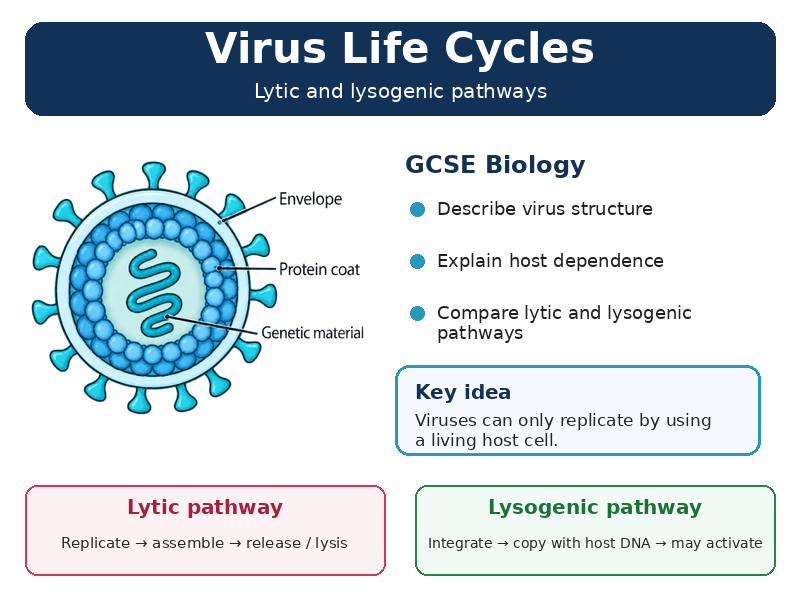
A complete GCSE Biology lesson on virus life cycles, designed to develop students’ understanding of virus structure, host-cell dependence, and the lytic and lysogenic pathways. Students learn that viruses contain genetic material surrounded by a protein coat (capsid) and can only replicate using the machinery of a living host cell. Virus_Life_Cycles
The lesson takes students step-by-step through the lytic pathway—attachment, entry, replication, assembly and release/lysis—and contrasts this with the lysogenic pathway, where viral genetic material integrates into host DNA and can be copied during cell division before later entering the lytic pathway. Virus_Life_Cycles Virus_Life_Cycles
Activities include a retrieval Do Now, key vocabulary, labelled diagrams, mini-whiteboard AFL, sequencing and hinge questions, comparison tasks, bacteriophage plaque analysis with calculations, GCSE-style exam questions with a mark scheme, and a final exit ticket. The lesson combines explicit teaching, retrieval practice, mathematical skills and frequent checks for understanding, making it suitable for a structured GCSE Biology lesson or revision session. Virus_Life_Cycles Virus_Life_Cycles
Learning objectives: Describe virus structure; explain why viruses depend on host cells to replicate; and compare the lytic and lysogenic pathways. Virus_Life_Cycles
Something went wrong, please try again later.
This resource hasn't been reviewed yet
To ensure quality for our reviews, only customers who have purchased this resource can review it
Report this resourceto let us know if it violates our terms and conditions.
Our customer service team will review your report and will be in touch.
£4.00