


What, How, Why is a writing activity that helps students develop more detailed literary analysis by connecting carefully chosen quotations to a clear analytical explanation.
Macbeth is used throughout the resource as the example text, making the activities particularly useful for English teachers teaching Shakespeare and literature. As Macbeth is one of the most commonly taught Shakespeare plays in UK secondary English classrooms across KS3-4, the examples provide a familiar and immediately applicable context for many teachers and students.
The activity encourages students to explore what the writer presents, how they present it through language, form and structure, and why these choices are significant. Students learn to move beyond identifying a quotation or technique and instead develop a clear explanation of its meaning, effects and significance.
However, What, How, Why is not intended to create a formulaic or limiting structure. Instead, it provides a flexible writing frame that helps students develop their ideas and make meaningful connections between the writer’s choices, their effects, and the wider character, themes and message of the text.
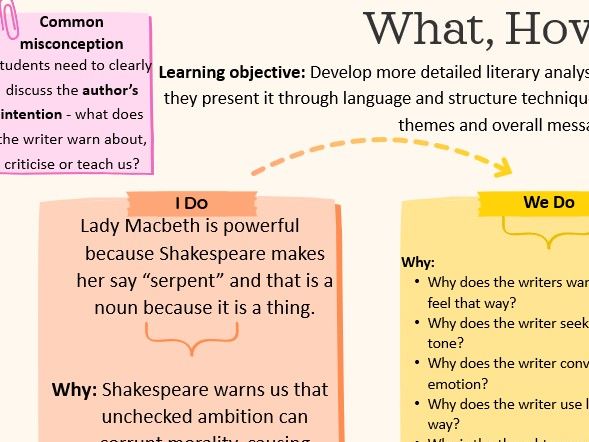
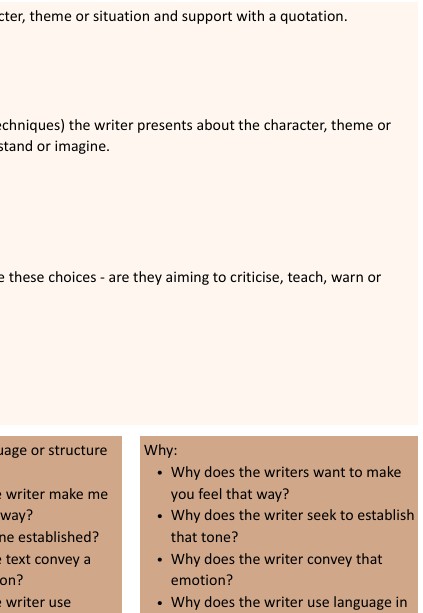
Learning Objective: Develop more detailed literary analysis by explaining what the writer presents, how they present it through language and structure techniques, and why this is significant to the character, themes and overall message of the text.
What’s Included?
A ready-to-use presentation
An accompanying student worksheet in PDF format
An overview of the lesson activities
I Do: Teacher modelling
We Do: Guided practice
You Do: Independent application
A modelled example of effective What, How, Why analysis
Common misconceptions and guidance for addressing them
The What, How, Why activity encourages students to develop a clear chain of analysis rather than treating quotations and techniques as isolated points. Students consider what is being presented, how the writer’s choices communicate meaning, and why those choices are significant.
This helps students move from simple identification and explanation towards analysis that is detailed, connected and perceptive, while giving them a practical framework for developing their own interpretations.
Something went wrong, please try again later.
This resource hasn't been reviewed yet
To ensure quality for our reviews, only customers who have purchased this resource can review it
Report this resourceto let us know if it violates our terms and conditions.
Our customer service team will review your report and will be in touch.
£2.00