


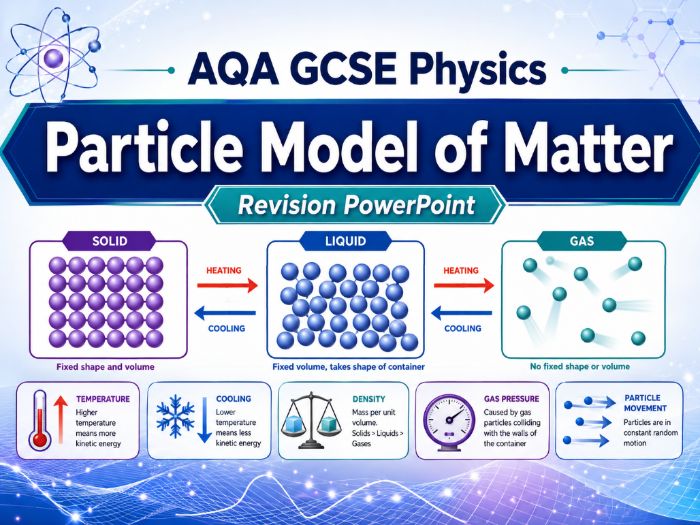
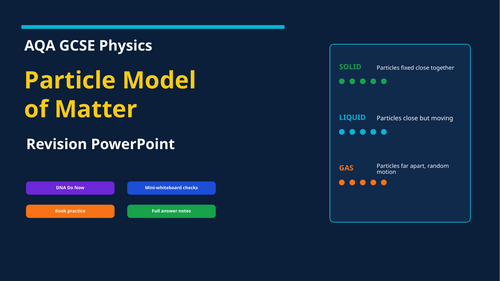
AQA GCSE Physics Particle Model of Matter revision PowerPoint covering density, changes of state, internal energy, specific heat capacity, latent heat and gas pressure.
This editable PowerPoint resource supports students revising AQA GCSE Physics: Particle Model of Matter. It is designed for classroom display and follows a clear revision structure with Do Now retrieval, teacher modelling, mini-whiteboard checks, independent book practice and correction slides.
The resource covers key physics content including density of materials, particle arrangement in solids, liquids and gases, finding the density of regular and irregular objects, changes of state, melting, freezing, evaporating, condensing, sublimation, deposition, conservation of mass during state changes, physical and chemical changes, internal energy, kinetic energy and potential energy of particles, temperature change, specific heat capacity, specific latent heat, latent heat of fusion, latent heat of vaporisation, heating and cooling curves, particle motion in gases, Brownian motion, gas pressure and pressure-volume relationships.
Physics-only and Higher tier content is also included, such as pressure in gases, pressure changes in sealed containers, the relationship between gas temperature and pressure, the inverse relationship between pressure and volume for a fixed mass of gas, using (p_1V_1 = p_2V_2), and explaining how doing work on a gas increases its internal energy and temperature.
Each topic begins with a Do Now Activity using a DNA-style retrieval format. These questions revisit previous learning and help students settle quickly into revision. Each Do Now activity is followed by a full answer slide so students can self-correct before moving on.
Students practise calculating density, rearranging equations, explaining changes of state using the particle model, describing internal energy, calculating temperature change using specific heat capacity, calculating energy needed for a change of state using specific latent heat, interpreting heating and cooling curves, explaining gas pressure using particle collisions and applying pressure-volume calculations.
This resource is suitable for:
AQA GCSE Physics
AQA Combined Science Physics
Year 10 and Year 11 revision
Foundation and Higher tier students
Physics-only particle model content
Higher tier gas pressure content
Intervention lessons
Retrieval practice
Exam preparation
Whole-class teaching
Mini-whiteboard questioning
Calculation practice
Required practical and equation revision
Cover lessons with teacher guidance
Included file type: Editable PowerPoint (.pptx)
The resource can be used as a complete revision lesson sequence, split into shorter intervention sessions, or used to target specific weaknesses in density, changes of state, internal energy, specific heat capacity, latent heat and gas pressure before assessments and GCSE exams.
Something went wrong, please try again later.
This resource hasn't been reviewed yet
To ensure quality for our reviews, only customers who have purchased this resource can review it
Report this resourceto let us know if it violates our terms and conditions.
Our customer service team will review your report and will be in touch.
£3.00