

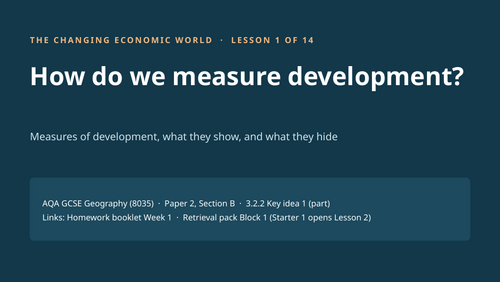

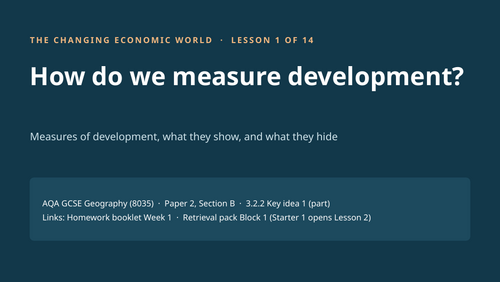
A free, complete one-hour lesson for AQA GCSE Geography’s The Changing Economic World (Paper 2, Section B): how do we measure development, and what do those measures hide? It is Lesson 1 of a 14-lesson sequence, and it works as a stand-alone lesson. Try it with a class before deciding whether to use the rest.
The big question: is a richer country always a more developed one? Students answer it with data. They compare the UK, Jamaica, India, Nigeria and Malawi using World Bank and UNDP figures, and finish by writing an exam-style answer.
What is in the lesson:
- A 22-slide PowerPoint with a Do Now (and answers), think–pair–share, HIC / NEE / LIC classification, and a sorting task on the nine measures in the specification.
- Definitions of GNI per head and HDI, then worked examples of the calculations students need: mean, “how many times as large” and range.
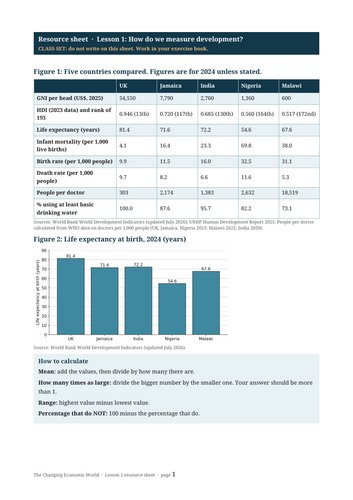
- A data task using a table and a chart, a puzzle on why Malawi’s death rate is lower than the UK’s, a matching task on the limitations of measures, and a map task on the “North–South” divide.
- A stretch activity with every task, for higher-attaining students.
- Two original exam-style questions (01.1 [2] and 01.2 [4]) with a writing frame, a student-friendly mark scheme, a model answer with a checklist, and an exit ticket with a red/amber/green check.
- A video slide linking to a short YouTube clip (Hans Rosling’s “200 Countries, 200 Years, 4 Minutes”), with a QR code and three watch-for questions.
- A two-sided printable resource sheet (Word and PDF). Students work in exercise books, so this is the only printing.
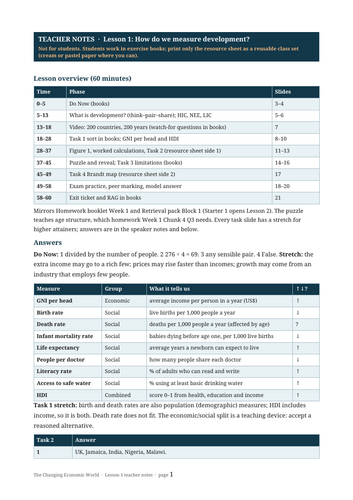
- Teacher notes: a minute-by-minute plan for 60 minutes, answers to every task and stretch, the mark scheme, a specification map, common misconceptions, and a table of commonly taught figures that are now out of date.
Want the rest? Lessons 2–14 cover the DTM, closing the gap, Jamaica, Nigeria, the UK economy, exam technique and an end-of-topic assessment: Changing Economic World: 14 AQA GCSE Lessons.
Something went wrong, please try again later.
This resource hasn't been reviewed yet
To ensure quality for our reviews, only customers who have downloaded this resource can review it
Report this resourceto let us know if it violates our terms and conditions.
Our customer service team will review your report and will be in touch.
£0.00