pptx, 466.54 KB
pptx, 466.54 KB
docx, 13.04 KB
docx, 13.04 KB
docx, 12.25 KB
docx, 12.25 KB
docx, 12.47 KB
docx, 12.47 KB
docx, 13.49 KB
docx, 13.49 KB
docx, 12.63 KB
docx, 12.63 KB
pdf, 565.84 KB
pdf, 565.84 KB

Complete KS3 lesson on chemosynthesis – life at deep-sea vents compared with photosynthesis: editable PowerPoint, worksheets, activity and answers.

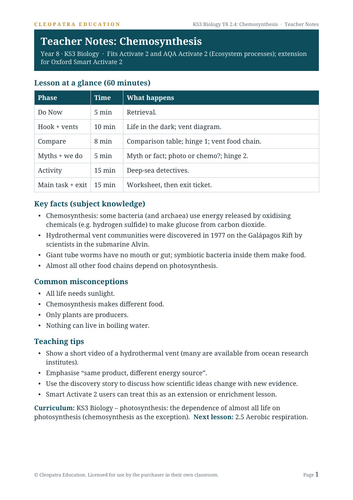
Perfect for Year 8 Biology. Students learn how bacteria at deep-sea hydrothermal vents make food using chemical energy, compare chemosynthesis with photosynthesis, build a vent food chain, and see how the 1977 discovery changed scientific ideas. Written for the Activate 2 and AQA Activate 2 courses (Ecosystem processes, lesson 2.4 Chemosynthesis), and works as an extension lesson for Oxford Smart Activate 2.

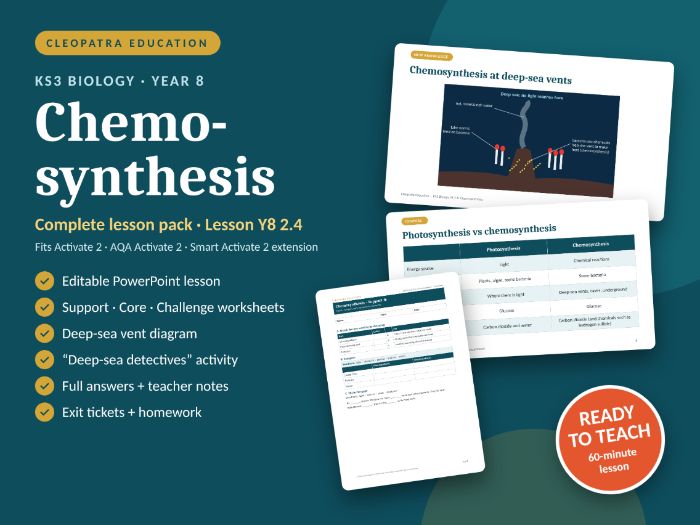
WHAT’S INCLUDED (6 editable files + PDF copies)

  1. Lesson PowerPoint – 20 slides
  • Do Now retrieval starter
  • Know / Explain / Apply learning objectives
  • Key words with definitions
  • Hook: “Life in the dark”
  • Original deep-sea vent diagram
  • Photosynthesis vs chemosynthesis table
  • A food chain without sunlight
  • Myth or fact? slide tackling common misconceptions
  • “Photo- or chemo-?” we-do task
  • 2 hinge questions with explanations for every wrong answer
  • “Deep-sea detectives” activity
  • Exit ticket and summary
  • Hidden answer slides (they do not show in slideshow mode)
  • Teacher notes on every slide
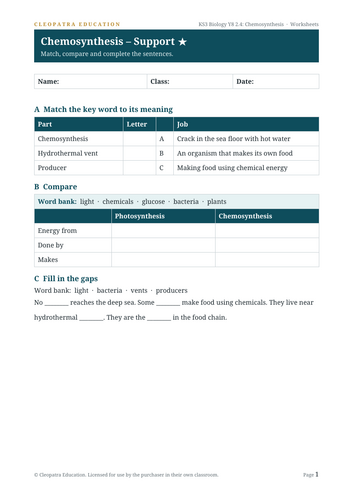
  1. Differentiated worksheets – Support ★, Core ★★ and Challenge ★★★
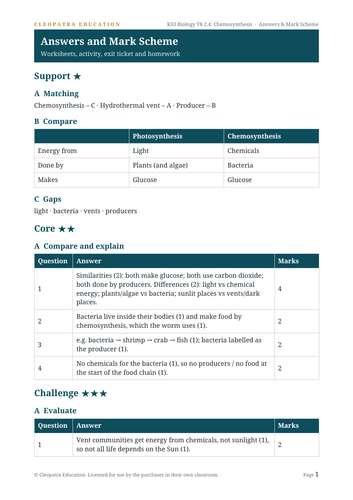
  • Match key words; comparison table; gap fill
  • Compare the two processes; tube worms; vent food chains
  • Evaluate “all life depends on the Sun”
  • Extremophiles and energy at vents
  • Stretch: life on icy moons
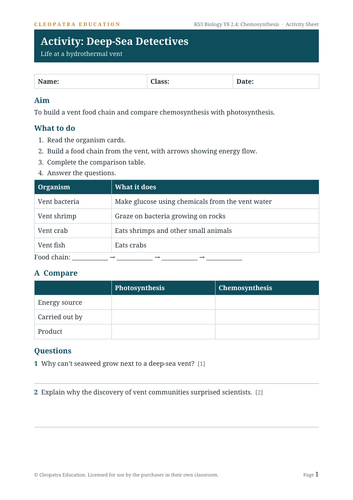
  1. Activity sheet
  • Build a deep-sea vent food chain
  • Compare photosynthesis and chemosynthesis
  1. One-page teacher notes – ideal for non-specialists
  • Lesson timings (60 minutes)
  • Key subject facts
  • Common misconceptions
  • Teaching tips
  1. Full answers and mark scheme
  • Every worksheet level, the activity, the exit ticket and the homework, with marks
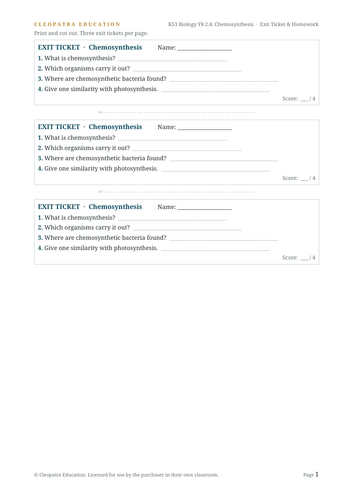
  1. Exit tickets (3 per page) + homework
  • Homework reading “Diving into the Unknown” (the 1977 discovery) with questions

CURRICULUM LINKS

  • KS3 National Curriculum (Biology – Photosynthesis): the dependence of almost all life on Earth on the ability of photosynthetic organisms to use sunlight to build organic molecules.
  • Working scientifically: compare processes; evaluate evidence; understand how scientific discoveries change ideas.

FILE FORMATS
PowerPoint (.pptx) and Word (.docx) – fully editable. PDF copies included.

Previous lesson: 2.3 Plant Minerals. Next lesson: 2.5 Aerobic Respiration.

If you find this resource useful, please leave a review – it really helps! Visit the Cleopatra Education shop for more KS3 Biology lessons.

This resource is independently created and is not affiliated with or endorsed by Oxford University Press or AQA.

Get this resource as part of a bundle and save up to 44%

A bundle is a package of resources grouped together to teach a particular topic, or a series of lessons, in one place.

Bundle

Ecosystem Processes Bundle | KS3 Activate 2

Complete KS3 Ecosystem Processes bundle: 9 ready-to-teach Year 8 Biology lessons on photosynthesis, respiration, food webs and ecosystems. Everything you need to teach the Year 8 Ecosystem Processes chapter. Students learn the photosynthesis equation, investigate leaves, stomata and plant minerals, meet chemosynthesis at deep-sea vents, compare aerobic and anaerobic respiration with pea and yeast practicals, build food webs, analyse DDT bioaccumulation and pollinator data, and estimate populations with quadrats. SAVE 52%: 9 lessons for £15.00 instead of £31.50 bought separately. LESSONS INCLUDED (9) 2.1 Photosynthesis - Practical: Light and Photosynthesis - Homework reading: "The Ocean’s Hidden Gardens" 2.2 Leaves - Practical: Looking at Stomata - Homework reading: "Why Leaves Change Colour" 2.3 Plant Minerals - Activity: Plant Doctor - Homework reading: "Farming Without Soil" 2.4 Chemosynthesis - Activity: Deep-Sea Detectives - Homework reading: "Diving into the Unknown" 2.5 Aerobic Respiration - Practical: Do Peas Respire? - Homework reading: "Keeping Warm" 2.6 Anaerobic Respiration - Practical: Yeast Fermentation - Homework reading: "The Science of Bread" 2.7 Food Chains and Webs - Activity: Build a Pond Food Web - Homework reading: "The Wolves of Yellowstone" 2.8 Disruption to Food Chains and Webs - Activity: DDT Data Detectives - Homework reading: "Silent Spring" 2.9 Ecosystems - Practical: Quadrat Sampling - Homework reading: "Beavers Return" EVERY LESSON INCLUDES - Editable PowerPoint (18–25 slides): Do Now retrieval starter, Know / Explain / Apply objectives, key words, hook, explanation slides with original diagrams, Myth or fact? misconception slide, 2 hinge questions with explanations for every wrong answer, main task, exit ticket and summary - Hidden answer slides (they do not show in slideshow mode) and teacher notes on every slide - Differentiated worksheets: Support ★, Core ★★ and Challenge ★★★, with a GCSE-style stretch - Practical sheet with technician list, or an activity sheet for lessons without an experiment - One-page teacher notes, ideal for non-specialists: timings, key facts, misconceptions and tips - Full answers and mark scheme for every task - Exit tickets (3 per page) and a homework reading with questions - PDF copies of every file CURRICULUM LINKS KS3 National Curriculum (Biology – Photosynthesis, Cellular respiration and Relationships in an ecosystem): the reactants in, and products of, photosynthesis, and a word summary for photosynthesis; the dependence of almost all life on Earth on the ability of photosynthetic organisms to use sunlight in photosynthesis to build organic molecules; the adaptations of leaves for photosynthesis; the role of leaf stomata in gas exchange in plants; plants making carbohydrates and requiring mineral nutrients from the soil; aerobic and anaerobic respiration in living organisms, including fermentation; the interdependence of organisms in an ecosystem, including food webs and insect pollinated crops; how organisms affect, and are affected by, their environment, including the accumulation of toxic materials. FILE FORMATS PowerPoint (.pptx) and Word (.docx) – fully editable. PDF copies included. Also available: the Year 7 Biology bundles (Cells, Body Systems and Reproduction), Year 8 Health and Lifestyle and Adaptation and Inheritance bundles, and every lesson on its own. If you find this bundle useful, please leave a review – it really helps! Visit the Cleopatra Education shop for more KS3 Biology. This resource is independently created and is not affiliated with or endorsed by Oxford University Press or AQA.

£15.00

Reviews

Something went wrong, please try again later.

This resource hasn't been reviewed yet

To ensure quality for our reviews, only customers who have purchased this resource can review it

Report this resourceto let us know if it violates our terms and conditions.
Our customer service team will review your report and will be in touch.