


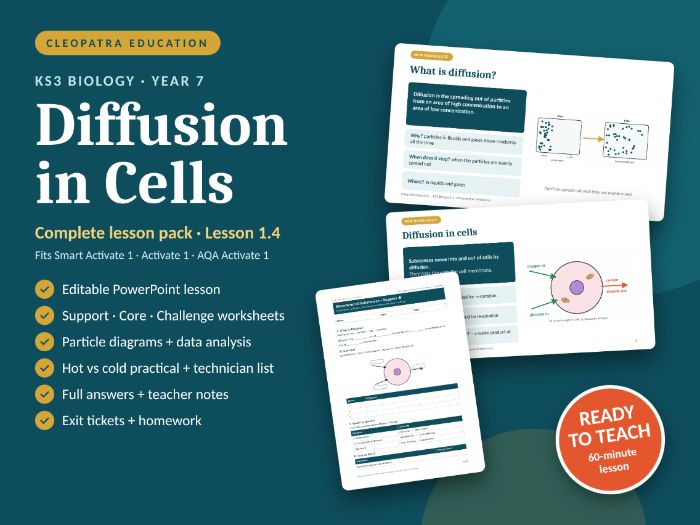
Complete KS3 lesson on diffusion and movement of substances in cells: editable PowerPoint, 3-level worksheets, practical, data and answers.
Perfect for Year 7 Biology. Students define diffusion, use the particle model to explain it, learn how oxygen, glucose and carbon dioxide move into and out of cells, and investigate how temperature affects the rate of diffusion – with variables, a results table and data analysis. Written for the Oxford Smart Activate 1, Activate 1 and AQA Activate 1 courses (Cells, lesson 1.4 Movement of substances), and suitable for any KS3 scheme of work.
WHAT’S INCLUDED (6 editable files + PDF copies)
- Lesson PowerPoint – 21 slides
- Do Now retrieval starter
- Know / Explain / Apply learning objectives
- Key words with definitions
- Hook: air freshener demo and a prediction
- Particle diagram of diffusion
- Diffusion in cells: oxygen, glucose and carbon dioxide
- What makes diffusion faster
- Myth or fact? slide tackling common misconceptions
- “In or out?” we-do task
- 2 hinge questions with explanations for every wrong answer
- Hot vs cold water practical with safety points
- Independent, dependent and control variables slide
- Exit ticket and summary
- Hidden answer slides (they do not show in slideshow mode)
- Teacher notes on every slide
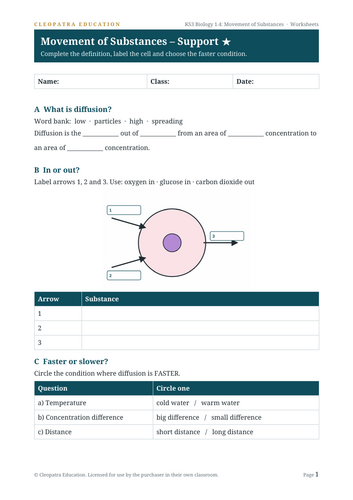
- Differentiated worksheets – Support ★, Core ★★ and Challenge ★★★
- Definition gap-fill, in/out labelling, faster/slower and true/false tasks
- Particle-model explanations and an in/out table
- Interpret a real-style data set (temperature vs time)
- Plot a graph, predict and apply to the lungs
- GCSE preview stretch: osmosis
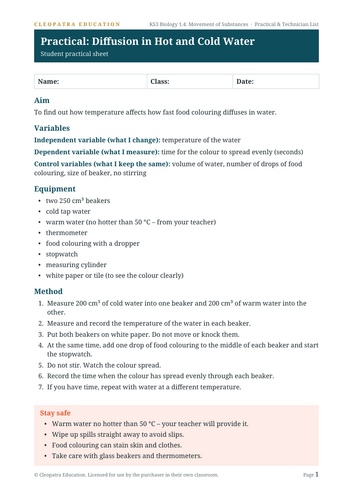
- Practical sheet + technician list
- Aim, variables, equipment, method, safety, results table, conclusion frame and questions
- Technician list per group, including warm water guidance
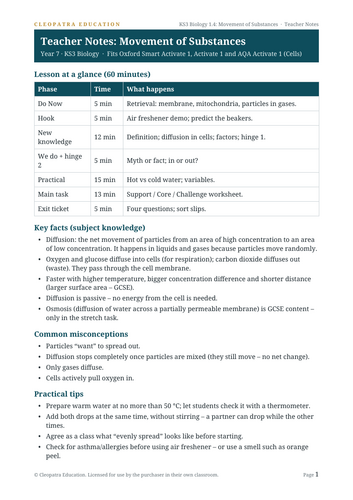
- One-page teacher notes – ideal for non-specialists
- Lesson timings (60 minutes)
- Key subject facts
- Common misconceptions
- Practical tips
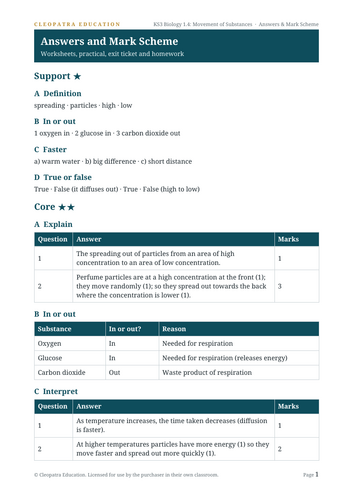
- Full answers and mark scheme
- Every worksheet level, the practical, the exit ticket and the homework, with marks
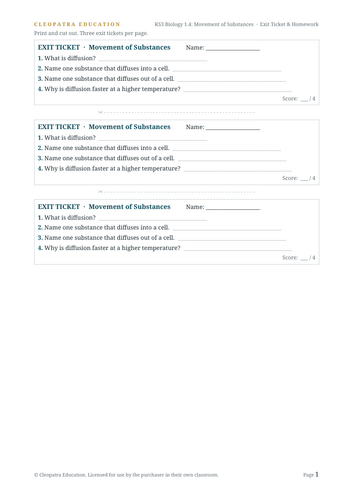
- Exit tickets (3 per page) + homework
- Homework reading “Diffusion in Your Body” (lungs and small intestine) with questions
CURRICULUM LINKS
- KS3 National Curriculum (Biology – Cells and organisation): the role of diffusion in the movement of materials in and between cells.
- KS3 National Curriculum (Chemistry – Particulate nature of matter): diffusion explained using the particle model.
- Working scientifically: identify independent, dependent and control variables; make and record observations and measurements; interpret data.
FILE FORMATS
PowerPoint (.pptx) and Word (.docx) – fully editable. PDF copies included.
If you find this resource useful, please leave a review – it really helps! Visit the Cleopatra Education shop for more KS3 Biology lessons.
This resource is independently created and is not affiliated with or endorsed by Oxford University Press or AQA.
Something went wrong, please try again later.
This resource hasn't been reviewed yet
To ensure quality for our reviews, only customers who have purchased this resource can review it
Report this resourceto let us know if it violates our terms and conditions.
Our customer service team will review your report and will be in touch.
£3.00