pptx, 837.77 KB
pptx, 837.77 KB
docx, 348.76 KB
docx, 348.76 KB
docx, 12.41 KB
docx, 12.41 KB
docx, 12.66 KB
docx, 12.66 KB
docx, 13.86 KB
docx, 13.86 KB
docx, 12.66 KB
docx, 12.66 KB
pdf, 928.88 KB
pdf, 928.88 KB

Complete KS3 lesson on development of a fetus – placenta, umbilical cord, gestation and birth: editable PowerPoint, worksheets, activity and answers.

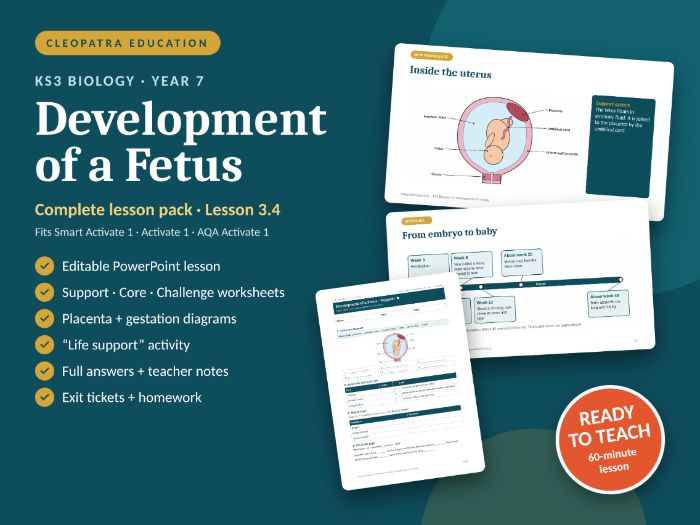
Perfect for Year 7 Biology. Students label a fetus in the uterus, explain how the placenta and umbilical cord supply oxygen and nutrients and remove waste, follow the gestation timeline, describe birth, and explain how smoking, alcohol and diet affect the fetus. Written for the Oxford Smart Activate 1, Activate 1 and AQA Activate 1 courses (Reproduction, lesson 3.4 Development of a fetus), and suitable for any KS3 scheme of work.

WHAT’S INCLUDED (6 editable files + PDF copies)

  1. Lesson PowerPoint – 22 slides
  • Do Now retrieval starter
  • Know / Explain / Apply learning objectives
  • Key words with definitions
  • Hook: “Nine months in the making”
  • Original labelled diagram of a fetus in the uterus
  • Placenta structure and function table
  • Gestation timeline
  • Mother’s lifestyle and the fetus
  • Step-by-step birth slide
  • Myth or fact? slide tackling common misconceptions
  • 2 hinge questions with explanations for every wrong answer
  • “Life support” activity
  • Exit ticket and summary
  • Hidden answer slides (they do not show in slideshow mode)
  • Teacher notes on every slide
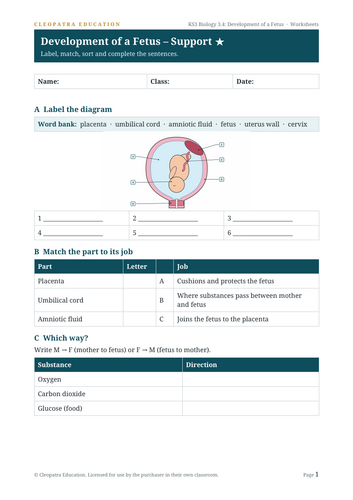
  1. Differentiated worksheets – Support ★, Core ★★ and Challenge ★★★
  • Label the fetus in the uterus (with and without a word bank)
  • Match parts to jobs; which way do substances move?
  • Explain the placenta, alcohol and birth
  • Interpret the gestation timeline and birth-weight data
  • Stretch: premature babies and incubators
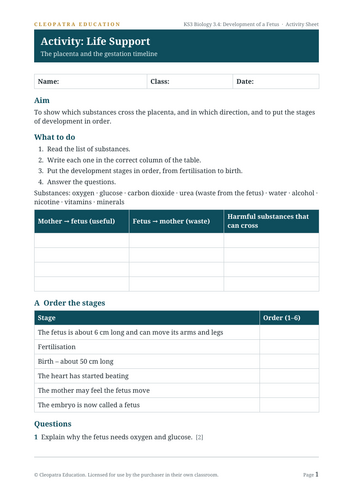
  1. Activity sheet
  • Sort the substances that cross the placenta
  • Order the stages of development
  1. One-page teacher notes – ideal for non-specialists
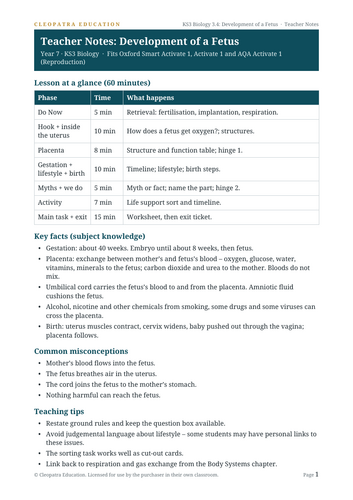
  • Lesson timings (60 minutes)
  • Key subject facts
  • Common misconceptions
  • Teaching tips
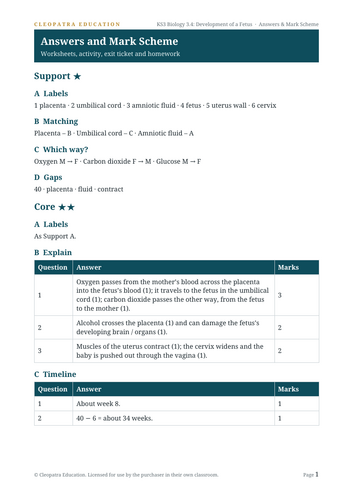
  1. Full answers and mark scheme
  • Every worksheet level, the activity, the exit ticket and the homework, with marks
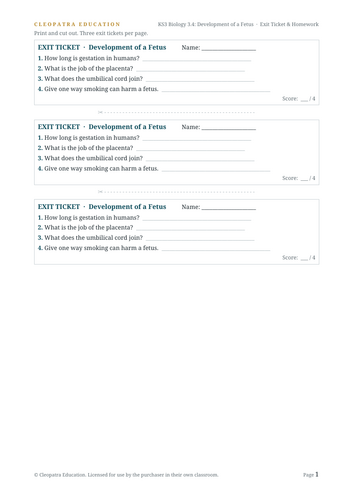
  1. Exit tickets (3 per page) + homework
  • Homework reading “The First Few Weeks” (birth and newborn babies) with questions

CURRICULUM LINKS

  • KS3 National Curriculum (Biology – Reproduction): reproduction in humans (as an example of a mammal), including gametes, fertilisation, gestation and birth, to include the effect of maternal lifestyle on the fetus through the placenta.
  • Working scientifically: interpret information in diagrams and timelines; use scientific vocabulary accurately.

FILE FORMATS
PowerPoint (.pptx) and Word (.docx) – fully editable. PDF copies included.

Previous lesson: 3.3 Fertilisation and Implantation. Next lesson: 3.5 The Menstrual Cycle.

If you find this resource useful, please leave a review – it really helps! Visit the Cleopatra Education shop for more KS3 Biology lessons.

This resource is independently created and is not affiliated with or endorsed by Oxford University Press or AQA.

Get this resource as part of a bundle and save up to 44%

A bundle is a package of resources grouped together to teach a particular topic, or a series of lessons, in one place.

Bundle

Reproduction Bundle | KS3 Activate 1 Ch3

Complete KS3 Reproduction bundle: 8 ready-to-teach Year 7 Biology lessons on human and plant reproduction, with PowerPoints, worksheets and answers. Everything you need to teach the Year 7 Reproduction chapter. Students study adolescence and puberty, the male and female reproductive systems, fertilisation and implantation, development of a fetus, and the menstrual cycle (without hormones, as the curriculum requires), then flowers and pollination, plant fertilisation and germination, and seed dispersal. Sensitive topics are written in a calm, factual, age-appropriate way, with teacher guidance on ground rules. SAVE 52%: 8 lessons for £13.50 instead of £28.00 bought separately. LESSONS INCLUDED (8) 3.1 Adolescence - Activity: Growing Up – Growth Data - Homework reading: "Looking After Yourself" 3.2 Reproductive Systems - Activity: Organ Match-Up - Homework reading: "Little People in Sperm?" 3.3 Fertilisation and Implantation - Activity: Sequence the Journey - Homework reading: "The First IVF Baby" 3.4 Development of a Fetus - Activity: Life Support - Homework reading: "The First Few Weeks" 3.5 The Menstrual Cycle - Activity: Cycle Detectives - Homework reading: "Period Products and Period Poverty" 3.6 Flowers and Pollination - Practical: Flower Dissection - Homework reading: "Busy Pollinators" 3.7 Fertilisation and Germination - Practical: Conditions for Germination - Homework reading: "The 1,200-Year-Old Seed" 3.8 Seed Dispersal - Practical: Paper Helicopters - Homework reading: "Inspired by Burrs" EVERY LESSON INCLUDES - Editable PowerPoint (18–25 slides): Do Now retrieval starter, Know / Explain / Apply objectives, key words, hook, explanation slides with original diagrams, Myth or fact? misconception slide, 2 hinge questions with explanations for every wrong answer, main task, exit ticket and summary - Hidden answer slides (they do not show in slideshow mode) and teacher notes on every slide - Differentiated worksheets: Support ★, Core ★★ and Challenge ★★★, with a GCSE-style stretch - Practical sheet with technician list, or an activity sheet for lessons without an experiment - One-page teacher notes, ideal for non-specialists: timings, key facts, misconceptions and tips - Full answers and mark scheme for every task - Exit tickets (3 per page) and a homework reading with questions - PDF copies of every file CURRICULUM LINKS KS3 National Curriculum (Biology – Reproduction): reproduction in humans (as an example of a mammal), including the structure and function of the male and female reproductive systems, menstrual cycle (without details of hormones), gametes, fertilisation, gestation and birth, to include the effect of maternal lifestyle on the fetus through the placenta; reproduction in plants, including flower structure, wind and insect pollination, fertilisation, seed and fruit formation and dispersal, including quantitative investigation of some dispersal mechanisms. FILE FORMATS PowerPoint (.pptx) and Word (.docx) – fully editable. PDF copies included. Also available: the Cells (Chapter 1, 5 lessons) and Body Systems (Chapter 2, 6 lessons) bundles, and every lesson on its own. If you find this bundle useful, please leave a review – it really helps! Visit the Cleopatra Education shop for more KS3 Biology. This resource is independently created and is not affiliated with or endorsed by Oxford University Press or AQA.

£13.50

Reviews

Something went wrong, please try again later.

This resource hasn't been reviewed yet

To ensure quality for our reviews, only customers who have purchased this resource can review it

Report this resourceto let us know if it violates our terms and conditions.
Our customer service team will review your report and will be in touch.