


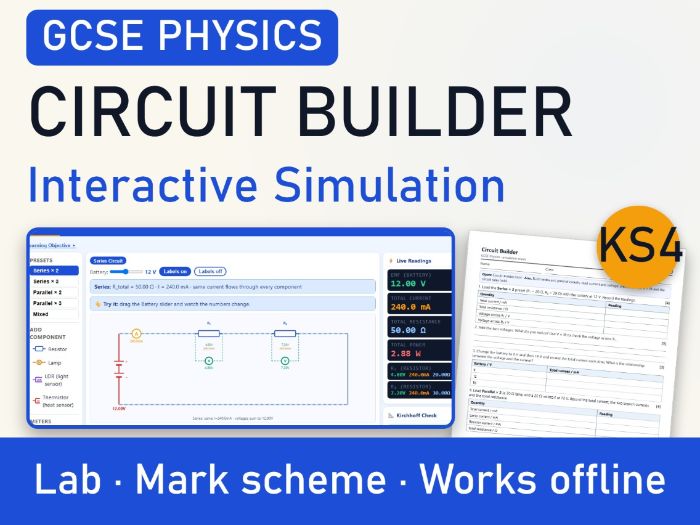

A complete physics simulation for GCSE-level science (ages 14 to 16): a circuit bench for series and parallel circuits with live meters, with an A4 student sheet, an answer key and teacher notes. One offline file; no website, no login and nothing to install.
What is this?
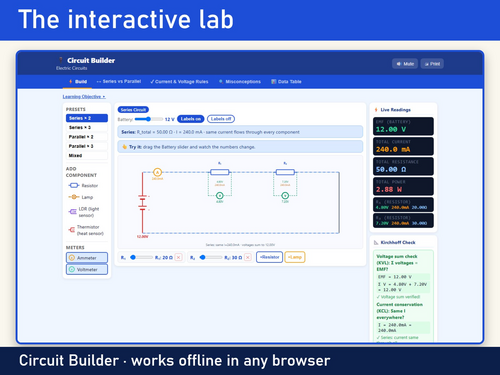
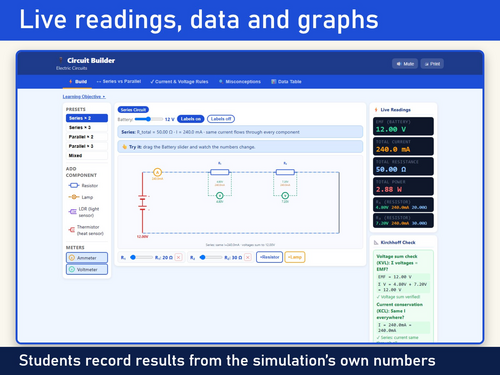
Students load a preset or build a circuit from resistors, lamps, an LDR and a thermistor, add ammeters and voltmeters, move the battery slider and watch the readings, a live Kirchhoff check and the circuit diagram change.
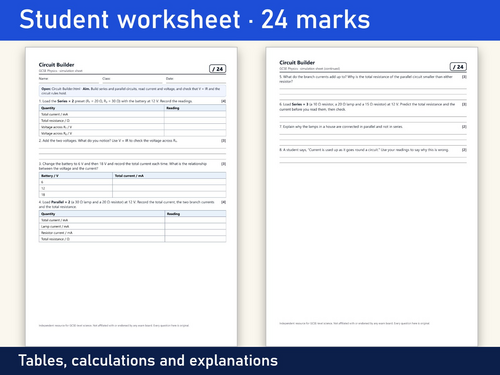
It runs offline from a single file on any device, from a Chromebook to a projector. It comes with a two-page student sheet (22 marks) written for this simulation, with tables to fill in from the simulation’s own numbers, short explanations, calculations and an evaluation question. The answer key gives every number the simulation produces, so marking is quick.
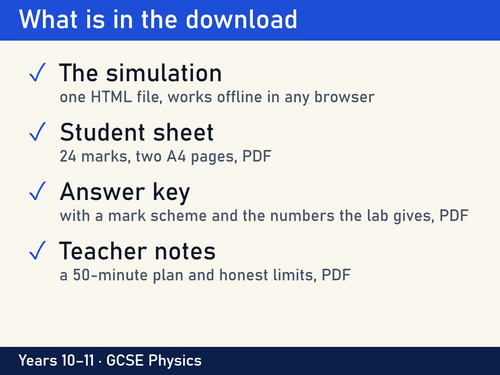
What is in the zip
- The simulation (Circuit-Builder.html): one file for any modern browser. Works offline, sends nothing anywhere and uses no live AI at run time.
- Student sheet (PDF, 2 pages, 22 marks) for printing or sharing.
- Answer key (PDF) with a mark scheme and the numbers the simulation gives.
- Teacher notes (PDF): how to run a 50-minute lesson, how the simulation behaves, and its honest limits.
What the simulation includes
- Five presets: series with two or three resistors, parallel with two or three, and mixed
- Resistors, lamps, an LDR and a thermistor, with ammeters and voltmeters
- Live readings: EMF, total current, total resistance, total power, and each component
- A Kirchhoff check for current and voltage
- A Series vs Parallel comparison tab
- A misconceptions quiz and a data log
What students learn
- V = IR, and current is proportional to voltage for a fixed resistor.
- In series the current is the same everywhere and the voltages add to the battery voltage.
- In parallel the branch currents add up and the total resistance is lower than any branch.
- Why household lamps are in parallel.
- Why current is not ‘used up’.
Where it fits
GCSE Physics: electric circuits, series and parallel circuits, V = IR and the circuit rules. Use it as a starter, main activity, prep for the real practical, cover work, homework or revision.
What it does, and what it does not
The numbers come from a model, not from measurements, so real data will look messier. It does not replace working with real apparatus: use it to prepare, to practise reading and plotting data, or when the practical cannot be run. There is a free demo of this simulation on Tes with one fixed set-up and a one-page sheet, so you can try the format first.
Written by a British science and maths teacher who taught for more than 12 years in international schools, including a spell as Head of Science. An independent resource, not affiliated with or endorsed by any exam board. Every question and the simulation are original.
Something went wrong, please try again later.
This resource hasn't been reviewed yet
To ensure quality for our reviews, only customers who have purchased this resource can review it
Report this resourceto let us know if it violates our terms and conditions.
Our customer service team will review your report and will be in touch.
£3.95