

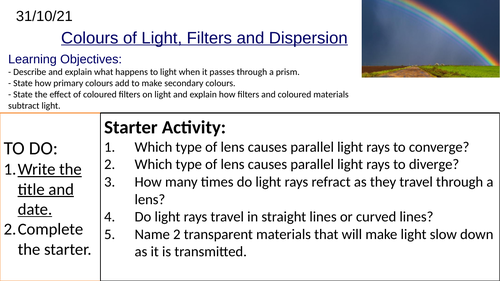

This PowerPoint resource provides an engaging middle school science lesson on light behavior, how it interacts with materials, and the concept of dispersion. It combines visual aids, hands-on activities, and real-world applications to deepen students’ understanding of light and color.
Key learning objectives:
- Explaining what happens to light when it passes through a prism, demonstrating the concept of dispersion.
- Understanding primary and secondary colors of light and how they combine to form white light.
- Describing how colored filters and objects interact with light, including absorption, reflection, and transmission.
Resource features:
The lesson begins with a starter activity designed to assess prior knowledge about lenses and light behavior, including questions like:
Which type of lens converges parallel light rays?
How many times do light rays refract as they travel through a lens?
Core topics include:
Dispersion of Light:
Demonstrates how a prism separates white light into a spectrum of colors (red, orange, yellow, green, blue, indigo, violet), with explanations of why colors refract differently based on their wavelengths.
Primary and Secondary Colors:
Introduces the primary colors of light (red, blue, green) and explains how they combine to form secondary colors and white light.
Interaction with Filters and Objects:
Discusses how objects appear specific colors based on the wavelengths they reflect and absorb (e.g., a red apple reflects red light while absorbing other colors). Includes analysis of how filters transmit certain wavelengths and block others.
Interactive tasks include:
- Drawing and labeling diagrams of light dispersion through a prism.
- Completing tables to predict the colors transmitted by filters and reflected by objects.
- Answering reflective questions about why objects appear certain colors under different lighting conditions.
The lesson concludes with a plenary to review key concepts, such as why rainbows form and how colored filters alter perceived colors.
File details:
This editable ‘.pptx’ file aligns with middle school science curricula and supports interactive and visual learning. It provides structured explanations, real-world examples, and practical activities, making it an essential resource for teaching the behavior of light and color.
Something went wrong, please try again later.
This resource hasn't been reviewed yet
To ensure quality for our reviews, only customers who have purchased this resource can review it
Report this resourceto let us know if it violates our terms and conditions.
Our customer service team will review your report and will be in touch.
£2.00