

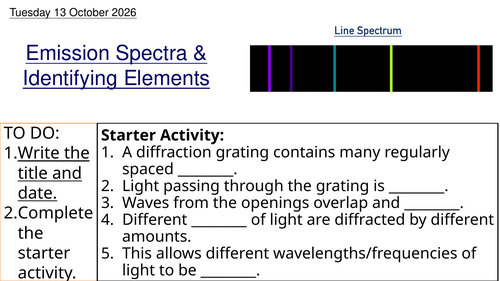

This Pearson BTEC Applied Science Unit 1 Physics PowerPoint covers emission spectra and identifying elements, including electron energy levels, photon emission and spectral lines.
Designed for the Waves in Communication topic, this comprehensive lesson develops students’ understanding of how atomic emission spectra are produced and used to identify elements. An atomic emission spectrum consists of specific frequencies of light emitted by an element, producing a characteristic pattern of spectral lines that acts as a unique fingerprint.
The PowerPoint includes a starter activity with answers, clearly defined learning objectives, key scientific terminology, detailed explanations, diagrams and worked examples. Students explore electron energy levels, excitation and de-excitation, learning how electrons absorb energy to move to higher energy levels before releasing photons when returning to lower energy levels.
The lesson explains why atomic emission spectra contain discrete spectral lines, rather than a continuous range of wavelengths, and how differences in electron energy levels produce characteristic spectra for individual elements.
Students also investigate diffraction gratings and spectroscopy, exploring how emitted light is separated into its component wavelengths and how unknown elements can be identified by comparing their spectral lines with reference spectra. The identification of multiple elements within a sample is also covered.
The lesson includes wave equation calculations (v = fλ), wavelength conversions and a worked example involving hydrogen’s emission spectrum. Additional practice activities reinforce scientific understanding and mathematical skills.
The resource concludes with 10 Check Your Understanding questions and answers, providing opportunities for assessment, consolidation and exam preparation.
This resource is suitable for classroom teaching, independent learning and revision for students studying Pearson BTEC Applied Science Unit 1 Physics.
File format: Editable PowerPoint (.pptx), allowing teachers to adapt the content to their teaching requirements.
Resource date: September 2026.
Something went wrong, please try again later.
This resource hasn't been reviewed yet
To ensure quality for our reviews, only customers who have purchased this resource can review it
Report this resourceto let us know if it violates our terms and conditions.
Our customer service team will review your report and will be in touch.
£2.00