

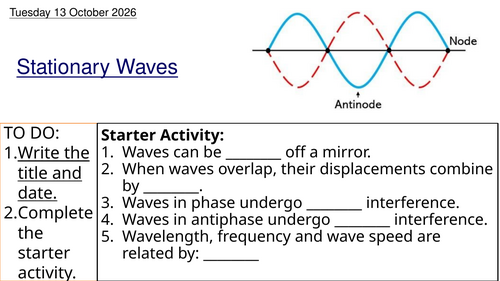

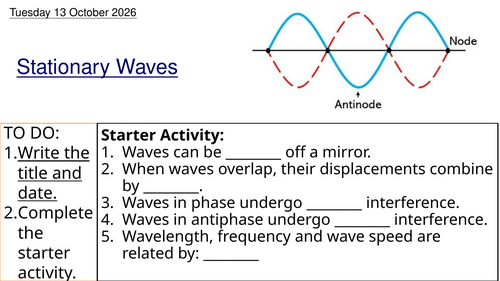
This Pearson BTEC Applied Science Unit 1 Physics PowerPoint covers stationary waves, including nodes, antinodes, harmonics, wavelength and frequency calculations.
Designed for the Waves in Communication topic, this comprehensive lesson develops students’ understanding of how stationary waves form and how they differ from progressive waves. A stationary wave, also known as a standing wave, is a fixed wave pattern produced by the superposition of waves travelling in opposite directions, resulting in no net transfer of energy along the wave.
The PowerPoint includes a starter activity with answers, clearly defined learning objectives, key scientific terminology, detailed explanations, diagrams and worked examples. Students explore the formation of stationary waves, including the reflection of incident waves, superposition and the constructive and destructive interference responsible for producing fixed nodes and antinodes.
The lesson also examines fundamental frequency and harmonics, explaining how different stationary-wave patterns form on strings fixed at both ends. Students learn to identify the first, second and third harmonics, determine wavelength from stationary-wave diagrams and use the wave equation (v = fλ) to calculate frequency.
Throughout the lesson, students develop mathematical and analytical skills through structured calculations involving node spacing, antinode spacing, wavelength and wave speed. Practical demonstrations, including a video of Melde’s apparatus, help students visualise standing-wave patterns and particle oscillations.
The resource includes practice activities, past paper questions and 10 Check Your Understanding questions with answers, providing opportunities for assessment, consolidation and exam preparation.
This resource is suitable for classroom teaching, independent learning and revision for students studying Pearson BTEC Applied Science Unit 1 Physics.
File format: Editable PowerPoint (.pptx), allowing teachers to adapt the content to their teaching requirements.
Resource date: October 2026.
Something went wrong, please try again later.
This resource hasn't been reviewed yet
To ensure quality for our reviews, only customers who have purchased this resource can review it
Report this resourceto let us know if it violates our terms and conditions.
Our customer service team will review your report and will be in touch.
£2.00