



Lesson 2: Why Did Factories Replace Homeworking?
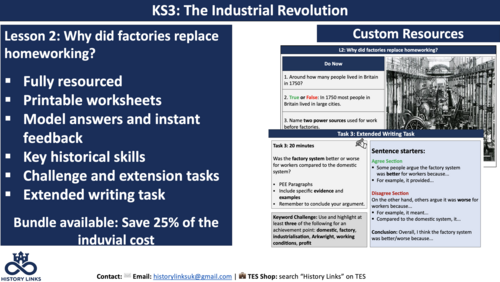
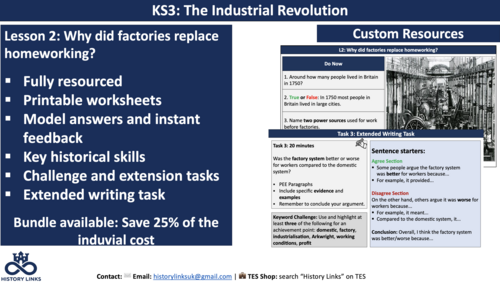
A clear and engaging KS3 History lesson exploring the shift from the domestic system of homeworking to the factory system during the Industrial Revolution. Students investigate how goods were produced before factories and why industrialisation transformed the way people worked.
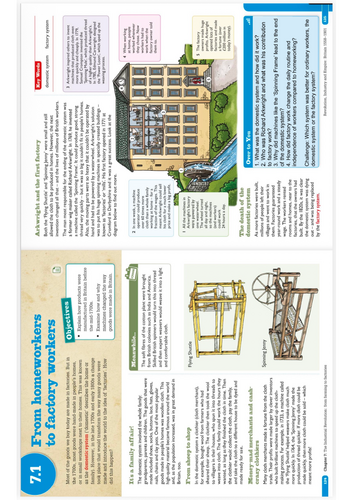
Through source analysis, guided reading, and structured discussion, pupils explore how the domestic system worked, where families produced goods at home using simple tools, and compare this with the new factory system powered by machines and water power. Students examine the role of key individuals such as Richard Arkwright, whose inventions and factories helped accelerate industrial change.
Students analyse the advantages and disadvantages of both systems, considering how factory production increased efficiency, speed, and profits, but also changed workers’ lives through longer hours, stricter rules, and dangerous working conditions. By comparing the two systems, pupils begin to understand how industrialisation reshaped work, family life, and economic organisation in Britain.
The lesson concludes with an extended analytical writing task where students evaluate whether the factory system was better or worse for workers compared to the domestic system, using evidence and examples to support their judgement.
Includes
• Fully resourced PowerPoint lesson and printable worksheets
• Think–Pair–Share starter activity analysing historical objects and work before factories
• Guided reading activity explaining the domestic system and early factories
• Comparison task analysing advantages and disadvantages of domestic and factory work
• Structured extended writing task with sentence scaffolds and model answer
• Challenge and extension questions to encourage deeper thinking
• Model answers and instant feedback slides
• Exit-ticket recall quiz to consolidate learning
Why Teachers Love This Lesson
• Fully resourced and ready to teach
• Helps students clearly understand the transition from homeworking to factories
• Excellent for mixed-ability classes with clear scaffolding and structured tasks
• Develops historical comparison and evaluation skills
• Encourages discussion about working conditions, economic change, and industrialisation
• Builds strong foundations for later lessons on industrial towns, child labour, and working conditions
Buy the full Industrial Revolution Unit Bundle and save 25%.
Leave a review on TES to receive two free lessons of your choice.
Something went wrong, please try again later.
This resource hasn't been reviewed yet
To ensure quality for our reviews, only customers who have purchased this resource can review it
Report this resourceto let us know if it violates our terms and conditions.
Our customer service team will review your report and will be in touch.
£3.00