Lesson 11
Subject: Physics
Age range: 14-16
Resource type: Lesson (complete)




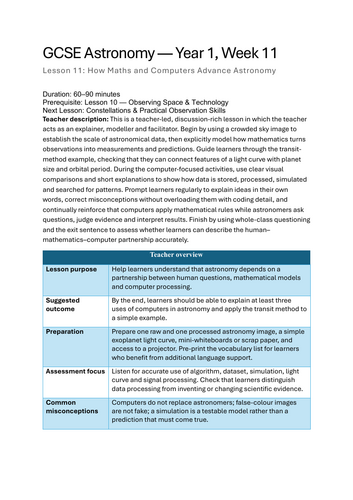
Teacher description: This is a teacher-led, discussion-rich lesson in which the teacher acts as an explainer, modeller and facilitator. Begin by using a crowded sky image to establish the scale of astronomical data, then explicitly model how mathematics turns observations into measurements and predictions. Guide learners through the transit-method example, checking that they can connect features of a light curve with planet size and orbital period. During the computer-focused activities, use clear visual comparisons and short explanations to show how data is stored, processed, simulated and searched for patterns. Prompt learners regularly to explain ideas in their own words, correct misconceptions without overloading them with coding detail, and continually reinforce that computers apply mathematical rules while astronomers ask questions, judge evidence and interpret results. Finish by using whole-class questioning and the exit sentence to assess whether learners can describe the human–mathematics–computer partnership accurately.
A bundle is a package of resources grouped together to teach a particular topic, or a series of lessons, in one place.
Something went wrong, please try again later.
This resource hasn't been reviewed yet
To ensure quality for our reviews, only customers who have purchased this resource can review it
Report this resourceto let us know if it violates our terms and conditions.
Our customer service team will review your report and will be in touch.