pptx, 2.3 MB
pptx, 2.3 MB
pdf, 42.79 KB
pdf, 42.79 KB
docx, 22.32 KB
docx, 22.32 KB
pdf, 62.73 KB
pdf, 62.73 KB
docx, 24.06 KB
docx, 24.06 KB
pdf, 44.77 KB
pdf, 44.77 KB
docx, 24.11 KB
docx, 24.11 KB
pdf, 62.32 KB
pdf, 62.32 KB
pdf, 44.28 KB
pdf, 44.28 KB
pdf, 52.29 KB
pdf, 52.29 KB
docx, 21.84 KB
docx, 21.84 KB

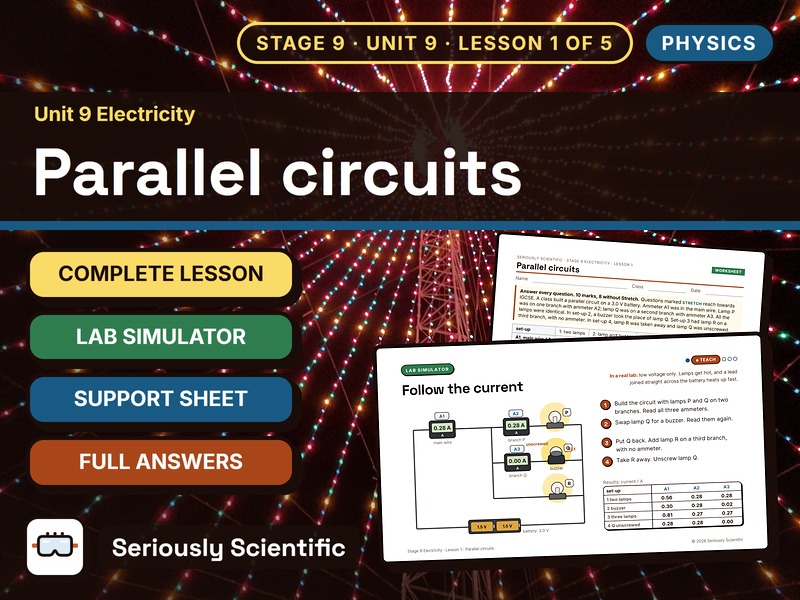
A complete, editable 50-minute lesson on parallel circuits for Cambridge Lower Secondary Science Stage 9: a PowerPoint with teacher notes, a differentiated worksheet, homework and full answers.

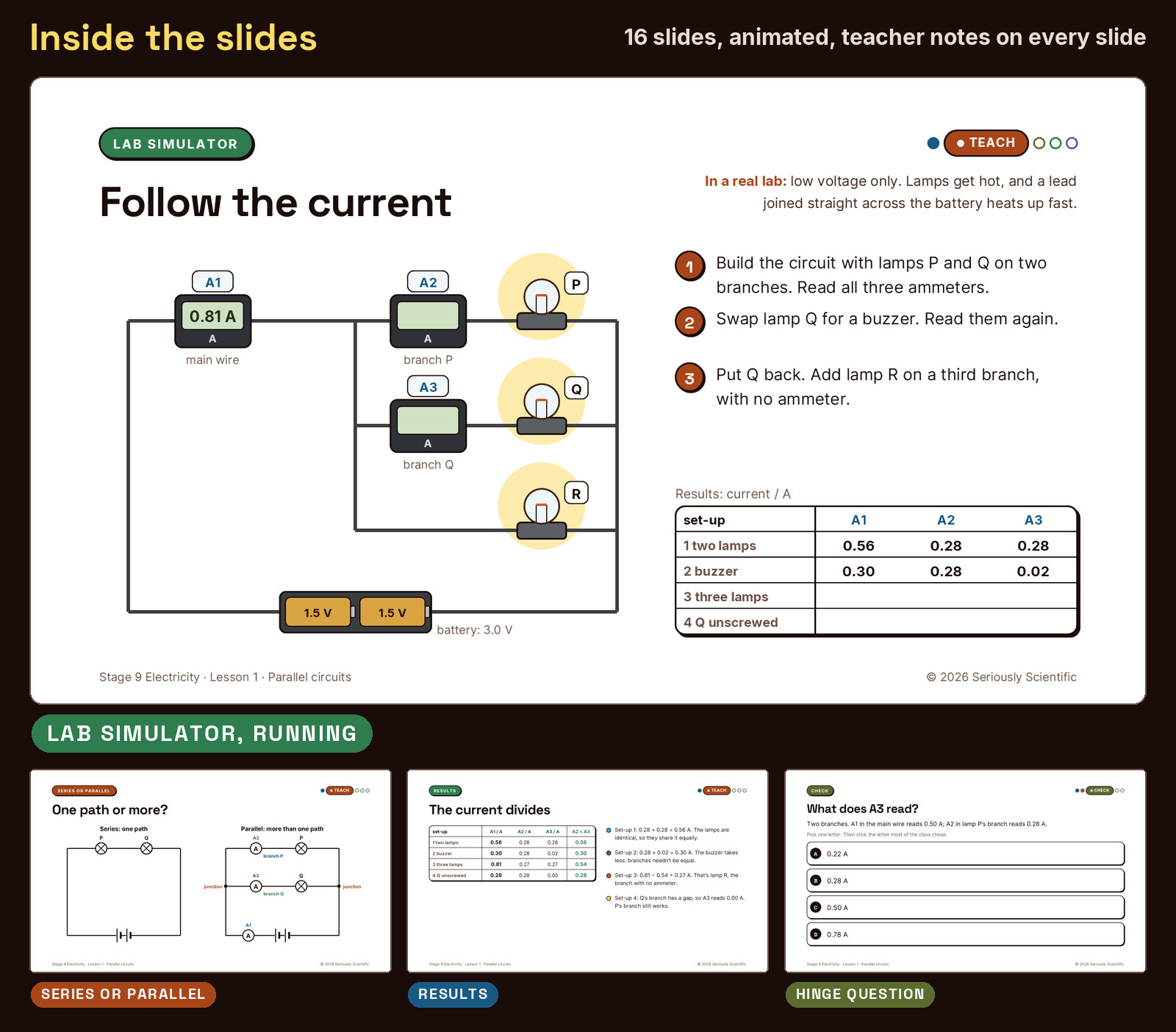
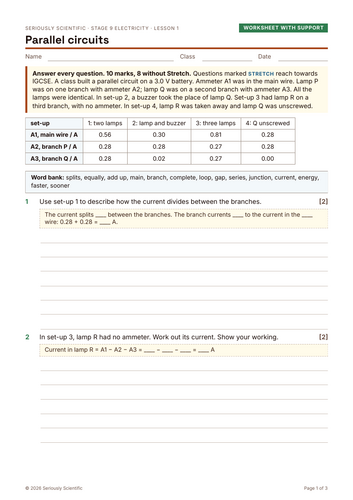
Lesson 1 of 5 in Unit 9 Electricity, covering framework code 9Pe.01. Its 16 slides open with a spot-the-mistake recall, the success criteria and key vocabulary to check with a click. In the Lab simulator, three ammeters round a parallel circuit show the branch currents adding up to the main current. After a hinge question and practice, the lesson ends with an exit ticket and a confidence check.

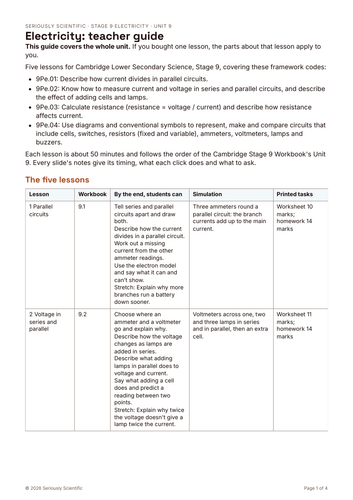
By the end, students can:

  • Tell series and parallel circuits apart and draw both.
  • Describe how the current divides in a parallel circuit.
  • Work out a missing current from the other ammeter readings.
  • Use the electron model and say what it can and can’t show.
  • Explain why more branches run a battery down sooner (Stretch).

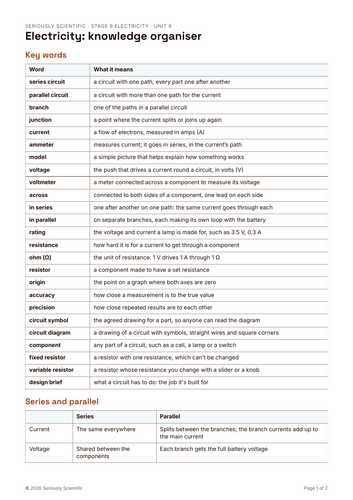
Key vocabulary

  • series circuit: a circuit with one path, every part one after another.
  • parallel circuit: a circuit with more than one path for the current.
  • Also: branch, junction, current, ammeter and model.

What’s in the download

  • PowerPoint deck, 16 slides, with teacher notes on every slide.
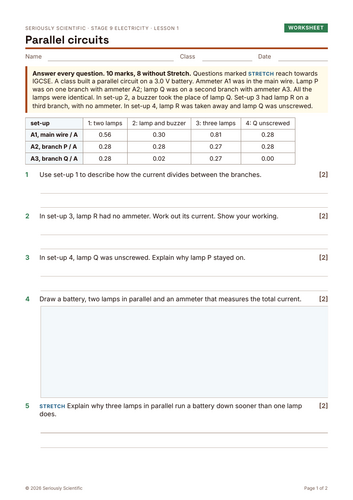
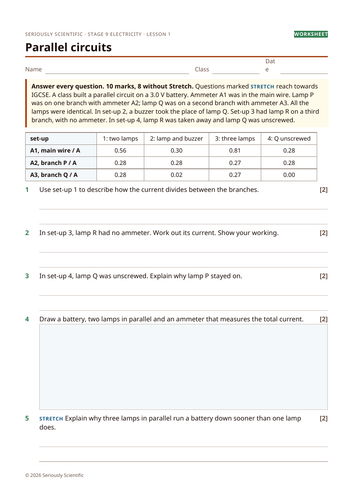
  • Worksheet, 10 marks (8 without Stretch), with mark scheme.
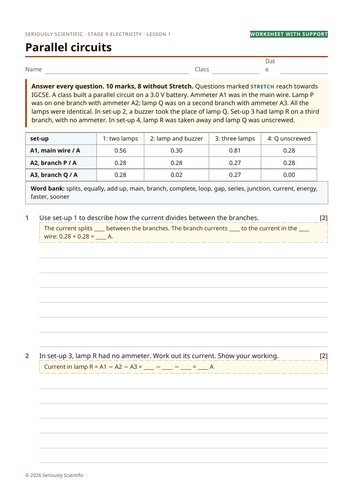
  • The same worksheet with support: a word bank and a sentence starter for each question.
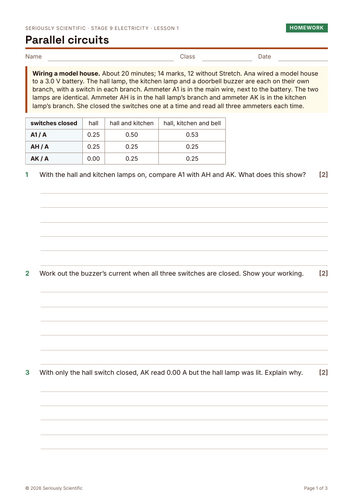
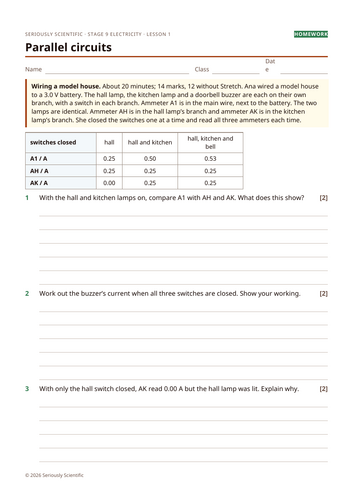
  • Homework, about 20 minutes, 14 marks (12 without Stretch), with mark scheme.
  • The unit’s teacher guide, knowledge organiser and technician sheet.
  • The worksheets, homework and technician sheet come as editable Word and PDF; the teacher guide and knowledge organiser come as PDF.

Cambridge Lower Secondary Science framework codes

  • 9Pe.01: describe how current divides in parallel circuits.
  • 9Pe.04 (revisited).

Thinking and Working Scientifically

  • 9TWSm.02: models and analogies, their strengths and limitations.
  • 9TWSp.03: predictions from scientific knowledge.
  • 9TWSa.02: trends, patterns and anomalous results.
  • 9TWSa.03: conclusions, their limitations and further investigation.

Outside Cambridge

  • KS3 in England covers current in series and parallel circuits, adding where branches meet, so this lesson also suits a KS3 class.
  • For IGCSE, the Stretch part (explain why more branches run a battery down sooner) reaches towards it; this is a Stage 9 lesson, not an IGCSE resource.

Good to know

Good preparation for the Cambridge Lower Secondary Checkpoint Science test. The Lab simulator is a complement to the real practical, or a backup when the lab isn’t free. Best presented in Microsoft PowerPoint, where every animation, click and sound plays as designed. Written in UK English.

All the questions, data, drawings and animations are my own work. Independent resource, not produced or endorsed by Cambridge University Press & Assessment.

I keep my packs up to date. If it works for your class, a review helps other teachers find it.

Get this resource as part of a bundle and save up to 41%

A bundle is a package of resources grouped together to teach a particular topic, or a series of lessons, in one place.

Bundle

Cambridge Stage 9 Science Unit 9 Bundle: Electricity

**A complete, editable unit of five lessons for Cambridge Lower Secondary Science Stage 9, Unit 9 Electricity: PowerPoints with teacher notes, differentiated worksheets, homework, an end-of-unit test and full answers.** All five lessons of Unit 9 Electricity: four teaching lessons, then a review lesson with the end-of-unit test, covering framework codes 9Pe.01, 9Pe.02, 9Pe.03 and 9Pe.04. Every teaching lesson runs its practical in the Lab simulator. **The lessons, in teaching order:** 1. Parallel circuits (Lab simulator) 2. Voltage in series and parallel (Lab simulator) 3. Calculating resistance (Lab simulator) 4. Practical circuits (Lab simulator) 5. Review and test (10 slides): a review, then the end-of-unit test, 28 marks (26 without Stretch).   **In the bundle** - A PowerPoint deck for every lesson, with teacher notes on every slide. - Lessons 1 to 4: a worksheet, the same worksheet with support and a homework, all with mark schemes. - Lesson 5: the end-of-unit test, the test with support and a revision homework, all with mark schemes. - The teacher guide, a knowledge organiser, a technician sheet and a self-assessment checklist. - The worksheets, homework, tests, technician sheet and self-assessment checklist come as editable Word and PDF; the teacher guide and knowledge organiser come as PDF. - Each lesson's download includes the unit's teacher guide, knowledge organiser and technician sheet, so you'll see them in every lesson (the review and test lesson has the self-assessment checklist in place of the technician sheet).   Bought as a bundle, the five lessons cost £9.99 instead of £17.00. **Cambridge Lower Secondary Science framework codes** - 9Pe.01, 9Pe.02, 9Pe.03 and 9Pe.04.   **Thinking and Working Scientifically** - 9TWSa.02, 9TWSa.03, 9TWSa.04, 9TWSa.05, 9TWSc.02, 9TWSc.04, 9TWSm.02, 9TWSm.03, 9TWSp.03 and 9TWSp.04.   **Outside Cambridge** - In England's KS3 programme of study: current in series and parallel circuits, with currents adding where branches meet; potential difference measured in volts; battery and bulb ratings; and resistance in ohms as the ratio of potential difference to current. KS3 says potential difference where Stage 9 says voltage, and it doesn't name circuit symbols or variable resistors. - For IGCSE, the Stretch part (a lamp's resistance rising as it heats) reaches towards it; this is a Stage 9 unit, not an IGCSE resource.   **Good to know** Good preparation for the Cambridge Lower Secondary Checkpoint Science test. The Lab simulator is a complement to the real practical, or a backup when the lab isn't free. Best presented in Microsoft PowerPoint, where every animation, click and sound plays as designed. Written in UK English. All the questions, data, drawings and animations are my own work. Independent resource, not produced or endorsed by Cambridge University Press & Assessment. I keep my packs up to date. If it works for your class, a review helps other teachers find it.

£9.99

Reviews

Something went wrong, please try again later.

This resource hasn't been reviewed yet

To ensure quality for our reviews, only customers who have purchased this resource can review it

Report this resourceto let us know if it violates our terms and conditions.
Our customer service team will review your report and will be in touch.