



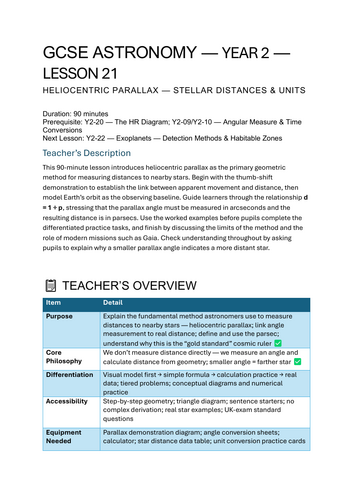
This 90-minute lesson introduces heliocentric parallax as the primary geometric method for measuring distances to nearby stars. Begin with the thumb-shift demonstration to establish the link between apparent movement and distance, then model Earth’s orbit as the observing baseline. Guide learners through the relationship d = 1 ÷ p, stressing that the parallax angle must be measured in arcseconds and the resulting distance is in parsecs. Use the worked examples before pupils complete the differentiated practice tasks, and finish by discussing the limits of the method and the role of modern missions such as Gaia. Check understanding throughout by asking pupils to explain why a smaller parallax angle indicates a more distant star.
Get this resource as part of a bundle and save up to 33%
A bundle is a package of resources grouped together to teach a particular topic, or a series of lessons, in one place.
Something went wrong, please try again later.
This resource hasn't been reviewed yet
To ensure quality for our reviews, only customers who have purchased this resource can review it
Report this resourceto let us know if it violates our terms and conditions.
Our customer service team will review your report and will be in touch.
£3.00