

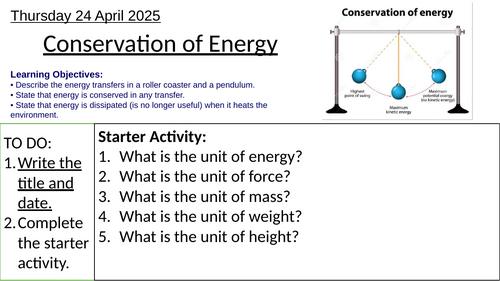

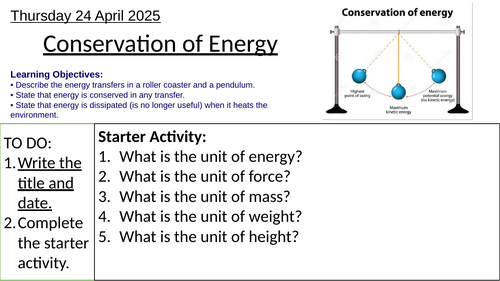
This PowerPoint resource provides a comprehensive lesson on the principle of energy conservation, energy transfers, and the concept of energy dissipation. Designed for high school physics classes, this lesson integrates theoretical knowledge with practical applications to make learning engaging and meaningful.
Key learning objectives:
- Describing energy transfers in systems such as roller coasters and pendulums.
- Stating the principle of conservation of energy: energy cannot be created or destroyed, only transferred, stored, or dissipated.
- Exploring energy dissipation as wasted energy transferred to the thermal store of the surroundings.
Resource features:
The lesson begins with a starter activity to review fundamental units, such as joules for energy and newtons for force, ensuring students have the foundational knowledge required. It then introduces the principle of conservation of energy through relatable examples, including a roller coaster ride and a swinging pendulum.
Key topics include:
- Roller Coaster Energy Transfers: Energy transitions between gravitational potential energy (GPE) and kinetic energy (KE), with calculations to demonstrate energy conservation and dissipation due to friction.
- Pendulum Motion: Analysis of energy changes as the pendulum swings, emphasizing maximum GPE at the top and maximum KE at the bottom, and how friction leads to energy loss as heat.
- Practical Investigation: Students calculate GPE and KE changes when a pendulum is dropped from varying heights, analyze discrepancies due to energy dissipation, and identify variables to ensure a fair test.
The lesson concludes with reflection questions and guided discussions, reinforcing the principle of conservation of energy and its implications in real-world systems.
File details:
This editable ‘.pptx’ file aligns with physics curricula and supports both classroom instruction and independent learning. It includes clear visuals, step-by-step guidance, and interactive tasks, making it an invaluable resource for teaching energy conservation and transfers.
Something went wrong, please try again later.
This resource hasn't been reviewed yet
To ensure quality for our reviews, only customers who have purchased this resource can review it
Report this resourceto let us know if it violates our terms and conditions.
Our customer service team will review your report and will be in touch.
£2.00