CHYSOCOLLA
Subject: Chemistry
Age range: Infinity - -Infinity
Resource type: Visual aid/Display


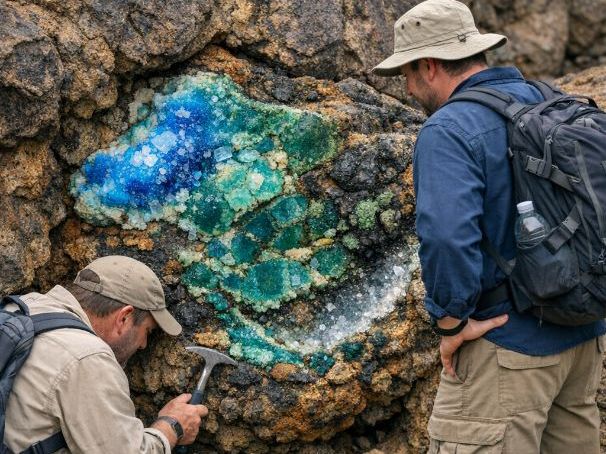



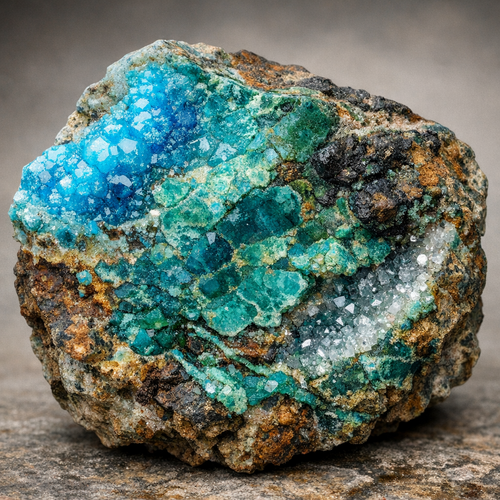
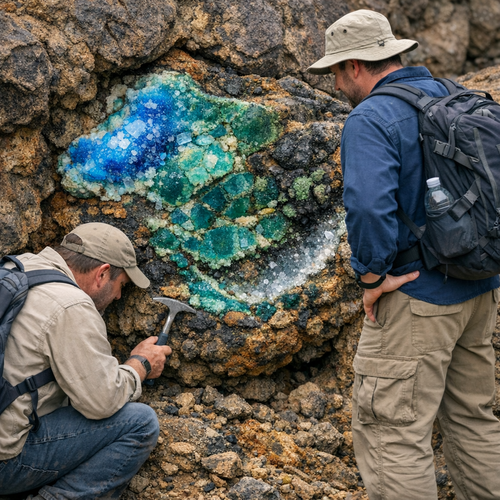
Chrysocolla is a hydrated copper silicate that forms in the oxidation zones of copper deposits. It is not a true crystalline mineral in most cases—more often an amorphous gel-like copper silicate mixed with chalcedony, opal, or other phases. This is why its hardness and durability vary so dramatically.
Color & Visual Spectrum
Chrysocolla’s palette is one of the most recognizable in copper mineralogy:
Electric cyan (high copper, low silica)
Blue‑green / teal (common)
Deep blue (spertiniite-rich zones)
Greenish black (iron contamination)
Brown/yellow patches (limonite or dehydration)
Your archive would benefit from noting that pure chrysocolla is rarely uniform—its color zoning often reveals micro‑geochemical changes in the host rock.
Nature: Often amorphous, sometimes a mixture of:
Chrysocolla gel
Spertiniite (Cu(OH)₂)
Chalcedony
Opal-CT
Crystal system: Orthorhombic (theoretical; rarely expressed)
This amorphous character is why chrysocolla behaves more like a copper-rich silica gel than a rigid mineral.
Geological Context
Chrysocolla forms where copper sulfides oxidize and weather. It thrives in:
Arid climates
Fractures, cavities, and vein coatings
Copper-rich host rocks (basalts, andesites, limestones)
Common associates:
Quartz (especially drusy quartz overgrowths)
Azurite
Malachite
Cuprite
Limonite
Tenorite
The presence of chrysocolla often signals a mature oxidation zone with long-term water–rock interaction.
Hardness & Durability (Critical for Classification)
Chrysocolla is not one thing—its hardness depends on silica content:
2.5–3.5 → Soft, chalky, fragile (pure chrysocolla)
5–7 → Hard, durable (silicified chrysocolla, “chrysocolla chalcedony”)
7+ → When fully replaced by quartz (gem-grade)
This is why some pieces behave like turquoise, while others behave like compressed clay.
Gem & Lapidary Use
Chrysocolla is used for:
Cabochons
Beads
Carvings
Inlay
Drusy quartz specimens
High-silica chrysocolla is the only type suitable for rings or daily-wear jewelry.
Low-silica chrysocolla is strictly for display or gentle handling.
Etymology & History
From Greek:
χρυσός (chrysos) = gold
κόλλα (kolla) = glue
Theophrastus (315 BC) described it as a material used in gold soldering—likely referring to a copper-bearing flux rather than the mineral as we know it today.
Key Localities
Arizona (USA) – Globe, Morenci, Bisbee
Democratic Republic of Congo – Kolwezi (intense blues)
Israel – Eilat Stone (chrysocolla + malachite + turquoise)
Peru – Silica-rich, stable material
Mexico – Often mixed with quartz or tenorite
Each locality has a distinct color–silica signature, useful for archival classification.
Something went wrong, please try again later.
This resource hasn't been reviewed yet
To ensure quality for our reviews, only customers who have downloaded this resource can review it
Report this resourceto let us know if it violates our terms and conditions.
Our customer service team will review your report and will be in touch.