


Suitable for 14-19-year olds (secondary and high schools, and college), this article and accompanying activity sheet can be used in the classroom, STEM clubs and at home.
This resource links to KS4 and KS5/Grade 9-10 and Grade 11-12 Geography and Biology.
It can also be used as a careers resource and links to Gatsby Benchmarks (UK):
Gatsby Benchmark 2: Learning from career and labour market information
Gatsby Benchmark 4: Linking curriculum learning to careers
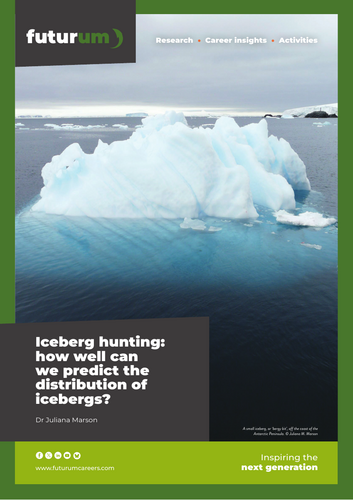
• This teaching resource explains the work of Dr Juliana Marson from the University of Manitoba in Canada. She is using numerical models to understand how icebergs move and the impact they have on ocean processes and ecosystems.
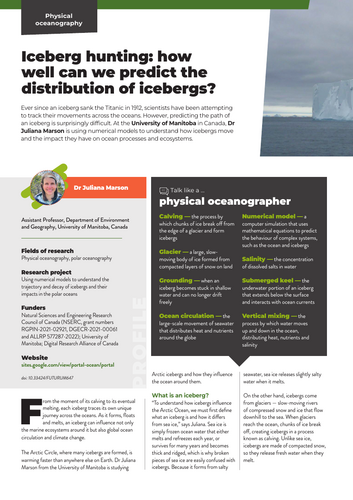
• This resource also contains an interview with Juliana, and offers an insight into careers in physical oceanography. If your students have questions for Juliana, they can send them through the Futurum Careers website.
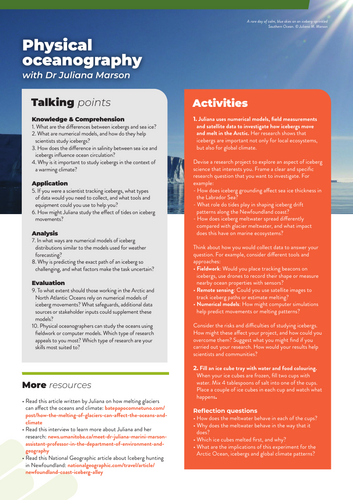
• The activity sheet provides ‘talking points’ (based on Bloom’s Taxonomy) to prompt students to reflect on Juliana’s research and challenges them to devise a research project to explore an aspect of iceberg science that interests you.
This resource was first published by Futurum Careers, a free online resource and magazine aimed at encouraging 14-19-year-olds worldwide to pursue careers in science, tech, engineering, maths, medicine (STEM) and social sciences, humanities and the arts for people and the economy (SHAPE).
If you like these free resources, or have suggestions for improvements, please let us know and leave us some feedback. Thank you!
Something went wrong, please try again later.
This resource hasn't been reviewed yet
To ensure quality for our reviews, only customers who have downloaded this resource can review it
Report this resourceto let us know if it violates our terms and conditions.
Our customer service team will review your report and will be in touch.
£0.00