


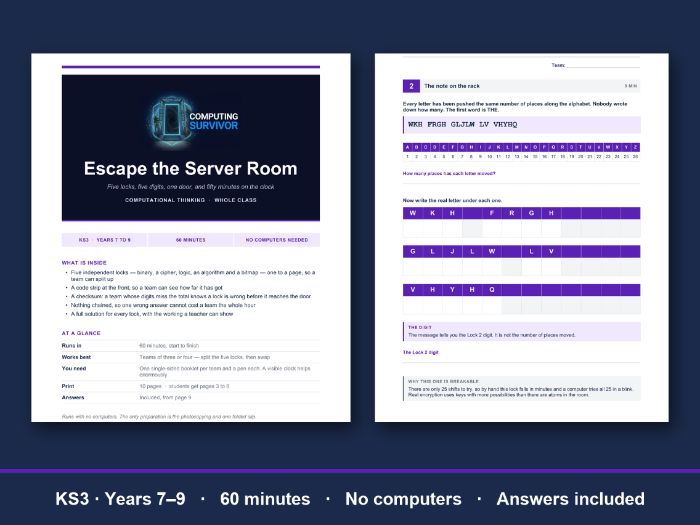
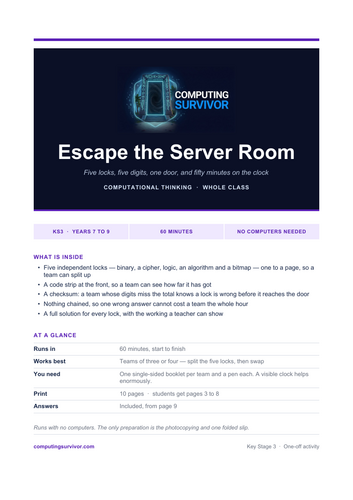
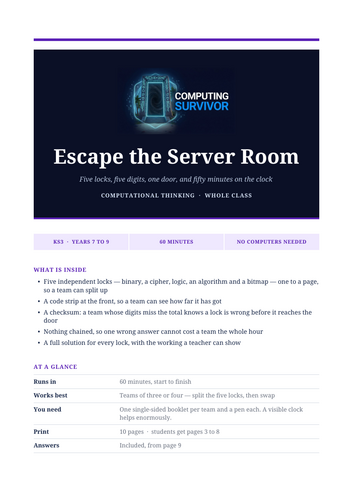
A ready-to-run KS3 computing escape room: five locks on binary, a Caesar cipher, logic, an algorithm trace and a bitmap. One hour, no computers.
Somebody has locked the school server room and left five puzzles taped to the racks. Each lock gives one digit; five digits open the door.
What’s inside (10 pages, PDF and editable Word)
- A one-page teacher run sheet (page 2): a timed plan for the hour, what to print and what to keep back, and what to say to a table that is stuck or flying.
- The team booklet (pages 3 to 8): a code strip, one lock to a page so a team can split up and work in any order, and a door page where the team adds up its digits and writes out the exit code.
- Worked solutions (pages 9 and 10) for every lock, with the working a teacher can show and the common slips to watch for. Printed double-sided, they start on a sheet of their own.
The five locks
- The light panel: three rows of 4-bit binary to turn into denary.
- The note on the rack: a Caesar cipher with the shift withheld. Students are given the first word and work the shift out.
- The switch board: three switches feed a door bolt through NOT and AND. Students complete the truth table a column at a time and count the settings that open it.
- The maintenance routine: a two-step algorithm traced by hand in a trace table, with a boundary case to argue about.
- The status lights: seven rows of five bits to shade into a 5 × 7 bitmap.
There is also a stretch sixth lock for fast teams, on how long a computer would take to try every code on a five-digit keypad against a ten-digit one, and a question on what an adding checksum cannot catch.
Why it works in a real classroom
- Nothing is chained, so one wrong answer cannot cost a team the whole hour.
- Teams check their own answers. The digits must add up to a printed total, so a team whose digits miss it knows a lock is wrong before it reaches the door.
- No guessing the last digit. Four locks would give away the fifth by subtraction, so a digit only counts if its working is on the page.
- Every student is busy. Teams of three or four split the five locks between them, then swap and check each other’s digits.
You need: one single-sided booklet per team, printed loose rather than stapled, a pen for each student, a clock the whole room can see, and one folded slip with the exit code taped under your own desk. There is nothing to install and nothing to log in to.
Good for: the first week of Year 7, an end-of-term lesson, a cover lesson a non-specialist can run from the run sheet, or a revision hour on data representation and logic. It covers KS3 computing topics: binary, Boolean logic, algorithms and how data is represented.
Made by a practising computing teacher. The answers are written out in full and checked. If you use it, a review helps other teachers find it.
Something went wrong, please try again later.
This resource hasn't been reviewed yet
To ensure quality for our reviews, only customers who have downloaded this resource can review it
Report this resourceto let us know if it violates our terms and conditions.
Our customer service team will review your report and will be in touch.
£0.00